Overview and revenue baseline
To keep the discussion concrete we use a working example rather than claim market-wide fixed prices. Our model assumes 1,000 paying attendees and uses an illustrative average ticket price of £40. That produces a gross ticket revenue of £40,000. If you choose a different ticket price, substitute your number and the proportional results will follow.
Entry control is primarily about protecting that revenue and delivering a reliable guest experience. Wristband choice is a small line item in the budget but can influence re-entry policy, anti-fraud measures, guest perception and logistics.
Why plan around a 5,000 unit production run?
Ordering more units than your immediate need is commonplace. A larger production run reduces the unit price because setup costs and per-item production overhead are spread over more pieces. Extra units serve as contingency stock for pre-sales, staff, VIPs, replacements, and future events. For this analysis we use a hypothetical production run of 5,000 units and show how per-unit economics look when you only consume 1,000 at the event.
Important: the exact price you would pay depends on the supplier, material, print complexity, number of colours and lead time. Below we present example unit prices and one-off setup fees so you can see the arithmetic and make informed decisions for your own procurement.
Example calculation: Tyvek 3/4 wristband (paper-like material)
Tyvek style wristbands are often used for day events, conferences and lower-cost ticket types because they are light, quick to apply and secure enough for single-day access control.
For the production run we present an example scenario: if the supplier quotes a unit price of £0.03 (3 pence) at 5,000 units and a one-off artwork/setup fee of £10, the arithmetic is as follows.
Example calculation:
Production cost at 5,000 units: 5,000 x £0.03 = £150.
Plus one-off setup: £10.
Total net cost for the run: £160.
Effective cost per unit across the whole run: £160 / 5,000 = £0.032 (3.2 pence).
If you use 1,000 of those bands at the event, the attributable production cost is 1,000 x £0.032 = £32. Viewed against the illustrative £40,000 ticket revenue, that is effectively negligible in percentage terms, even before you account for staff and other operational costs.
Example calculation: Fabric wristband with plastic lock
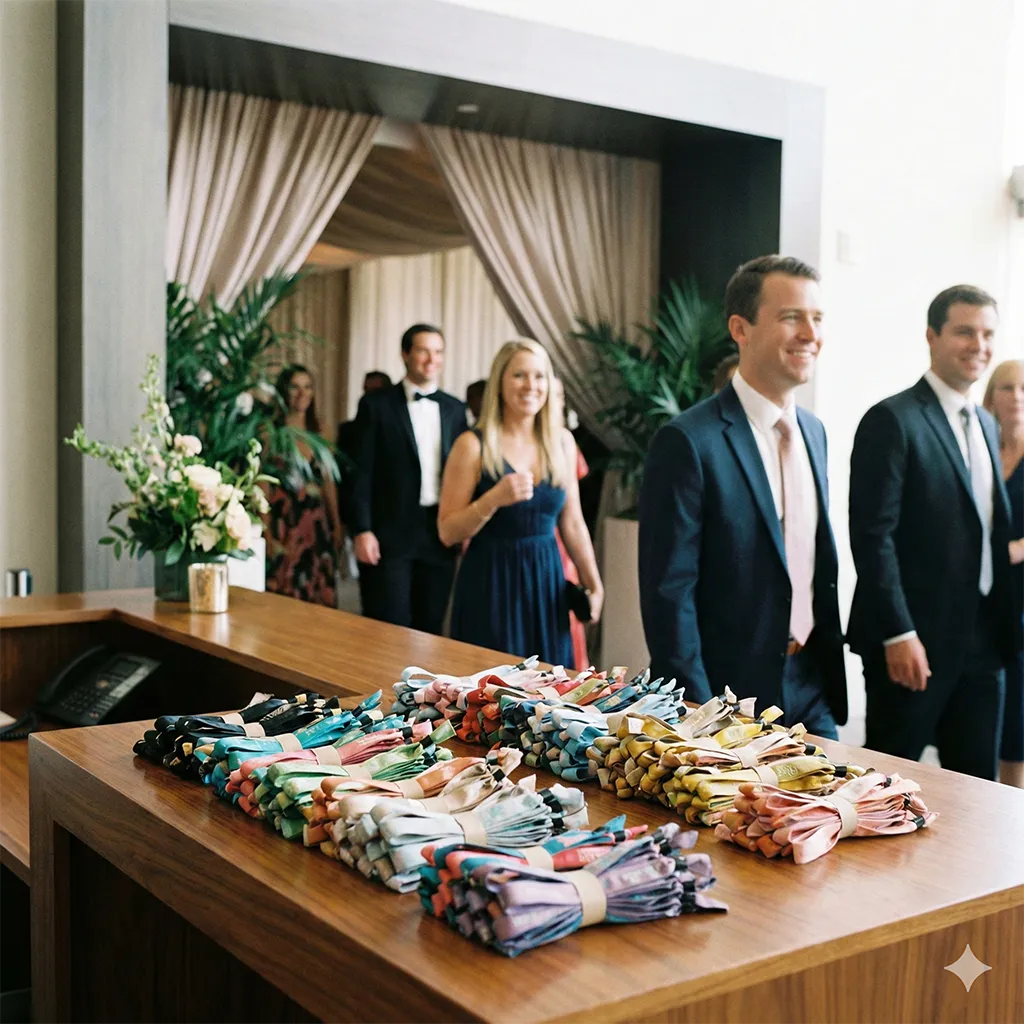
Reusable-feel fabric wristbands with a plastic self-locking clip are widely used for premium concerts, multi-day festivals and events where brand presence and perceived value matter. They are harder to remove intact, contribute to guest experience and often become keepsakes.
For illustration, if a supplier quotes a unit price of £0.12 (12 pence) at a 5,000 unit quantity and charges a one-off setup fee of £8, the example maths is:
Production cost at 5,000 units: 5,000 x £0.12 = £600.
Plus one-off setup: £8.
Total net cost for the run: £608.
Effective cost per unit across the whole run: £608 / 5,000 = £0.1216 (about 12.16 pence).
If you use 1,000 bands at the event, the attributable production cost is 1,000 x £0.1216 = £121.60. Again this is a small fraction of a £40,000 revenue base, but markedly larger than the Tyvek example.
Direct example comparison
| Wristband type | Example production cost (5,000 units) | Example setup fee | Total example cost | Effective unit cost (averaged) |
| Tyvek 3/4 (example) | £150 | £10 | £160 | £0.032 |
| Fabric with plastic lock (example) | £600 | £8 | £608 | £0.1216 |
Relative cost compared to ticket revenue
Using the illustrative ticket revenue of £40,000, if you attribute the full cost of the 1,000 consumed bands to this event the figures look like this in percentage terms.
Tyvek - attributable cost: £32 which is 0.08 percent of £40,000. Fabric - attributable cost: £121.60 which is 0.30 percent of £40,000.
These percentages underline a simple point: wristbands are rarely a budget-breaker even when using higher-quality materials. The choice is more about fit with event format, security needs and brand positioning than about pure cost-savings when you are operating at this scale.
Operational considerations beyond unit price
Unit price is just one dimension. Consider these operational factors when choosing a wristband type:
1. Speed of application. Tyvek and paper-style bands are normally faster to apply than fabric bands with locks. If you expect a high arrival rate in a short window you may prefer the quicker option to avoid long queues.
2. Security and tamper-resistance. Fabric bands with locking mechanisms are less easy to transfer between people and are therefore a better deterrent when re-entry rules are relaxed or when wristbands function as a payment or backstage pass.
3. Perceived value and branding. Fabric bands are tangible brand assets that guests keep and they can add to the premium feel of an event.
4. Environmental considerations. Tyvek is lightweight and recyclable in some systems, while fabric bands can be produced from recycled materials. Ask suppliers for material composition and recycling guidance if sustainability is a priority.
5. Logistics and storage. Larger production runs require storage space and tracking. Consider labelling, batch numbers and a clear system for who receives what wristband type.
How many spare wristbands should you order?
Contingency is important. Typical practices include ordering extra wristbands for the following reasons:
- Staff and crew allocation. Allocate wristbands for gate staff, VIP staff and technicians. Depending on your staffing model this might be 5 to 10 percent of the attendee number.
- Lost or damaged bands during distribution. Guests sometimes lose wristbands during queuing or before the event. Plan a spare pool to minimise disruption.
- Last-minute sales, gate upgrades and giveaways. Events often sell more tickets at the door or distribute additional promo bands.
Ordering a 5,000 unit run for 1,000 expected guests gives you very wide headroom. If you prefer to minimise inventory, ordering a smaller run with a slightly higher per-unit cost may be preferable. The right choice depends on your cash flow, storage capacity and event series planning.
Practical staffing and throughput example
Beyond wristband materials, the human factors of entry control determine queue length and guest satisfaction. As an example, assume a single gate operator can process on average 35 to 60 guests per minute if band application is quick and ID checks are minimal. A fabric band that needs more careful fitting will lower throughput.
For 1,000 guests arriving over a 90 minute window, you need to design for peak flows. If arrival is evenly spread you need a capacity of about 11 guests per minute. With a conservative per-operator throughput of 40 guests per minute using Tyvek bands you would theoretically need only one operator, but you should allow for irregular peaks, ticket checks and contingencies and therefore staff multiple lanes.
Practical staffing recommendation: operate at least 3 to 4 staffed lanes for a typical 1,000 person event to keep queues short and absorb peaks. Faster wristband application reduces staffing pressure; premium bands raise application time slightly but can be offloaded by using volunteers or dedicated fitters at a pre-check area.
Common organiser mistakes
Several mistakes recur in event planning:
Relying solely on unit price. The cheapest wristband may cost you in longer queues, poor guest experience or higher fraud risk.
Not factoring in contingency and staff allocation. Insufficient spares or staff during peak arrival creates chaos.
Underestimating branding value. Wristbands are a low-cost touchpoint - if your event relies on perception, a small extra spend can yield disproportionate returns.
Ignoring fulfilment lead times. Custom prints, special colours or metallic inks have longer lead times. Book production early to avoid rush premiums.
Decision matrix for a 1,000-person event
Below are pragmatic recommendations to help you decide, based on event type and priorities.
If the event is a day conference where speed and cost are priorities - Tyvek or similar paper-style bands are a sensible default.
If the event is a premium concert, multi-day festival or an experience where the wristband is part of the guest offering - fabric bands with locks are recommended.
If you need a deterrent against transfer and want to enable on-site payment or backstage access - use fabric bands that are difficult to remove intact, or combine wristbands with RFID or near-field technology if your budget allows.
How to procure - practical checklist
When you request quotations, include the following to get apples-to-apples pricing:
- Exact order quantity and whether you will use partial quantities at the event.
- Material choice and approximate artwork complexity (number of colours, full bleed or single-colour print).
- Any add-ons such as security printing, tamper-evident features or RFID chips.
- Lead time and delivery address. Ask for a breakdown of setup fees and unit prices at your quantity.
- Reordering terms and sample availability. Request physical samples before placing the full run, particularly for fabric materials.
A worked example to apply to your event
Follow these steps to run the numbers for your specific context:
1. Choose an illustrative ticket price for your event and multiply by expected attendees to get gross ticket revenue.
2. Request quotes for at least two wristband options at a sensible production quantity. Ask suppliers to include a breakdown of per-unit price and one-off setup charges.
3. Calculate the total run cost and then the effective averaged unit cost by dividing the total run cost by the total units produced.
4. Multiply that averaged unit cost by the number of units you expect to use at the event to get the attributable cost. Compare that figure with your revenue base to see the proportion it represents.
5. Add operational costs - staff, entry equipment, gates - to complete the entry control budget line.
Final professional summary
For a 1,000-person event, wristband procurement choice is rarely decisive from a pure cost perspective. Ordering a 5,000 unit production run often reduces your effective per-unit cost substantially and provides contingency stock. Using our illustrative examples, Tyvek-like bands present the lowest per-unit outlay and fastest application, while fabric bands increase cost per used unit but deliver higher perceived value and greater tamper resistance.
Your decision should be driven by event format, guest journey expectations and operational needs rather than by marginal cost differences. Use the example calculations above with the precise supplier quotes you obtain, and you will be able to make a quantified, defensible decision that balances budget, security, and brand.
If you want, send your ticket price, expected staff count for entry and a shortlist of wristband suppliers you are considering and I will run the numbers on your real quotes and propose an optimised procurement plan for the event.