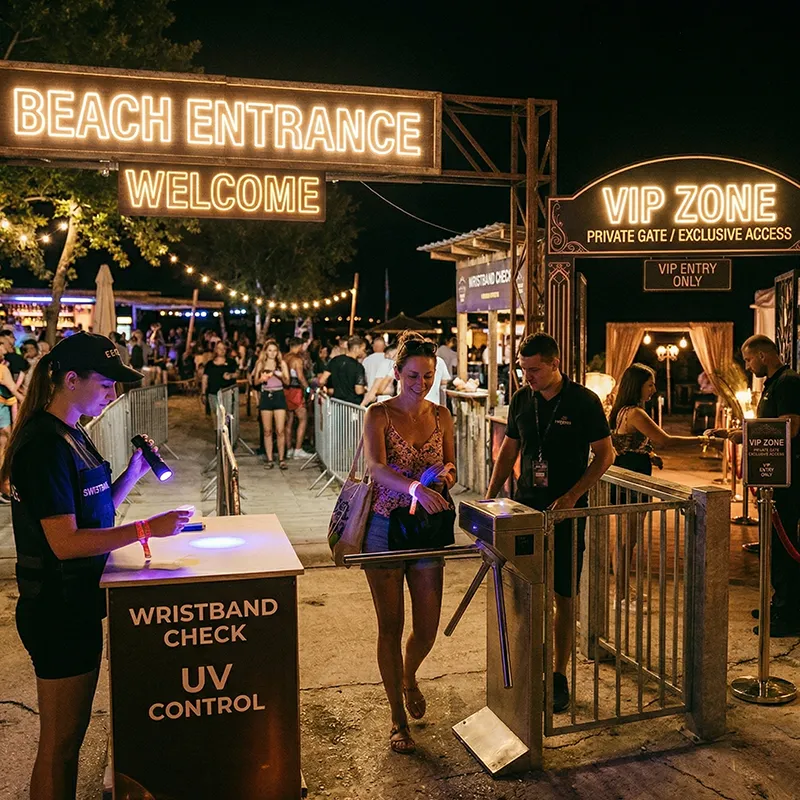
Why beach and waterfront access control is a different problem
Indoor events tend to be single-entry, enclosed and predictable. A beach event is not. Attendees enter and exit repeatedly, the environment is wet and abrasive, and people are far more likely to remove or swap a wristband. You therefore need continuous control rather than a one-off stamp or a disposable item.
Decisions made early in procurement affect throughput, security, person-hours and ultimately your bottom line. Treat wristbands and entry devices as part of a system: the physical token, the verification method, the team and the procedures for re-entry and incident handling.
Wristband materials and what they actually deliver on the shore
There are three mainstream wristband materials used for public events. Each has pros and cons that become more pronounced in a beach or lakeside setting.
Paper-like (Tyvek) wristbands are inexpensive and quick to apply. They work for short, dry events where re-entry is rare. At the seaside they are vulnerable to water saturation, abrasion and deliberate removal. If your event is an afternoon party with little re-entry, they can be a pragmatic choice.
Vinyl wristbands are robust, waterproof and resist sun and salt. They perform well when attendees go swimming or when wristbands need to remain on for many hours or days. Vinyl supports clear printing and added security features like serial numbers or UV marks.
Textile or woven wristbands are the premium option. They are comfortable for multi-day use, difficult to remove and replace without detection, and offer strong branding potential. They are ideal for VIP access, multi-day beach festivals or events where you want a souvenir-quality item.
Choosing the cheapest material to save on upfront cost often backfires. What matters is the total cost of ownership: the cost of the wristbands plus the cost of fraud, slower gate throughput and extra staff required to police weak tokens.
Security features you should consider
Security for waterfront events must be pragmatic and layered. Relying on a single visible measure is risky. Combine physical and operational controls.
Serial numbering keeps track of issued items and makes mass re-sale or duplication easier to detect. UV printing is inexpensive and quick to verify with a small torch; it also works at dusk or in shaded beach bars. Tamper-evident closures that clearly show attempted removal are essential for vinyl and textile types. For high-value events, consider RFID or NFC wristbands to control access electronically and to enable cashless payments, but be aware of higher unit costs and integration requirements.
Whatever combination you choose, ensure staff know the verification routine and have the right tools. A basking-room style entry with staff scanning for UV and checking serial numbers will be far more effective than an ad-hoc approach.
Procedures and human factors
Even the best wristband can be compromised by poor processes. Define and rehearse a clear re-entry policy and communicate it to attendees via signage, website pages and on-site staff. If re-entry is allowed, use a visible marker in addition to the wristband, such as a stamped hand or a second secondary token. If you allow re-entry, decide how many times and under what conditions and make this consistent across all gates.
Staffing levels must match peak flows. A small gate with low staffing creates queues and pressure that encourage shortcuts and fraud. Train gate staff to recognise tamper signs, to perform quick UV checks and to escalate disputes. A calm, consistent approach reduces confrontation and keeps lines moving.
Example cost modelling without relying on fixed market prices
When budgeting, work with variables rather than fixed unit prices. Use the following simple formulas and plug in realistic values from suppliers.
Total revenue = attendance x average ticket price. If you expect 1500 attendees and your average ticket price is P, then total revenue is 1500 x P. For example, if P is £20, total revenue would be 1500 x 20 = £30,000. This is an example only; choose P to match your market.
Total wristband cost = attendance x unit cost of wristband (U). If U is the unit price of the wristband including custom printing and any additional security features, then total wristband cost is 1500 x U. For example, if U were 0.10 (ten pence), cost would be 1500 x 0.10 = £150. Exact unit costs depend on material, customisation, quantity and lead time.
Estimated loss due to unauthorised entries = attendance x fraud rate x average ticket price. If the estimated fraud rate without proper controls is F, then potential loss is 1500 x F x P. If F is 0.03 (3 percent) and P is £20, the loss would be 1500 x 0.03 x 20 = £900. Use differing values for different scenarios to stress-test your plan.
Comparing scenarios: calculate net benefit of investing in better wristbands and processes. Example: scenario A uses low-cost wristbands with unit cost U1 and results in estimated fraud rate F1. Scenario B invests in more robust wristbands and controls with unit cost U2 and achieves a lower fraud rate F2. Compute net revenue for both and compare the difference. The incremental cost per wristband multiplied by attendance is usually small against the avoided losses from lower fraud and the improved guest experience.
Remember that additional costs such as express production, courier fees, custom artwork setup, RFID hardware or staff overtime should be included when you finalise your supplier quotes. The exact price will depend on the combination of product specification and volumes you select.
Security gaps common at beaches and how to close them
The most common weaknesses we see are predictable and fixable. One is multiple uncontrolled entry points. If a beach area has several informal paths from the foreshore, someone can simply swim or walk in from the water edge and bypass gates. Patrols and temporary fencing for the event footprint help reduce this risk.
Another gap is inconsistent verification. If only one gate checks wristbands properly while a second gate allows quicker entry, people will gravitate to the weak gate. Standardise checks, rotate staff so no one becomes complacent and use simple tools like small UV torches at every gate.
A third issue is lack of incident logging. Every disputed admission, every attempt to swap or remove a wristband should be recorded. This data allows you to identify weak times, vulnerable gates and problem individuals for future planning.
A UK seaside case study adapted for organisers
A medium-sized seaside organiser initially opted for a low-cost wristband and minimal gate staffing. During the first season they observed frequent re-entry and wristband swapping. Their post-event reconciliation suggested revenue leakage well above acceptable levels.
For the next season they introduced a layered system. They moved to vinyl wristbands with serial numbers and UV marks, introduced two-point verification at each gate (visual check plus UV), and used a low-key patrol team to monitor common approach paths from the beach. They also established a clear re-entry policy communicated during ticket purchase and on-site.
The result was measurable. Gate throughput improved because staff spent less time arguing about passes. Fraud dropped significantly and guest satisfaction scores rose. The additional spend on better wristbands and minor staffing changes paid back within the season because of recovered revenue and lower dispute-handling time.
Decision matrix for waterfront events
| Situation |
Recommended approach |
| Single-day beach party with minimal re-entry |
Tyvek with clear printing and visible tamper instructions |
| Multi-day festival or events with swimming |
Vinyl with UV and serial number, tamper-evident closure |
| VIP or high-value ticketing |
Textile/woven wristbands or RFID for controlled access |
| High refund or exchange risk, strong resale market |
Serialised wristbands and a robust re-entry log |
Procurement and lead times
Many organisers underestimate lead times. Standard production for printed vinyl or textile wristbands can take several working days plus shipping. Custom artwork setup, additional security inks or RFID encoding add to lead times. Order with a buffer. If orders slip into express production, unit costs rise and options shrink.
Start discussions with suppliers early. Request sample materials to check colourfastness in sunlight and salt water. Confirm whether the supplier can supply UV printing, sequential numbering, tamper closures and whether they offer compatibility with RFID if you may upgrade later.
Common mistakes and how to avoid them
Organisers make repeatable errors: ordering too late, choosing the cheapest option, not rehearsing gate procedures and failing to communicate re-entry rules clearly. Avoid these by planning procurement timelines, comparing the total cost of ownership rather than unit price alone, conducting a dry run with gate staff and adding clear signage and pre-event communications.
Another mistake is separating security and customer experience decisions. A slow, congested entry creates frustration that staff then try to mitigate by relaxing checks. Design systems that keep lines moving while maintaining reliable verification.
When to consider RFID and cashless integrations
RFID and NFC wristbands provide strong control and can combine access control with cashless payments and behaviour analytics. They are not universally appropriate. Consider them when your event has a higher average spend per attendee, when you need fast, touch-free gates, or when you want to collect anonymised crowd flow data for operational improvement.
The trade-offs are higher upfront cost, integration with point-of-sale systems and additional technical support on site. Run a pilot before rolling RFID out across a whole event profile.
A simple checklist organisers can use
Confirm your expected attendance and peak entry times. Choose materials that match the environment and re-entry rules. Ask suppliers for proof of water, UV and abrasion testing if available. Plan staff rosters to match peak flows, provide simple verification tools to every gate and log incidents. Allow additional lead time for production and a small contingency budget for express orders or last-minute changes.
Conclusion
Beach and waterfront events require pragmatic, systems-level thinking. Wristbands are important, but they are only one element in a coherent access control strategy. By selecting the right materials, adding affordable security features, training staff and modelling costs with simple formulas, you reduce losses, improve guest experience and increase operational predictability.
If you are planning a seaside event, start procurement early, choose robustness over lowest-cost temptation and document your verification processes. The upside is not only better security but a smoother guest experience and a healthier financial outcome for your event.