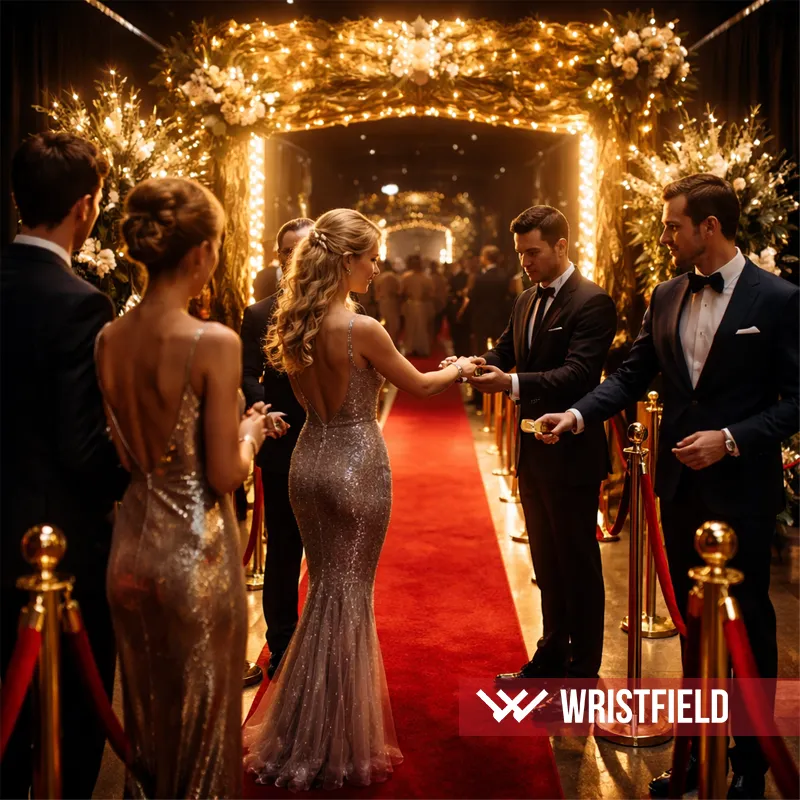
The real purpose of a VIP zone
At the simplest level a VIP zone signals exclusivity. Guests who pay a premium expect an experience that is measurably different: faster service, better sightlines, more comfort and a sense of recognition. Those expectations are both psychological and operational. A VIP area that looks and feels distinct reinforces the purchaser's decision, invites social sharing and increases loyalty to the brand behind the event.
If control is weak, general-admission attendees encroach on the VIP space and the differential evaporates. That loss of exclusivity is immediately visible to paying guests and quickly translates into reputational harm. Over time poor VIP delivery undermines future premium sales and the long-term revenue model of the event.
Designing a multi-level access system
Most events need more than a binary VIP versus regular scheme. A typical 1000-person outdoor festival, mid-size conference or corporate event benefits from separate access classes: general admission, VIP, backstage, press and staff. Each class requires a different level of control, and the operational approach must reflect that.
Using the same wristband for every category makes visual checks slow and error-prone. A colour-coded tier system is the simplest, fastest and cheapest method to keep checks effective at busy gates and bar points. Visual differentiation reduces ambiguity for front-line staff and speeds up throughput.
Beyond colour, consider graphical elements such as words (VIP, Backstage), icons, serial numbers and tamper-evident features. If you need to combine entry time windows with location access then combine colour with printed details or numbered tickets for additional validation.
Which wristband materials for which roles
Wristband choice impacts not only how the area feels but also how secure it is and how much it costs. Broadly speaking there are three categories worth considering for VIP systems.
Tyvek wristbands are inexpensive, quick to fit and useful where single-day, low-security identification is the priority. They are suitable for general admission or one-off promotional access where cost per unit matters most.
Vinyl wristbands are more durable and water resistant; they sit in the middle ground between economy and premium and are useful for multi-day events or where security concerns are elevated.
Textile wristbands with an adjustable self-locking loop or sewn closure are the preferred option for VIP areas. They feel premium, photograph well and are harder to transfer without visible damage. For backstage or restricted-crew access consider customised textile bands with unique graphics or integrated security features.
Cost modelling and example calculations
Given the variability of suppliers and order quantities it is safer to show example calculations than to publish fixed prices. Use these worked examples to understand how wristband and pricing decisions interact with revenue.
Imagine a 1000-person event where 150 VIP tickets are sold. If a VIP ticket is priced at X (insert your chosen figure) and a general admission ticket at Y the revenue delta is simply the number of VIPs multiplied by the price difference. For example, if VIP is set at 15 units and general admission at 8 units, the gross VIP revenue is 150 times 15 equals 2250 units and the regular revenue is 850 times 8 equals 6800 units; the total is 9050 units. Replace units with your chosen currency and ticket prices to model your event.
Wristband production is usually a small fraction of ticket revenue. If a textile wristband costs A per item to produce and you order 150, the wristband production cost is 150 times A. Even if A is a nominal figure, the point is that wristband cost rarely exceeds one percent of VIP revenue at scale. Still, you should model packaging, printing setup fees and any rush charges into the final budget.
Consequences of weak control
Weak access control has immediate and long-term consequences. In the short term overcrowding reduces comfort, increases service times for bar and catering and creates frustration among paying guests. Over the medium term the perceived value proposition for VIP is undermined and upgrades in subsequent years will sell less well.
Put numbers on the risk to understand its scale. If due to weak control 20 unauthorised guests gain access to a VIP area, the paying guests notice the change in atmosphere and some will not repurchase next year. Quantify this by estimating the number of lost premium tickets in the following season and multiply by your premium ticket margin to project revenue at risk. Use a conservative scenario and an optimistic scenario to stress-test your assumptions.
A decision matrix for material and control
| Zone | Recommended material | Reason |
| General admission | Tyvek | Fast to apply and cost efficient for high volume |
| VIP | Textile | Premium appearance and greater durability |
| Backstage | Textile or vinyl with custom graphic | High control and hard to replicate without bespoke printing |
Typical organiser mistakes
Organisers frequently underestimate the importance of visual differentiation. When wristbands for different access levels look too similar the margin for human error increases. Staff training is often overlooked; a short briefing or laminated cheat sheet for gate staff reduces confusion significantly.
Another common error is combining access control with ticket validation in a way that creates bottlenecks. If every check requires multiple steps the throughput at peak arrival times will collapse. Design the process so front-line staff have exactly one simple decision to make: does the wristband match the required colour or feature for this zone? If yes, allow entry.
Case study: midsummer music festival
Consider a 1200-person outdoor music event that introduced three tiers: general admission, VIP and backstage. The organisers used colour-coded textile bands for VIP, bespoke printed bands for backstage and Tyvek for general admission. They also printed a simple staff guide showing the colours and associated zones. After implementation reported breaches dropped to zero and VIP sales rose by 20 percent the following year.
The success factors were clear: clear visual hierarchy, staff training and sufficient dedicated entry lanes for VIP. These elements were more important than any single expensive security technology.
Capacity planning and queue optimisation
VIP guests expect a fast, frictionless arrival. A very practical measure is to model arrival profiles and ensure sufficient dedicated lanes to absorb peak flows. If 150 VIP guests are expected to arrive within the first 45 minutes, that averages out to just over three arrivals per minute. In practice arrivals come in peaks when public transport drops large groups off, so design for the peak period not the average.
Entry throughput depends on the complexity of checks. If staff only check colour and fit, a lane can process more people per minute than if they must check ticket, wristband and a printed guest list. Plan capacity assuming 12 to 15 people per minute per lane for mixed checks. That means a single well-staffed VIP lane can comfortably process 150 VIPs in the arrival window. If you lack an exclusive lane and VIPs join the general queue the VIP experience is compromised.
Calculating VIP area size and infrastructure
Area sizing must match the expected simultaneous occupancy rather than total ticket sales. If 150 VIP tickets are sold but the average dwell time is three hours across an eight-hour event, peak occupancy might be 80 to 120 people depending on guest behaviour. If your space comfortably accommodates 100 people and your peak occupancy estimates exceed that the area will feel crowded and exclusivity is lost. Use conservative assumptions and provide flexible seating and overflow zones.
Revenue optimisation through tiering
You do not have to treat VIP as a single category. Introducing multi-tiered premium access such as Silver, Gold and Backstage allows price discrimination and the capture of different willingness to pay. Example modelling helps here. If you sell 100 Silver at P1, 40 Gold at P2 and 10 Backstage at P3, multiply the quantities by the chosen prices to get separated revenue lines and test different mixes to find the optimal allocation in your market.
The extra cost of producing different coloured textile bands and separate signage is normally a negligible portion of incremental revenue. Use distinctive graphics and, if appropriate, a numbered or coded system for tighter control.
Multi-level wristband implementation
Keep the checks for each zone simple and standardised. Front-line teams should never be required to interpret ambiguous designs. For Silver use one colour and simple text, for Gold a second colour and a metallic ink or thread, for Backstage a third colour and a bespoke printed motif. Optionally add a numbered sequence to allow cross-checking with a guest list for the most restricted areas.
Conflict resolution on the ground
Expect attempts to bring unauthorised guests into VIP areas. The common trigger is when guests try to bring partners or late arrivals. Clear signage stating the terms of access, combined with calm, well-trained staff who can offer alternatives such as a temporary guest wristband or an upgrade on availability, defuses situations quickly. The visual clarity of wristbands reduces the number of confrontations because decisions are immediate.
Long-term brand value and marketing
Textile wristbands often persist as souvenirs. These items act as marketing artefacts when guests post photos on social media. A well-designed band strengthens brand recall and can become an earned media asset. Consider adding subtle branding or a hashtag to the wristband or the VIP area design so that social posts carry your message organically.
Sensitivity testing by VIP ratio
Run sensitivity scenarios to understand how VIP mix affects revenue. A simple test: hold VIP price constant and vary the number sold. Doubling VIP sales from 100 to 200 at the same premium increases gross VIP revenue proportionally. Evaluate venue constraints, service capacity and the marginal effect on guest experience to decide whether expanding VIP capacity is the right move.
Complete system cost example - use supplier quotes
| Item | Example cost (illustrative) |
| 200 textile VIP wristbands | 200 x A (unit price depends on supplier and print options) |
| 800 Tyvek general wristbands | 800 x B (unit price depends on supplier and quantity) |
| Setup and print artwork | One-off fee C |
| Total | Sum of above - the precise figure depends on unit costs, print complexity and lead time |
Request supplier quotes for your exact quantities and design options and include shipping and any rush fees. The example above is intentionally generic because unit costs vary by season, material choice and supplier lead times.
Reputational risk modelling
Guest dissatisfaction spreads quickly on social channels and review platforms. Even a small number of visible negative experiences among VIP guests will have a magnified effect. Model reputation risk by estimating the number of dissatisfied VIPs required to reduce future VIP sales by a percentage. Convert that percentage into a monetary value to evaluate how much it is worth investing in prevention today.
Technical fine-tuning of access systems
Visual wristbands are the foundation, but consider layered security where needed. Time-limited wristbands for access to certain activities, bar-coded or numbered wristbands that can be scanned against a list, or RFID for high-value backstage control are all valid enhancements. Start with the simplest reliable system and only add complexity where the cost-benefit makes sense.
Colour strategy and visual psychology
Colour choices matter. High-contrast palettes increase recognition speed and reduce mistakes. Dark or metallic colours such as black or gold convey luxury; vivid colours draw attention. Choose colours that are distinct under the lighting conditions of your venue. If your VIP is intended to be discreet, an elegant but clearly different colour from general admission is the right choice.
Error-rate modelling and overload scenarios
Identify the capacity of your VIP area and model overload situations. If the comfortable capacity is 120 people and you sell 150 VIP tickets, allow for rotation and average dwell time. Add an allowance for unauthorised guests and calculate the percentage overload. Use these results to decide whether to limit sales, increase capacity or accept a degree of crowding.
Monetising the VIP experience beyond tickets
An effective VIP zone increases per-head secondary spend. If VIP guests on average spend more on food and drink, estimate the uplift per head and multiply by the expected number of VIPs to model ancillary revenue. Provide incentives for spending such as dedicated bars, complimentary upgrades, or exclusive menu items to maximise this opportunity.
Backstage access and higher-security controls
Backstage access should be the most tightly controlled. Use bespoke graphics or unique printed elements that are hard to replicate. Where personnel require frequent access, consider staff lanyards with secure clips and an audit process for authorisations. Even with small backstage capacities, two unauthorised entrants can be immediately noticeable, so invest in clarity rather than complexity.
Staffing the VIP zone efficiently
VIP areas often require fewer staff but with higher training levels. Prioritise customer service skills and conflict de-escalation ability over raw throughput skills. Well-trained, empowered staff improve service speed and reduce escalation to management, creating a better overall experience and lower overtime costs.
Annual strategy and iteration
If your event runs annually, treat VIP provision as a strategic asset to be tuned each year. Use sales data, guest feedback and social monitoring to iterate on price points, capacity and wristband design. Small continuous improvements compound over years and can transform a marginal revenue stream into a core profit centre.
Long-term revenue forecasting
Model the impact of small changes in VIP penetration over multiple seasons. A modest annual increase in VIP share can produce a large cumulative uplift in revenue. Use scenario planning to test the sensitivity of your forecasts to price changes, perceived value and capacity constraints.
Strategic conclusion
Managing a VIP zone successfully requires a blend of operational discipline, clear visual systems and commercial thinking. Wristband choice is important but secondary to the clarity of your access rules, the training of your staff and the match between capacity and sales. Invest in simple, robust controls, request supplier quotes for your exact requirements, and treat VIP provision as an iterative, strategic capability that protects revenue and builds brand value over time.