How to prevent wristband counterfeiting at events
Controlling access reliably is one of the most basic responsibilities for an event organiser. When wristbands are used as proof of entitlement, weaknesses in their design or in the access-control routine create opportunities for unauthorised entry. This article explains common fraud methods, what materials and security features reduce those risks, and how to combine technical measures with staff routines to protect revenue and safety, using practical, UK-focused examples.
How wristband fraud typically occurs
There are three frequent modes of abuse.
Relocation. A wristband that can be removed intact can be transferred to another person. This is the simplest form of abuse and often goes undetected until rates climb.
Copying. When a wristband design is plain or easily photographed, it can be reproduced by a skilled printer or even by a high-quality colour photocopy. Simpler graphics and lack of covert security elements make copying straightforward.
Manipulation of originals. Fraudsters sometimes attempt to defeat tamper-evident closures by cutting and re-joining them with glue or tape. If the closure shows no clear evidence of tampering, the trick can succeed.
The role of base material in preventing abuse
The substrate you choose defines the baseline level of protection. Different materials have different strengths and weaknesses, and the right choice depends on event type, duration, and expected wear and tear.
Tyvek wristbands are a common economical choice for day events and conferences. Their adhesive-backed closure tends to delaminate or tear when removed, so relocation is difficult without visible damage. For short, low-contact events Tyvek provides acceptable protection when combined with other measures.
Vinyl wristbands are thicker and more resistant to wear. Their robustness makes manipulation harder, and they are a good option for multi-day events or outdoors where durability matters. Vinyl is often preferred where attendees are likely to swim, sweat, or be physically active.
Textile wristbands (woven or printed polyester) with a one-time plastic or metal closure offer the highest level of tamper evidence. Closures are designed to lock and fracture if reopened, and the fabric resists cutting and reassembly. Textile bands are widely used for festivals, VIP areas and access that needs a premium feel.
Serialisation and inventory control
Adding unique serial numbers to wristbands is one of the simplest and most effective controls. Serial numbers allow you to reconcile how many were printed, how many were issued, and what remains unallocated. For example, if you ordered 2,000 wristbands and numbers range from 1001 to 3000, you can spot any suspicious numbers at entry.
Serialisation also helps when using mixed channels of distribution, such as pre-sales, guest lists and promoter allocations. Where staff scan or visually log serial numbers at issue, you create an audit trail that deters casual abuse and helps investigate incidents.
Hidden security features - UV ink and covert marks
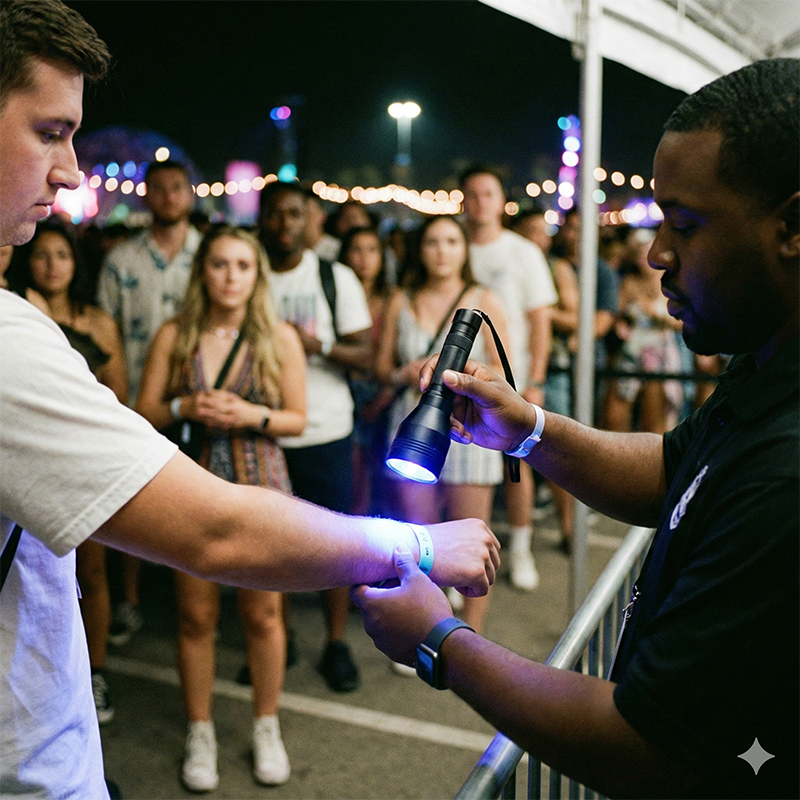
Covert features are not visible in normal light but can be checked quickly with a handheld UV lamp. UV-reactive inks, invisible fluorescent fibres or microtext printed in UV inks are low-cost, highly effective measures. Because they are hard to reproduce without access to similar inks and printing processes, these features stop low-level copying attempts.
Other covert options include microtext (extremely small printed text), guilloche patterns, and custom serial fonts. Holographic foils or tamper-evident foils add another layer though they are typically more expensive; their visual complexity makes counterfeiting very difficult.
Case study - VIP concert with 1,200 attendees
Consider a mid-sized, ticketed VIP concert with 1,200 attendees where VIP ticket prices are substantially higher than general admission. The organiser chose textile wristbands with one-time locking closures, serialisation and UV covert marks. The combination was selected to protect high-value entries and to present a premium guest experience.
In the previous year the organiser observed an estimated 2 percent unauthorised entry rate. After implementing the upgraded wristbands and a controlled check routine, that rate dropped below 0.5 percent. If you use an illustrative ticket price to gauge impact, for example if a VIP ticket were priced at £60, reducing unauthorised access from 2 percent to 0.5 percent would reduce the number of unauthorised entries from 24 to 6. The revenue difference depends on your ticket price and allocation; the exact savings should be modelled using your pricing and mix.
The key lessons were not only the technical change but the operational discipline: staff were trained to check closures and to use UV torches for spot checks, and they logged serial numbers for guestlist entries.
Cost modelling and return on security investment
When debating security extras, frame the decision as a risk-weighted investment. Rather than focus solely on unit cost of a wristband, consider potential revenue at risk and the expected reduction in that risk. Extra features such as serialisation and UV marking normally add a small incremental cost per band but produce disproportionately higher protection for higher ticket values.
An example calculation: for a 2,000-person concert, use a hypothetical ticket price to illustrate the math. If the average ticket value were £40 and unauthorised entry were 2 percent, the direct lost revenue is 40 x (0.02 x 2,000) = £1,600. If security upgrades reduce unauthorised entry to 0.7 percent, the loss becomes 40 x (0.007 x 2,000) = £560, a saving of £1,040. The cost of security features should be compared to that saving. Exact unit prices for wristbands and features depend on supplier, order quantity and specification, so obtain quotes. Typical experience shows security additions often pay back quickly in higher-value contexts.
Decision matrix by event type and risk level
| Event type |
Recommended base material |
Suggested security extras |
Rationale |
| Single-day conference |
Tyvek |
Serial numbering |
Economical and sufficient where abrasion is limited |
| General concert |
Vinyl |
Serial number and bespoke artwork |
Durable for active crowds and rain |
| VIP area or premium ticket |
Textile |
UV covert print + serialisation |
High perceived value and need for reliable tamper evidence |
Typical mistakes made by organisers
Focusing only on base material and ignoring operational controls. Even the best wristband will not protect revenue if staff do not check for tamper evidence or covert marks.
Failing to order contingency stock. Underestimating the number of wristbands needed can create furtive onsite improvisation that lowers security, for example by using plain unprinted bands as replacements.
Not reconciling serial numbers. If bands are serialised but numbers are not recorded on issue, the benefit of serialisation is lost for proactive control. Logging helps both at the gate and for post-event audits.
Large festival scenario - 3,000 attendees
A 3,000-person outdoor festival faces different pressures compared with a small conference. There is more deliberate fraud and economies of scale matter. Imagine an average ticket value used only for illustration, for example £45. If unauthorised entry is 1.5 percent that equates to 45 people and represents 45 x 45 = £2,025 in direct revenue loss. If the rate rises to 3 percent, the loss doubles to approximately £4,050. At these levels, spending more on textile wristbands, unique artwork and UV covert ink is often commercial sense rather than an optional luxury because the avoided losses exceed the additional cost.
For multi-day festivals consider durable wristbands with day-of-week colour codes or integrated RFID to tighten control across camp areas and stages. RFID provides an alternate model of control and useful data, but it comes with higher setup and data-handling responsibilities.
The psychology of fraud and visible controls
Many attempts at unauthorised entry are opportunistic. A visible and credible verification routine deters most would-be offenders. The presence of UV torches, periodic visual checks for serial ranges, and clearly displayed staff procedures create a perception of surveillance that reduces attempts.
Design elements that increase visibility of entitlement, such as prominent colour coding for different access levels, make mistakes less likely and reduce the incentive to try copying. Where staff actively verify both the overt look and a covert UV mark, fraud attempts drop markedly.
Operational routines for entry control
Technical features are effective only when integrated into a staff routine. Recommended practices include:
Issue logging. Record serial numbers against ticket or guest names for pre-sold allocations and guest lists.
Spot checks. Introduce a routine of random checks using UV torches and closure inspection. Even small, visible checks deter fraudulent attempts.
Interval verification. Gate staff should periodically confirm the expected serial number range and current colour codes at set intervals, for example hourly or at shift changes. An incorrectly sequenced number should trigger immediate follow-up.
VIP double-check. For premium or restricted areas, apply a two-stage check: visual closure check and UV verification, logged by two members of staff where practical.
Quick guide to selecting security features
Match your security spend to the value at risk. If you expect high ticket values, premium guests or multi-day attendance, invest in a higher-spec wristband and well-documented entry procedures. For low-value, one-time indoor events, basic Tyvek bands with serial numbering and staff awareness are often sufficient.
Always request supplier samples and check how covert features appear under UV. Get written confirmation about serial number ranges and ask about the production lead time and minimum order quantities, because tight lead times can force compromises that impact security.
Final professional summary
Preventing wristband counterfeiting is a combination of product choice and disciplined operations. The right substrate reduces the risk of relocation and physical tampering. Serialisation creates accountability and an audit trail. Covert UV marks and similar features make copying expensive and therefore unattractive for opportunistic fraudsters. Most importantly, staff must be trained to apply these tools consistently. When these elements are combined, the protective effect is far greater than the sum of the parts, and security spend typically pays for itself by protecting revenue and reputation.
If you would like help modelling the cost-benefit for a specific event or determining the optimal wristband specification for your risk profile, suppliers and security consultants can produce tailored quotes and sample runs. Exact unit prices vary by supplier, order size and specification, so use the examples above as a framework and obtain quotes to finalise budgets.