When Is Express Wristband Production Worth It?
Wristbands are more than entry tokens. They are a control mechanism, a sponsor space and often a first physical touchpoint for the attendee experience. When production times are tight, you can choose to accept the scheduling risk or pay extra to accelerate production. Understanding the variables that affect that choice will help you make a defensible decision rather than an emotional one.
What do we mean by express production?
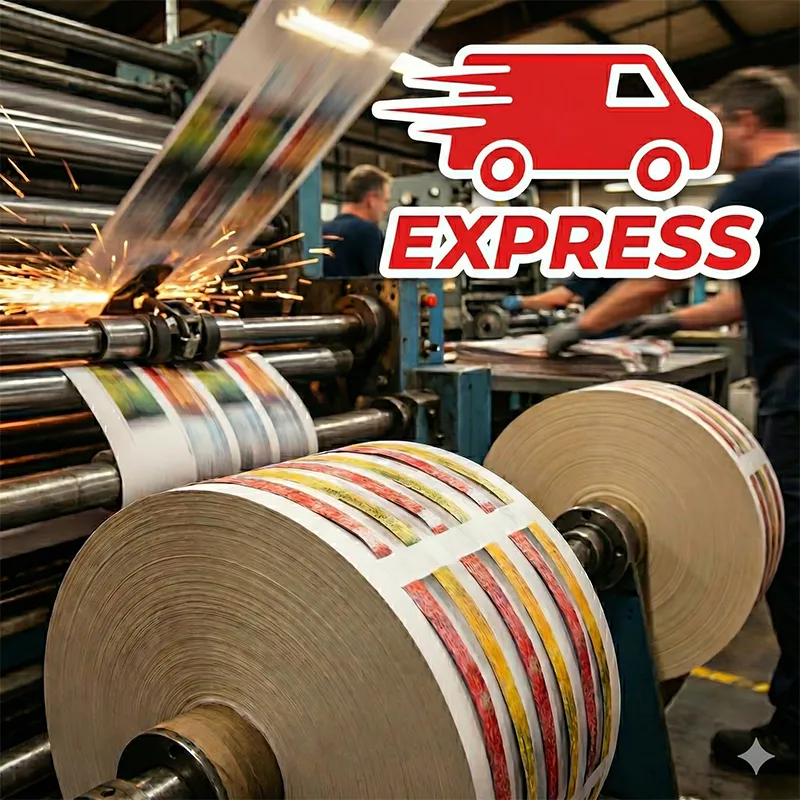
Express or rush production means the supplier prioritises your order through the prepress and manufacturing queue to reduce lead time. For personalised or printed wristbands, this can involve prioritising artwork checks, faster printing runs and expedited finishing and packing. Some materials, like simple Tyvek, are quicker to print and finish than woven fabric or PVC wristbands, but express service alters the priority level across the whole workflow.
Which risks does a late or missing wristband create?
If wristbands do not arrive on time you must adopt ad hoc solutions: manual stamping, paper passes, lanyards, or temporary tags. These are workable, but they affect three areas: operational flow at arrival, revenue protection and public perception of the event. Even modest increases in unauthorised access or queue times can have measurable financial and reputational costs.
Consider a mid-sized event. If you expect 800 attendees and the average ticket price is, say, 45, the gross ticket intake is 36,000. If poor access control increases unauthorised entries by 2 per cent, that corresponds to 16 extra people, or roughly 720 in lost revenue in this example. If express production would have cost you an additional 200, the surcharge is smaller than the risk cost. These figures are illustrative. Replace the example values with your specific ticket price and expected attendance to see the real impact for your event.
Cost modelling: standard production versus express
Rather than quoting fixed supplier prices, use a simple model. Start with these inputs: expected attendance, ticket price, baseline unauthorised entry rate with standard wristbands, estimated increase in unauthorised access if you use a temporary control method, and the express surcharge.
For example: if attendance is 1,000 and average ticket revenue is 30, total revenue is 30,000. If switching to temporary ticketing due to missing wristbands raises unauthorised access from 2 per cent to 5 per cent, the difference is 30 tickets, or 900. If the express surcharge is 400, the surcharge is justified in expected-value terms because it is less than the likely revenue loss. The precise numbers depend on your ticket price, your crowd profile and how effective your temporary control would be.
Express for last minute sponsor changes: an illustrative case study
Imagine a 1,500 person conference. Three days before the event, a headline sponsor asks to be added to the wristband artwork. Running standard production will miss the deadline. You have two choices: accept a temporary workaround or pay to expedite the artwork change and production. If the sponsor is paying a substantial top-tier fee, timely visibility on printed wristbands can be worth several thousand pounds in sponsor satisfaction and future renewals.
In one real world scenario, an organiser who chose express production recovered the additional cost quickly because the sponsor payment covered multiple line items and cemented a relationship that led to future collaboration. Use sponsor contract terms and lifetime value to estimate whether the immediate cost of express is an investment rather than an expense.
Decision matrix by deadline
| Time before event |
Recommended approach |
Rationale |
| More than 12 days |
Standard production |
Lower unit cost and comfortable lead time |
| 5 to 12 days |
Case by case |
Depends on artwork readiness, material and courier options |
| Fewer than 5 days |
Express production strongly recommended |
High operational and reputational risk if wristbands do not arrive |
Typical organiser mistakes that push you towards rush orders
The most common errors are late artwork sign-off and underestimating courier time. Teams often wait for final sponsor approval, or delay approving the design until later stakeholder feedback arrives. Another frequent issue is under-ordering. Running out of wristbands and placing a small top-up order at the last minute almost always carries a heavy per-unit penalty and sometimes a rush service charge.
Avoid these by setting firm internal deadlines for artwork and considering order buffers. A typical buffer is 5 to 10 per cent extra wristbands depending on the variability of your ticket scans and guest lists. Use historical no-show rates and on-the-day sales to refine that percentage.
Combining express production with enhanced security features
If you need printed numbering, foil stamping, holograms or UV marks, these features can add production time. If you decide you require them, integrate that decision into the lead time model as early as possible. Express production can accelerate these steps, but not all enhancements can be fast-tracked without a premium or technical compromise.
Security features are not just an expense. If they materially reduce fraud risk, the cost should be compared with the expected fraud loss, not treated as an optional luxury. For example, if an enhanced wristband reduces fraudulent entries by an estimated 1 per cent at a high-value event, that saving can offset a substantial surcharge.
When express production is a poor use of money
If your event is small, low ticket price, and the timetable is stable, standard production will almost always be the sensible choice. Similarly, if the artwork is final, quantities are accurate and shipping lead time can be relied upon, there is no gain from paying a rush fee. Express is not a substitute for good planning.
Large festival modelling: an example for higher risk events
Risk scales with size. Take a 3,000 person outdoor festival as an example. If the average ticket price is 60, the gross ticket intake is 180,000. If access control weakens and unauthorised entries grow from 2 per cent to 4 per cent, the difference is 60 tickets equating to 3,600 in lost ticket revenue. In addition to revenue loss, long queues and a messy entry create potential safety and reputation issues which can have far larger downstream costs in terms of refunds, complaints and poor press.
In high-stakes events, even relatively high express surcharges can represent prudent insurance against operational failure. Treat the surcharge as a risk management cost and estimate it against the probability-weighted value of failure scenarios.
Shipping and logistics: the overlooked variable
Many organisers focus only on manufacturing time and forget courier reliability. A wristband consignment delivered on the day of the event is risky. Ideally aim for at least five working days buffer between receipt of the parcel and the event. That gives you time to check quantities, perform quality control and rework a small portion if required.
Express production often comes with expedited shipping options. That reduces but does not eliminate the risk. Consider route reliability, customs clearance if ordering internationally, and the courier's track record for on-time delivery to the event location.
Graphic approval and the cost of a single day delay
Artwork is another common cause of delay. Files supplied in the wrong format, low resolution assets or late sponsor edits can postpone print runs. A single day of delay in approving artwork can be enough to push a standard order into express territory. Use a clear approval workflow and mandate final sign-off dates tied to production start times.
If you use an online design tool or provide print-ready templates to your designers, the chance of format-related delay falls. Many suppliers also offer complimentary artwork checks which can eliminate last minute surprises. Build that support into your procurement plan.
A combined decision framework
Deciding to pay for express comes down to three core criteria: time to event, revenue at risk and reputational impact. Score each criterion on a simple scale and calculate an expected cost of inaction. If the expected cost exceeds the express surcharge, choose express. This simple expected-value approach gives a repeatable, objective basis for the decision.
Financial decision table - worked examples
| Event size |
Typical ticket price |
Hypothetical express surcharge |
Potential revenue at risk if control weakens |
Decision |
| 500 attendees |
25 |
150 (example) |
625 (if unauthorised access increases by 5 persons) |
Likely worthwhile if you value smooth entry |
| 1,500 attendees |
35 |
400 (example) |
1,575 (if unauthorised access increases by 45 persons) |
Strongly consider express |
| 3,000 attendees |
55 |
900 (example) |
3,300+ (if unauthorised access increases notably) |
Express is a strategic insurance purchase |
Practical checklist for avoiding unnecessary express orders
Set internal artistic sign-off deadlines at least 10 working days before the production cutoff. Order a buffer quantity and reconcile your pick-up or shipping schedule to ensure at least five working days between delivery and the event. Communicate early with sponsors about deadlines for logo delivery. And finally, discuss artwork checks and expedited courier options with your supplier before the critical window so you know your realistic lead times.
Final strategic summary
Express wristband production is not a luxury; it is a risk management tool. The decision should be grounded in expected value calculations, where you weigh the express surcharge against the likely financial, operational and reputational cost of not having wristbands in time. For large or high-profile events, higher surcharges can be fully justified as insurance. For small, low-stakes events, standard production and disciplined planning will normally be the better option.
Use the models and checklists in this article to make an objective choice. Replace the illustrative examples with your event-specific numbers to produce a simple cost-benefit calculation you can present to stakeholders. That approach turns a subjective rush into a reproducible procurement decision.
Note on pricing: this article uses example figures for clarity rather than supplier price quotes. Exact costs vary by material, print run, security features and courier choice. Ask your supplier for a written timeline and a breakdown of rush surcharges before committing to express production.