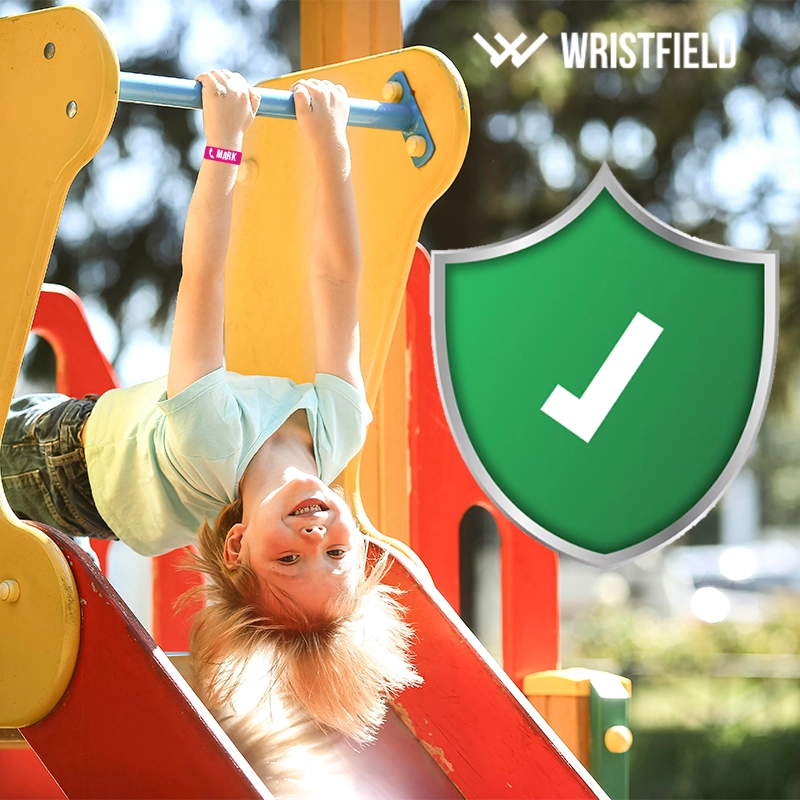
Why wristbands for children work
Wristbands are visible, inexpensive and quick to fit. For organisers they reduce search time when children become separated, provide a place for essential contact or medical notes, and help staff and volunteers to spot at-a-glance who belongs to which group or activity zone. For parents, they provide reassurance that a child can be linked back to a responsible adult without delay.
Primary benefits
Used correctly, wristbands support three core needs:
- Identification - quick visual confirmation of group membership and authorised access.
- Contact and medical information - a safe place for an emergency phone number or allergy note.
- Operational control - simpler head counts, easier grouping and faster reunification.
Where they are most useful
Typical settings include school trips, summer camps, after-school clubs, sports days, community festivals with family zones, swimming pools and attractions with queueing areas. They are also valuable at larger public events where a dedicated family area, lost-child point or reunion procedure is in place.
Choosing the right wristband material
Material choice affects comfort, durability, security and cost. For children's use you will most commonly consider Tyvek, vinyl and fabric wristbands. Each has advantages and constraints.
Tyvek
Lightweight, tear-resistant paper-like material with a simple adhesive closure. Tyvek is low-cost, single-use and water-resistant for short periods. It is a good choice for school trips and day events where you need cheap, disposable identification. Tyvek is not suitable where prolonged water exposure or heavy abrasion is expected.
Vinyl
Vinyl wristbands are more robust and water-resistant than Tyvek. They often have buckle or snap closures that make them semi-permanent for the duration of an event. Vinyl is useful for multi-day camps or outdoor activities where durability matters. Bear in mind that vinyl can be less breathable on hot days.
Fabric
Woven fabric wristbands are the most durable and comfortable for long-term wear. They are more expensive and often used at multi-day festivals or camps where wristbands double as a souvenir. For young children, check that the closure is child-safe and consider whether a fabric band is overkill for a short event.
Sizing, fit and comfort
Getting the fit right avoids discomfort and reduces the risk of the wristband being removed. Children have a wide range of wrist sizes, so choose a band designed for child wrists or use an adjustable closure.
| Age range |
Typical wrist circumference |
Recommended band type |
| Toddlers (2-4) |
11-14 cm |
Child-size Tyvek or small adjustable vinyl |
| Young children (5-8) |
13-16 cm |
Vinyl with snap or child-size Tyvek |
| Older children (9-12) |
15-18 cm |
Standard vinyl or fabric |
Always avoid overly tight fits. A useful test is that a finger should pass comfortably between the wrist and the band. If a child can easily slip the band off, consider a different closure or a tighter size - but never so tight that circulation is affected.
Customisation, numbers and UV varnish
Custom printing helps with identification and branding. Typical print options include group names, emergency contact fields, medical icons and sequential numbering. Two security or utility features commonly used are serialisation and UV varnish.
Serialisation and numbering
Numbering wristbands is helpful for reconciliation and lost-child procedures. If you issue wristbands from a sequenced pack and record which number is given to which child, reunification is faster and more reliable. For larger operations, keep a simple log with child name, guardian contact and wristband number.
UV varnish - what we mean
On our site UV varnish refers to a clear lacquer applied over printed text or markings that becomes visible only under UV light. It is not the same as UV printing. UV varnish is useful to make a covert authenticity mark that staff can verify using a small UV torch, helping to prevent counterfeiting at admission points. It is a low-cost security measure particularly effective where manual checks are appropriate.
Privacy, consent and data handling
Using wristbands with personal information brings data protection responsibilities. Keep the following safeguards in mind.
- Only include essential details on the wristband - a single emergency contact number is usually sufficient.
- Avoid full names or sensitive medical details printed on an externally-visible band unless parents consent and there is a clear operational need.
- If you record wristband numbers against children in a log, store that information securely and delete it when it is no longer needed.
- Communicate to parents how wristbands will be used and ask for consent where required by your organisation's policies.
Operational best practice - issuing and supervising
A clear issuing and supervision routine turns wristbands from a nice-to-have into an effective safety tool. Below are practical steps to include in your standard operating procedure.
Before the event
Decide who will record which band goes to which child, what information will be printed on the band and how many spare bands you will keep. Prepare a simple distribution log template and brief staff or volunteers on the wristband policy.
Issuing on arrival
Fit the wristband with the parent or guardian present, record the number if using serialisation, and confirm contact details. Explain the purpose of the band to the child in simple terms and show how it should remain on for the duration of the activity.
During activities
Conduct periodic head counts and visual checks. Use colour-coding for different groups or access levels to speed recognition. If you are using UV varnish as an authenticity measure, ensure staff in key positions have UV torches and know how to check bands quickly.
Reunification and removal
Only remove or replace wristbands when a child is handed back to an authorised guardian. Have a small supply of replacement bands and a clear signing-out process for lost or damaged bands so you can reissue without confusion.
Special situations and considerations
Certain environments and child needs require tailored solutions.
Water activities
For pools, beaches or waterparks use water-resistant vinyl or specialist waterproof bands. If bands may be worn in chlorinated water for long periods choose bands specified for swim use and check that print remains legible when wet.
Allergies and skin sensitivity
Some children have sensitive skin or latex allergies. Select latex-free bands and avoid prolonged sticky adhesives directly on delicate skin. If a child has a known skin condition discuss alternatives with parents in advance.
Behavioural or special educational needs
Children with special educational needs may find wristbands uncomfortable or upsetting. Provide alternatives such as a name label in a pocket, a badge on clothing or a discreet tag on a bag, and make plans with parents so identification does not cause distress.
Handling lost or counterfeit bands
Have a simple policy for lost bands: verify the child with a guardian and, if appropriate, reissue a new band after recording the exchange. If counterfeiting is a concern - for example at larger events - combine visible band features (colour, logo) with covert UV varnish and sequential numbering for staff checks.
Environmental and sustainability points
Consider the environmental impact of single-use products. Tyvek is lightweight and has a lower material footprint than heavier plastics, but it is single-use. Vinyl and fabric bands last longer but may be made from synthetic materials. Where possible reuse bands that are specific to a group over multiple sessions or choose recyclable options and provide clear disposal instructions to parents and staff.
Budgeting and procurement
Costs vary by material, print complexity and quantity. Because prices change and depend on specifications, avoid relying on a single price-point without checking the supplier. If you need a rough planning figure for budgeting, ask suppliers for a written quote that matches your chosen material, print run and any special features such as UV varnish or sequential numbering.
If you are ordering for a school or recurring programme, discuss volume discounts and lead times with your supplier. For urgent orders refer to guidance on lead times and express options to understand trade-offs between cost and turnaround.
Practical example - a school day trip
For a one-day school trip of 30 children, a common approach is:
- Use child-size Tyvek wristbands printed with school name and an emergency contact number.
- Issue bands at the school gate with teacher recording the sequence numbers in a simple log.
- Keep 10 spare bands and a small UV torch if you use covert varnish for anti-fraud checks at the venue.
- Remove bands on return or hand back to parents with a short explanation of disposal.
This approach is low-cost, easy to manage and effective for short trips.
Where to find more guidance
For practical details about materials, sizes, print options, UV varnish and lead times see our Event Wristbands FAQ: Event Wristbands FAQ. If you are planning a larger event or want to fold wristbands into a broader access control system, the Event Organiser's Handbook has in-depth operational guidance: The Event Organiser's Handbook. For security-minded organisers there is also a full practical guide to wristband-based entry control: Event security with wristband-based control.
Final checklist
Before your next activity with children, run through this short checklist:
- Choose a material appropriate to duration and environment.
- Decide what is printed and minimise personal data.
- Plan fit checks and have spare bands available.
- Log serial numbers if you need rapid reunification.
- Train staff on issuing, checking and removal procedures.
Used sensibly, wristbands are a small investment that delivers measurable safety and operational benefits for children, parents and organisers alike.
If you would like tailored advice for a specific event type - for example school trips, multi-day camps or family areas at festivals - see our guide on wristband systems compared for recommendations by use case: Wristband systems compared. For simple readiness checks download our event entry checklist: Event entry checklist.
Legal and data protection considerations
Wristbands for children intersect with privacy law in many jurisdictions. In the UK you must treat any personal information printed on or linked to a wristband as personal data under data protection legislation. The starting point is minimisation. Only include what you absolutely need to achieve safety and reunification. A school or event organiser will usually be better served by printing a contact number and a short code or sequential number on the band rather than a full name, date of birth or home address.
Where identifiable information is unavoidable, establish and document a lawful basis for processing and retain records for the shortest time necessary. Make sure parents or guardians are informed about why data is collected, how it will be used and how long the wristband data will be kept. Where appropriate obtain explicit parental consent, especially for young children and for any photographic or biometric monitoring paired with wristband use.
Operational measures are as important as paperwork. Protect logs that link wristband serial numbers to children with restricted access control and regular audits. If third party suppliers handle personal data, confirm they are contractually bound to comply with data protection standards and keep a record of data processing activities.