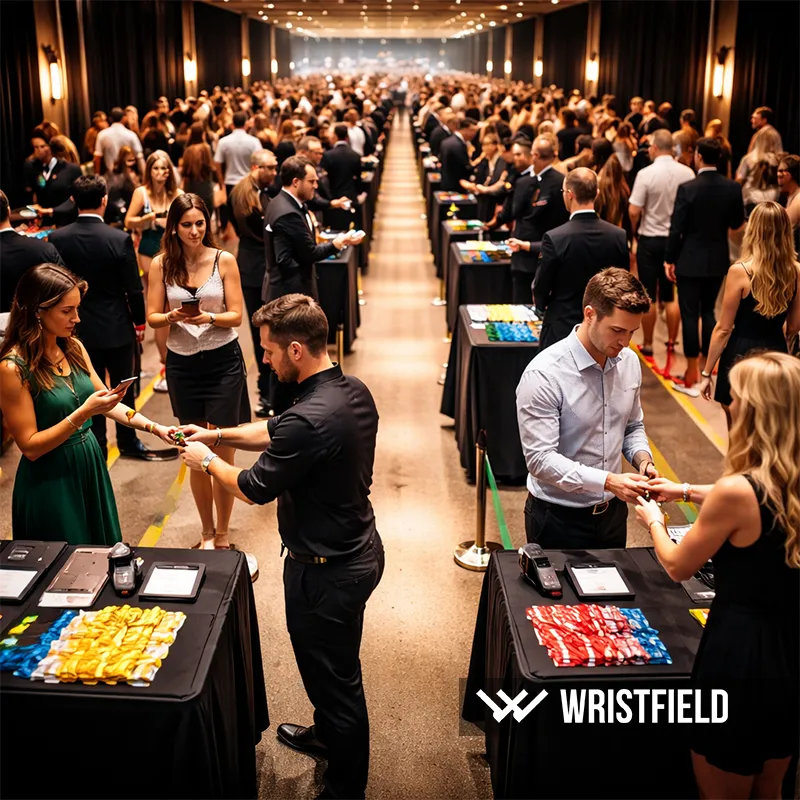
Baseline model and time arithmetic
Imagine a 1,000-person event where 70 percent of attendees arrive within the first hour. That is 700 people arriving in that period. If your current gate throughput is 15 people per minute per lane on paper, that suggests 900 per hour. In practice delays such as ticket search, scanning issues, and ad hoc checks reduce the average to closer to 12 people per minute per lane, or 720 per hour.
With 700 arrivals clustered in an hour the queue is effectively continuous. The operational target therefore is to increase average throughput to about 18 people per minute per lane, which equates to 1,080 per hour. That is a 50 percent increase versus the 12 people per minute starting point and creates breathing room to absorb spikes in arrival.
Where time is really lost
Most of the added time does not come from attaching a wristband. It comes from uncertainty. Slower actions such as searching for a ticket, hunting for a QR code on a smartphone, and resolving access rights add seconds per customer, and those seconds accumulate quickly.
If an unclear wristband or admission rule adds just 6 seconds extra per person, across 700 arrivals that is 4,200 seconds, or 70 minutes of cumulative slow-down. Identifying and eliminating those seconds is the quickest path to dramatic improvements.
Wristband strategy as a time optimisation tool
Choice of wristband type is an operational decision, not purely an aesthetic one. Lightweight Tyvek wristbands are extremely quick to apply and durable enough for most general admission events. Textile wristbands with a plastic locking mechanism are more premium and take slightly longer to fasten, but can be necessary for hospitality areas or multi-day festivals.
To illustrate: if a standard wristband can be applied in 2.5 seconds and a textile wristband in 4.5 seconds, applying 800 standard wristbands at 2.5 seconds each requires 2,000 seconds total, or about 33 minutes. At 4.5 seconds each the same 800 wristbands would take 3,600 seconds, or 60 minutes. The difference is 27 minutes saved by choosing the faster wristband where appropriate. That single change can approach a 30 percent speed improvement in the gate operation.
Optimising lanes and distribution
Increasing the number of lanes is obvious, but not sufficient alone. Two parallel lanes only double capacity if arrivals are balanced between them. If one lane is reserved for VIPs and goes largely unused while the other is overloaded, the net efficiency remains poor.
Distributing attendees correctly depends on pre-filtering. A staff member at the front of the queue who asks quick qualifying questions about ticket type can boost throughput by 10 to 15 percent by directing people to the correct lane immediately.
VIP lane with separate processing
VIP guests are often a small proportion of attendees but have higher expectations. If 150 VIPs arrive in the first 45 minutes that amounts to 3 to 4 VIPs per minute. A dedicated VIP lane keeps normal lanes moving at pace, prevents the extra briefing time that VIP checks require from spilling into general queues, and helps protect the premium experience.
Using a visibly distinct textile wristband with a secure locking clip for VIPs makes visual checks instant. This avoids the staff needing to read small print or scan ambiguous tags, which would slow everybody down.
Entry errors and their time impact
One common operational fault is an unclear entitlement system. If regular and VIP wristbands are not intentionally and visibly different, staff end up scrutinising each wristband. An extra 2 seconds per person for verification on a 700-person influx explains an extra 1,400 seconds, more than 23 minutes of cumulative delay.
Designing wristband colour, print and style intentionally, and training staff to recognise them, cuts verification time substantially and is a low-cost, high-impact intervention.
Labour costing versus time saved
Any optimisation must be judged against cost. For example, adding one extra gate team for four hours carries a staffing cost. Rather than assuming current hourly rates, frame the decision with an example calculation: if you pay an hourly rate of optional rate per staff member, multiply that by number of staff and hours to see the additional cost. Then compare the extra margin that faster entry generates.
For instance, if faster entry increases guest satisfaction and causes higher early-spend, the upside can be substantial. If, hypothetically, 500 guests spend an additional average of 15 currency units each during the first hour because they arrived earlier and were more relaxed, that is an additional 7,500 in revenue. Against the modest incremental staffing cost, this often represents strong return on investment. The exact figures depend on your event’s spend patterns and pricing, so run the arithmetic with your own average spend numbers.
Decision matrix for time reduction
| Factor | Impact on time | Cost | Recommendation |
| Use Tyvek for standard attendees | High | Low | Strongly recommended |
| Separate VIP lane | Medium | Low to medium | Recommended |
| Front-of-queue pre-filtering | Medium | Medium | Depends on event size |
Case study: 1,200-person outdoor concert
At a 1,200-person outdoor concert the first year featured a single entry lane. Average wait time reached 25 minutes and guest satisfaction flagged in feedback. The following year the organiser implemented two public lanes, a dedicated VIP lane, and switched general admission to fast-apply Tyvek wristbands while using textile wristbands in the VIP lane.
Average wait time dropped to 16 minutes. That is a 36 percent improvement and a meaningful uplift in satisfaction scores. From a practical perspective this demonstrates that straightforward changes in lane structure and wristband selection can deliver significant, measurable improvements.
Further optimisation opportunities
Small operational changes compound. Pre-perforating wristband rolls and preparing wristbands on trays reduces fumble time. Clear, large format visual signage and colour-coding reduce questions and bottlenecks. Training staff in a short pre-shift briefing and practising wristband application can yield a 5 to 10 percent speed gain.
A strategic view
Entry is not simply administration; it is the moment the guest begins their event experience. A 30 percent reduction in entry time is not a technology trick but the outcome of system thinking: secure and unambiguous wristband strategy, considered lane layout, clear entitlement rules, and staff deployment designed to balance capacity and demand.
Security considerations need not slow entry if they are built into the wristband design and staff procedures. Anti-fraud measures such as unique numbering, UV ink, or tamper-evident closures can be combined with clear visual distinctions for entitlement without lengthening processing time if chosen and implemented thoughtfully.
The mathematics of entry time - broken down
Optimisation works because you can measure the process. A typical entry flow has four stages: ticket check, entitlement recognition, wristband application, and release. If you optimise each stage incrementally the combined effect is multiplicative because queue build-up is sensitive to small per-person time changes.
Consider the following sample timings often seen in practice: ticket check 5 seconds, entitlement recognition 3 seconds, wristband application 2.5 seconds when using quick-apply wristbands, and release 1.5 seconds. That totals 12 seconds per person. If the same process stretched to 15 seconds per person for any reason, across 1,000 attendees that is a difference of 3,000 seconds or 50 minutes. Fifty minutes of queue time is already a material impact on atmosphere and satisfaction at any mid-sized event.
Micro-level interventions
Micro-optimisations are low cost and add up. Pre-organising wristbands so attendants never have to search for the right colour saves an estimated 0.5 seconds per guest. For 1,000 guests that is 500 seconds saved, more than eight minutes.
Simple front-of-queue signage that tells guests how to present tickets or where VIPs should queue can save another second per person, adding up to nearly 17 minutes across the same 1,000 people. Together these micro-changes can contribute 25 minutes of time saving.
Cost and time relationship - worked example
If adding an extra lane creates incremental staff cost, evaluate it against the revenue impact of reduced queue times. For example, suppose an extra lane costs you an additional staffing bill for the event window. If the faster entry causes an increase in early-spend by a proportion of attendees, the additional revenue can quickly offset the staffing expense. Use your event-specific average spend figures to build a realistic scenario. The example numbers here are illustrative: calculate with your own figures to make the case to stakeholders.
Crowd dynamics and behavioural psychology
Queue perception is not linear. A five-minute queue is acceptable; 15 minutes creates frustration; 20 minutes risks a contagion of negative mood. The aim is not only to reduce measured wait times but to improve the perceived waiting experience. Visible progress, clear lane signage, and staff presence that communicates control all reduce stress and perceived time.
Entitlement system design and time
Distinct colour, print and material choices for different entitlements lead to instant visual recognition at gate level. If two wristband types share too similar a colour or finish, staff lean in to confirm, asking questions that add 2 seconds per person. At 1,000 attendees that is 2,000 seconds, more than 30 minutes. Entitlement design therefore serves operational speed as much as brand presentation.
Balancing lane loads
If one lane proceeds faster than the others people will gravitate to it, creating imbalances. Deploy a member of staff to actively shepherd arrivals and even-out queues. This simple intervention can produce a 5 to 8 percent efficiency improvement and reduce the risk of one lane becoming a bottleneck while others sit idle.
Process redesign model
World-class gate processes make sure that by the time a guest is at the front of the queue they already know what to do. Encourage attendees to have QR codes ready, use large visible information boards, and make entitlements obvious. This front-loading of information can deliver up to a 20 percent speed improvement in throughput.
A consolidated 1,000-person model
Start point: 15 seconds per person. Optimised state: 10 seconds per person. That 5-second difference across 1,000 attendees equals 5,000 seconds, or about 83 minutes. In practice it is realistic to claim 30 to 40 percent of that theoretical maximum as achievable, which corresponds to a 25-35 minute net time saving at typical events after accounting for practical constraints.
Long-term operational benefits
Fast entry is not just about a single event. Guests who experience efficient, pleasant arrival are more likely to return. A modest uplift in return rate, applied to a full season of events, can represent significant incremental revenue. Think of entry improvement as both a short-term operational KPI and a contributor to your broader customer lifetime value.
Practical implementation plan
Begin by measuring your current throughput: time per guest and lane throughput. Next simplify entitlement rules so they are visually obvious. Third, decide on lane numbers and their purpose. Fourth, train staff in specific roles and wristband application speed. Fifth, finalise your wristband strategy so that materials match the function - quick-apply wristbands for general admission, more secure options for hospitality and multi-day credentials. Implement these steps together and you will reliably approach a 30 percent reduction in entry time.
Final thought
Every second at the gate is part of a process. When you design that process deliberately the time falls away. Entry efficiency is not luck; it is planning. If you treat wristbands, lane design and staff roles as system elements rather than isolated choices you will find that a 30 percent improvement is not only plausible but reproducible across multiple events.
Further reading
If you want to go deeper into specific elements of gate design and wristband selection these topics are useful next steps: a full 1,000-person gate throughput calculation; VIP area handling and guest flows; preventing wristband fraud; and considerations when ordering bespoke wristbands. Consult a trusted UK wristband supplier for samples and to test fit-for-purpose materials in rehearsal scenarios.