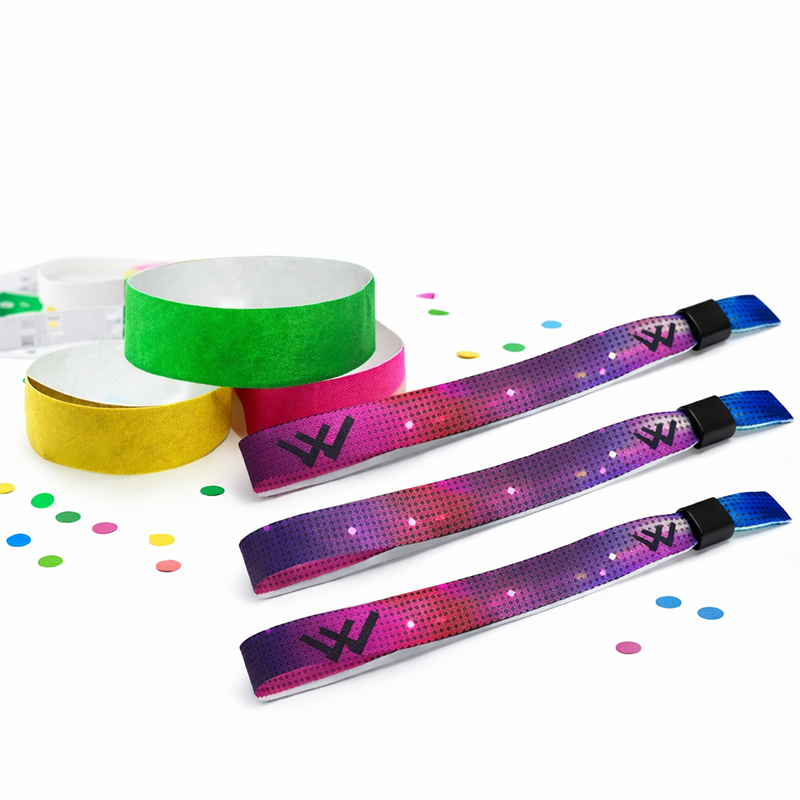
What determines the price of a custom wristband
The final price of a custom wristband is the sum of several elements. First is the base material. Second is the print or decoration method. Third is the production quantity. Fourth is any one-off setup or artwork preparation fee. Finally, optional extras such as numbered sequential printing, tamper-evident closures or security features add to cost.
A one-off setup fee covers the technical preparation required to get a design onto a wristband consistently at high quality. This may include vectorising a logo, colour separation, creating print plates or setting up a digital print run. The key point is that the setup fee is a fixed cost per design or print run rather than a per-item cost, so its impact fades as quantity increases.
Worked example: 1 000 cloth wristbands with a plastic snap
Cloth wristbands are commonly chosen for multi-day or premium events because they are durable and presentable. They also double as a tangible brand touchpoint for attendees.
To demonstrate how a price is built, consider this hypothetical example. If the unit production cost for a custom cloth wristband is GBP 0.20, then the manufacturing cost for 1 000 units is GBP 200. Add a one-off setup fee for the artwork, say GBP 15, which covers the initial colour and print set up for that design. The total production cost would then be GBP 215. Dividing that by 1 000 gives an effective unit cost of GBP 0.215, or about 21.5 pence per wristband.
Note that if you change the unit price assumption the totals scale accordingly. The important takeaway is that the setup fee has a much smaller per-unit impact at higher quantities. At 1 000 pieces, a modest setup fee only adds a few pence per wristband.
Worked example: 1 000 Tyvek 3/4 wristbands printed with black text
Tyvek wristbands are a cost-efficient option for single-day events, pool parties or situations where the wristband only needs to last for a short period. They are lightweight, waterproof and usually printed with a single-colour process.
Again using a clear example, if the unit production cost for a Tyvek wristband is GBP 0.05, the manufacturing cost for 1 000 units is GBP 50. If the setup fee for the Tyvek print run is GBP 25, the total cost would be GBP 75. The effective unit cost in this scenario is GBP 0.075, or 7.5 pence per wristband.
These figures are examples to illustrate how the components add up. The actual unit price you will be quoted depends on colour complexity, the chosen fastening method, the size and whether you add features like numbering, barcodes or thermal transfer security marks.
Comparing fabric versus Tyvek using the example figures
| Type | Manufacturing cost (example) | Setup fee (example) | Total (example) | Effective unit cost |
| Cloth 1 000 units | GBP 200 (if unit = GBP 0.20) | GBP 15 | GBP 215 | ~GBP 0.215 |
| Tyvek 1 000 units | GBP 50 (if unit = GBP 0.05) | GBP 25 | GBP 75 | ~GBP 0.075 |
The simple comparison highlights that Tyvek typically offers a lower per-item cost at small and medium quantities, whereas cloth wristbands carry a higher unit cost but offer a premium feel and a longer lifespan.
When the more expensive option pays back
The choice is not purely about who is cheapest. If the event is premium and the wristband functions as a marketing device, the cloth option often delivers more value. Festival attendees tend to keep cloth wristbands for months and they appear in social media images, effectively acting as free advertising.
For example, if your average ticket price is GBP 40 and the premium look is important to your positioning, paying an extra handful of pence per attendee is unlikely to change the overall profitability of the event. The economic trade off should be evaluated in the context of ticket revenue, brand exposure and attendee experience rather than on unit price alone.
Common budgeting mistakes by organisers
One frequent error is to focus solely on the quoted per-item price and ignore the setup fee, artwork costs or delivery charges. Another is under-ordering and then placing an urgent top-up order. Express production or small emergency batches typically come with a premium and can erode any initial savings.
It is also common to overlook logistic factors such as whether wristbands need to be pre-sorted by day, colour or entry type. Additional handling can add cost both in the supplier charges and in your on-site staffing time.
Decision matrix from a cost perspective
If the event is a single day and cost sensitive, Tyvek usually makes the most sense. If your event is multi-day, part of a brand activation or you want to create a collectible item, cloth wristbands are more appropriate. Vinyl wristbands sit between these options and may be a good choice if the wristband needs to be more durable than Tyvek but you are not ready to move to cloth.
Quantity modelling for 2 000 and 5 000 units
Most organisers start to see meaningful per-unit reductions beyond 1 000 units. To show this, let us extend the examples with hypothetical stepped pricing.
For Tyvek, suppose the unit price falls to GBP 0.04 at 5 000 units. The manufacturing cost would be GBP 200 for 5 000 units at that rate. With a setup fee of GBP 25 the total becomes GBP 225, giving an effective unit cost of GBP 0.045. If the unit price falls further at 10 000 units the impact is even larger.
For cloth wristbands the discounts also scale. If the unit price reduces to GBP 0.18 at 2 000 units, the manufacturing cost for 2 000 units is GBP 360. The one-off setup fee of GBP 15 is virtually negligible in per-unit terms. At 5 000 units, if the unit price declines to GBP 0.15, the manufacturing cost is GBP 750 and the effective per-unit cost approaches GBP 0.153.
The lesson is that larger orders yield lower effective unit prices. The decision to increase quantity should weigh storage, upfront cash flow and the probability of selling or distributing the additional wristbands.
Return on spend relative to ticket revenue
Consider a mid-size outdoor event with 5 000 tickets at an average price of GBP 40. Ticket revenue in that scenario equals GBP 200 000. If a Tyvek wristband programme costs GBP 225 in our earlier example, that represents a negligible fraction of overall revenue. Even a cloth wristband programme costing several hundred pounds is a tiny percentage of revenue, so the strategic question is whether the wristband supports your other objectives.
When you approach wristband selection from a revenue ratio perspective it becomes obvious that the decision should be driven by function and brand rather than a strict focus on pennies per unit.
Case study: a premium three day festival
A three day festival with 3 000 attendees decided to use cloth wristbands with plastic snap closures. The organisers reported that the wristbands were kept by many participants and featured in social media posts for weeks after the event. The organisers therefore gained more than simple access control; they gained visible brand presence.
This case underlines that for multi-day or high-profile events the marketing and experiential benefits of cloth wristbands often outweigh the higher upfront cost when compared to disposable alternatives.
Express production scenarios
Occasionally final numbers only become clear a few days before an event. Express production can be the difference between a smooth front of house and chaos at the entrance. Fast turnaround usually comes with a premium, but the cost has to be measured against the risk of uncontrolled entry or slow processing of queues on the day.
Where possible, agree express options and lead times with your supplier in advance so you know the price and can make an informed decision when deadlines tighten.
Security extras and their cost impact
Sequential numbering improves access control and helps reconcile sold tickets with people passing through the entrance. UV or invisible ink adds an extra layer of verification at a low incremental cost. If your event has high ticket values or you need to deter unauthorised entry, these measures are small insurance costs relative to the potential revenue protected.
For example, preventing even a small percentage of unauthorised admissions at a large event can protect thousands of pounds in revenue. The precise financial benefit depends on your ticket price, venue capacity and the incident rate you would expect without controls.
Final decision matrix: cost and purpose
If your primary objective is cost efficiency for a single day event, Tyvek is usually the correct choice. If you want to build brand recognition, create a premium user experience, or encourage attendees to keep and share the wristband, then cloth wristbands are worth the extra spend. Vinyl can be the right compromise when you need more durability than Tyvek but are not prepared to invest in cloth.
Professional conclusion
There is no single answer to the question of how much a custom wristband costs. The full context matters. For many events Tyvek offers a highly cost-effective solution, particularly for single-day occasions. Cloth wristbands have higher unit costs but provide a premium experience and ongoing marketing value.
Rather than choosing purely by the lowest per-item cost, consider the role the wristband will play in the guest experience, security and brand exposure. Use quantity modelling and factor in setup fees when budgeting. And if time is tight, weigh the cost of express production against the operational risk of inadequate wristbands on the day.
If you would like a specific quote, prepare your artwork and your quantity estimate, and ask suppliers for itemised pricing that separates manufacturing, setup and optional security features. That will let you compare like for like and make a decision that balances cost, functionality and brand impact.
If you are planning a UK event and want help translating your wristband requirements into a realistic budget, speak to a supplier who can provide sample pricing for your exact specification. Using worked examples and clear assumptions will help you avoid surprises and choose the right wristband for your event.