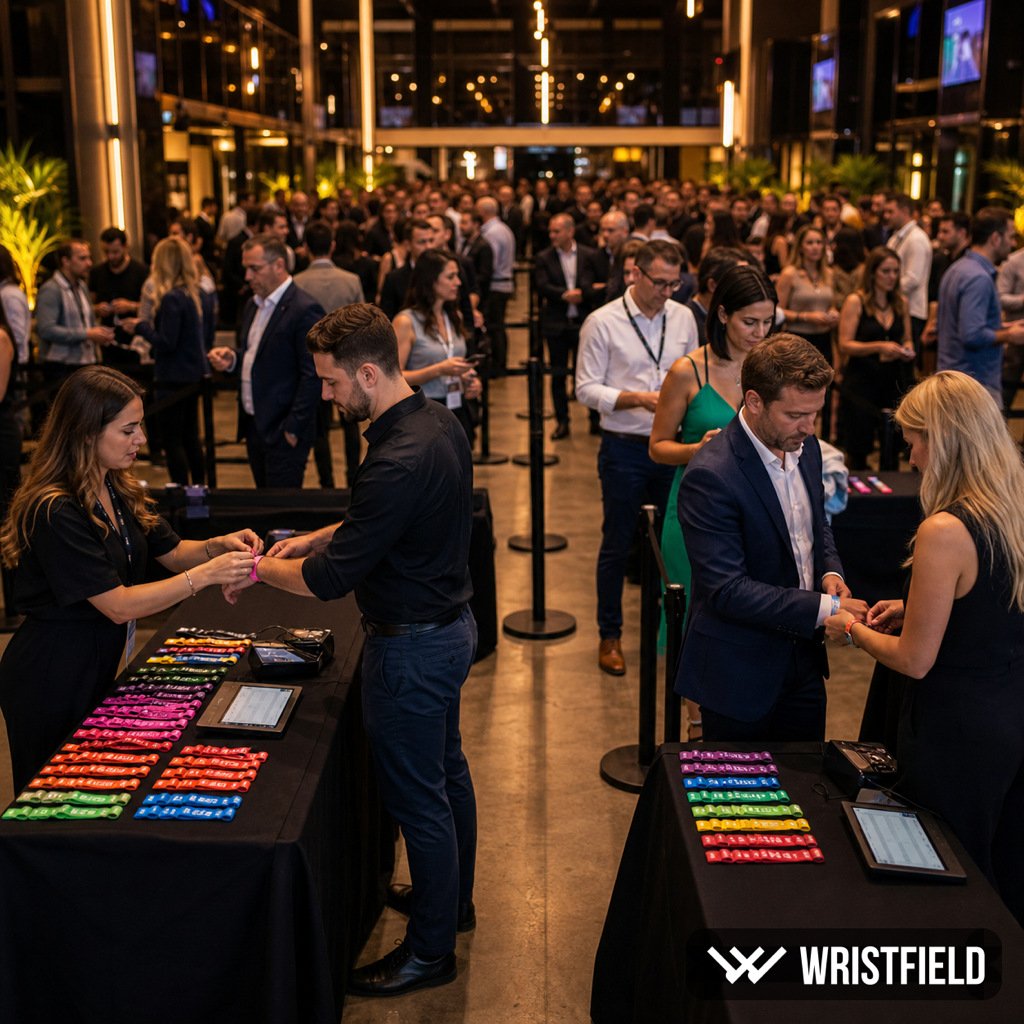
Numbered wristbands are one of the most cost-effective operational controls an event organiser can introduce. The principle is simple: every wristband receives a unique identifier. This may be a sequential number such as 0001, 0002, 0003, or a code that encodes day, zone or ticket type. The number on its own is not magical; it becomes valuable when the organiser knows what they want to control and how to record it.
What a number adds to a wristband in practice
When every wristband is uniquely numbered, the organiser gains traceability. If two wristbands with the same number appear during the event, that is immediately a trigger for investigation. Uniqueness is especially useful where wristbands are both proof of admission and a permission signal for restricted areas. If you issue 1 100 wristbands for a 1 000 guest event and you number them 0001 to 1100, a post-event check can show exactly which ranges were used and where discrepancies occurred.
Numbering becomes essential as complexity increases. It is straightforward to manage a single entry desk without numbering, but once you operate several desks or gates the operational picture blurs. You can allocate ranges: desk A manages 0001 to 0300, desk B 0301 to 0600 and desk C 0601 to 0900. If 100 wristbands cannot be accounted for at the end of the day, the range allocation helps narrow the investigation to a single desk and time window.
When numbered wristbands make sense
Not every event needs numbered wristbands. For a small private gathering where every attendee is listed by name, colour or a simple printed text may be enough. The tipping point is when you want verifiable data after the gates close. Use cases include financial protection, safety and security, multi-day access control and any scenario where multiple issuing points or many staff are involved.
A useful rule of thumb is to consider numbering from around 500 attendees and to regard it as essential once you approach 1 000 attendees. This is not because every event will experience fraud, but because when anything does go wrong the lack of numbering makes reconstruction much harder. A numbered system turns impressions into data: it is no longer about someone saying more or fewer wristbands were used, it is about which numbered ranges left which issuing points and when.
| Event type |
Numbering recommended? |
Primary benefit |
| 100-300 person corporate event |
Optional |
Handles guest lists and spares |
| 500-1000 club or concert |
Highly recommended |
Tracks issued wristbands accurately |
| Beach or waterside event |
Recommended |
Controls daily entries and re-entries |
| Multi-day festival |
Almost essential |
Separates days, zones and permissions |
Numbering and anti-counterfeit strategy
Numbering is not a replacement for choosing the right material or anti-tamper features, but it strengthens overall protection. A plain, unbranded, easily copied wristband gives security staff very little to check. Combine unique numbering with visual and covert markers such as distinct colours, full-colour printing, holograms or UV-visible varnish and you create multiple layers of verification. In this context UV varnish means a varnished marking that becomes visible under an ultraviolet torch and not UV ink printing.
Crucially, the staff must know what to look for. Numbering only helps if the team is briefed on which ranges are valid, which colours map to which zones and what to do when a number appears twice. A simple list for each issuing point is often sufficient to make the system operational.
Cost versus benefit - worked examples using typical Tyvek prices
Cost should not be considered in isolation. The right question is what a control failure would cost. Even a small percentage of unauthorised entries can represent significant lost revenue. Consider the traceability value that numbered wristbands provide versus their manufacturing cost.
Using the supplied price references, here are two practical examples using Tyvek wristbands. Tyvek plain wristbands (T1) are the economical choice for one-day events and single use access control. Full-colour printed Tyvek (T1FC) offers stronger branding and clearer visual differentiation and comes at a higher unit price.
Example 1 - 1 200 wristbands for a 1 000-attendee event with staff and spares. The unit gross price for plain Tyvek in the 1 000 to 2 000 band is GBP 0.0384. That makes the total cost for 1 200 pieces GBP 46.08 inclusive of VAT. If you choose full-colour printed Tyvek for that same quantity the unit gross price in the 1 000 to 3 000 band is GBP 0.12, giving a total of GBP 144.00 including VAT. The express full-colour option would be around GBP 172.80 for 1 200 units.
To put those sums in perspective, assume a modest rate of unauthorised entry of 2 percent at a 1 000-person event. That equals 20 people. If the average ticket value lies between GBP 30 and GBP 100, the potential lost revenue due to unauthorised entry ranges from GBP 600 to GBP 2 000. Even the full-colour wristbands are a small fraction of that figure, and plain Tyvek is negligible. Numbering adds a forensic layer that helps determine whether an apparent shortfall reflects fraud or legitimate operational factors.
Example 2 - a larger event of 2 200 wristbands. Plain Tyvek unit gross price in the 2 000 to 5 000 band is GBP 0.03. That yields a total cost of GBP 66.00. Full-colour Tyvek on the 1 000-3 000 band at GBP 0.12 per unit gives GBP 264.00. Again, the cost of adding numbering and a stronger print remains modest compared with typical ticket revenues and the value of accurate post-event data.
Which material to number - Tyvek, vinyl or fabric?
Numbering can be applied to Tyvek, vinyl and fabric wristbands. The decision depends on the event profile. Tyvek is light, waterproof and inexpensive, making it ideal for single-day events, club nights and beaches. Vinyl is thicker and more durable, better for multi-day events or when wristbands must be worn for several days. Fabric wristbands are premium, comfortable over long periods and commonly used for festivals where the wristband itself is part of the guest experience.
Numbering in Tyvek offers excellent cost efficiency for access tracking. For a multi-day festival or VIP areas, vinyl or fabric with numbering will last longer and look more premium while still providing the same traceability. The correct choice depends on whether your priority is cost, durability or brand experience.
Common organiser errors and how to avoid them
Organisers sometimes make three recurring mistakes. First, they order numbered wristbands but have no internal issuing rules, so the numbers exist but are not used operationally. Second, they give out spare wristbands from the same numbered range as main tickets, making post-event analysis ambiguous. Third, the issuing staff are not briefed on what to check or record.
A practical and effective system needs only a few elements: defined number ranges, a simple distribution plan, a short desk briefing and a quick end-of-event reconciliation. If these basics are observed, numbering stops being a decorative feature and becomes a source of operational intelligence.
How to prepare number ranges before you order
Plan your ranges before you place the order. For an event of 1 500 attendees you might allocate 0001 to 1500 for standard admissions, 1501 to 1600 for staff, 1601 to 1650 for performers, 1651 to 1700 for VIP and 1701 to 1800 as spare. The ranges should reflect how you operate on the day and who will be responsible at each issuing point.
Ranges also reduce ambiguity when colours are similar or lighting conditions are poor. Colour is a fast visual cue but can be unreliable at night or under club lights. Numbering provides a second verification layer. If a guest presents a wristband that looks correct by colour but the number sits outside the permitted range, staff can act promptly and consistently.
Operational workflow with numbered wristbands
A simple workflow makes the system easy to use. Before the event finalise which range is assigned to each desk or gate. Give each issuing point a short printed list showing its start and finish numbers. Issue wristbands by range and require staff to return leftovers at shift end. If spare or replacement wristbands are issued, record the number and reason. This documentation lets you reconcile issued quantities against ticket sales and identify which issuing points used more stock than expected.
This approach is particularly valuable when your event fills in waves. By analysing which ranges were consumed during each surge you learn whether you need extra desks, different staff scheduling or a different range allocation next time.
| Range |
Use |
Responsible point |
Post-event check |
| 0001-0800 |
General admission |
Gate A |
First leftover number |
| 0801-1600 |
General admission |
Gate B |
First leftover number |
| 1601-1750 |
VIP |
VIP desk |
Issued and returned counts |
| 1751-1850 |
Reserve |
Event manager |
Count of justified replacements |
Integration with digital ticketing
Digital tickets and numbered wristbands solve different problems and work well together. A QR or barcode verifies entitlement at the gate. The wristband is the physical proof once the guest is inside. Staff rarely scan a code every time they see a guest moving around the site. Numbered wristbands show quickly and reliably that a guest has been admitted and which permissions apply.
If a wristband needs replacing, numbering allows you to track replacements and ensures that spare wristbands are not mixed into standard ranges. Linking wristband numbers to ticket records is possible if you need to perform tighter post-event audits, but it does require careful data handling and compliance with privacy obligations. Only collect what you genuinely need for security or financial accounting.
How a number should appear on the wristband
Balance readability with aesthetics. For high-volume security checks use a clear, high-contrast number. For VIP or premium events choose a more discreet placement but ensure numbers remain legible to staff. Consider prefixes to encode day or category - for example SAT-0345 or STAFF-1082. That prevents ambiguity and speeds up checks. You can also start ranges at a non-zero base to reduce confusion with older wristbands from other events.
Why numbered wristbands improve the guest experience
Well designed control systems do not feel bureaucratic. When staff are confident about their rules they are decisive and fast. That reduces queues and disputes. Guests notice a smooth admitting process and associate the experience with a professional event. A clear first contact sets a positive tone for the whole event.
Conclusion
Numbered wristbands are a low-cost, high-value tool for event organisers. They provide a traceable, physical record of what was issued and where, help deter and detect misuse and supply data that makes future planning more precise. Whether you choose plain Tyvek for cost efficiency or full-colour and vinyl for durability and appearance, numbering will often repay itself many times over in reduced disputes, clearer post-event accounting and better operational insight.
If you are planning an event with more than a few hundred attendees or with multiple issuing points, prepare your number ranges before you order and brief your staff. The system is simple to operate but powerful in the insights it yields.