Why ticket value matters for fraud risk
Ticket price influences abuse risk through two linked mechanisms. First, higher-value tickets create stronger financial incentive for resale, duplication or unauthorised use. Second, higher-price events often justify tighter controls, but they also tend to have smaller throughput which makes in-depth checks feasible. Conversely, very low-price, high-volume events need fast processing, which limits how elaborate entry checks can be. Good practice balances deterrence against speed and guest experience.
How to measure abuse risk, not guess it
Risk assessment should be evidence based. Useful indicators include: the ticket price relative to local incomes; whether a re-sale market exists for the event type; the speed required at gates; how many VIP or limited tickets exist; and audience profile. Demographics matter: more tech-savvy or opportunistic groups can find new workarounds quickly. Distinguish between opportunistic abuse and organised counterfeiting; your controls differ for each.
Principle: proportional protection
Use protection levels proportional to the expected loss from abuse. The cheapest, most secure option is not always best value. Aim so that the cost of prevention is not disproportionate to likely loss from successful fraud. That includes financial loss, operational disruption and reputational damage. Also factor in how security affects throughput: expensive checks that cause long queues can cost more in indirect losses than they save.
Examples of proportional choices
For a charity gig with a low ticket price, a plain Tyvek wristband and efficient gates are usually best. For a single-ticket VIP experience worth many times the standard price, serialised fabric wristbands with UV varnish and trained gate staff are sensible. Medium-value events that last longer than a few hours often sit in the middle: durable wristbands such as vinyl or partial serialisation may be the right compromise.
When to use serial numbers
Serial numbers add accountability and make duplication harder to exploit. Use serialisation when ticket value is medium to high, capacity is limited, or certain tickets carry extra privileges such as backstage or hospitality access. Serial numbers are particularly valuable when they are linked to your ticketing database so staff can cross-check a wristband number with a booking record at the gate.
Serial numbers are less useful where throughput must be kept at maximum speed and staff cannot realistically check numbers at scale. They are also inefficient for single-day mass-entry events where visual checks are sufficient. Read more on implementation in our practical piece about numbered wristbands at /blog/numbered-wristbands-how-they-work-at-events.
When to use UV varnish (clarifying what we mean by UV)
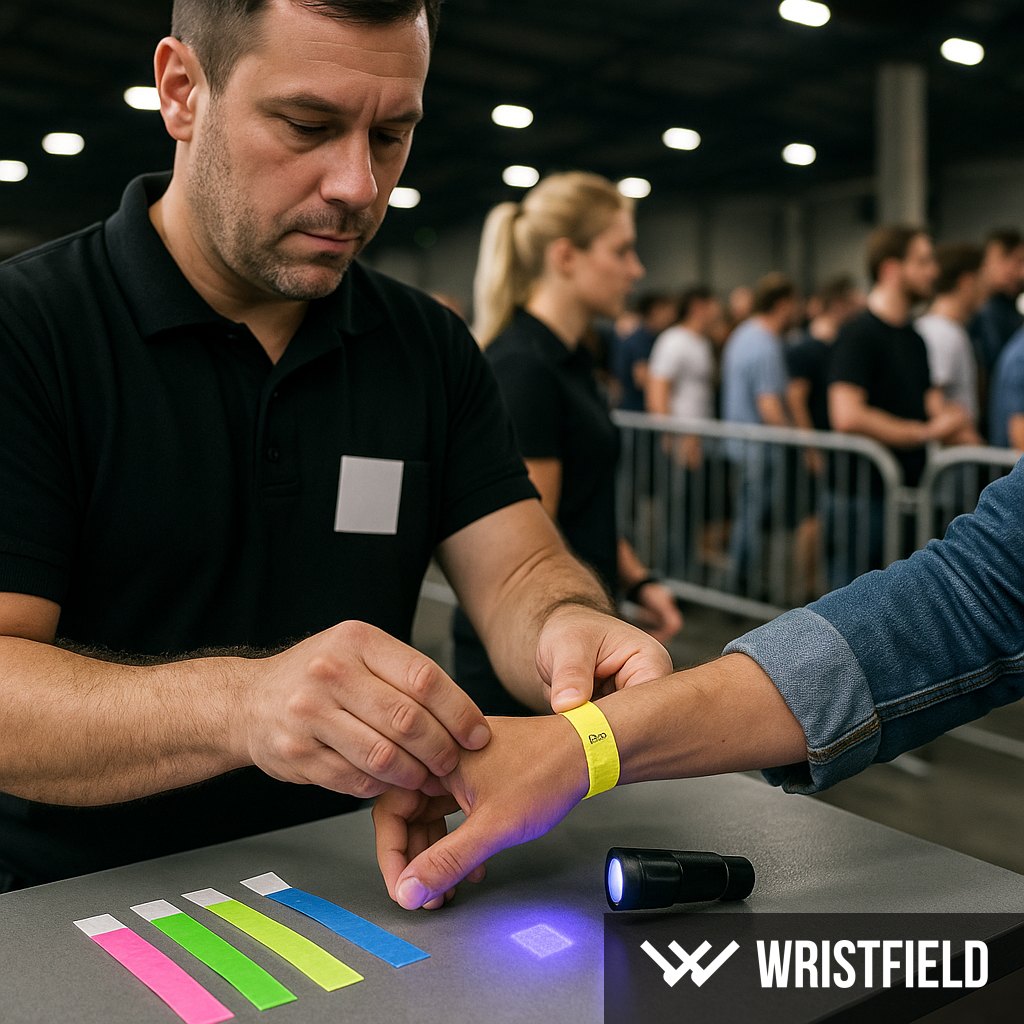
When we say UV varnish we mean a varnish or ink that is visible only under a UV lamp. This is not the same as UV printing. UV varnish is discreet, hard to copy using simple consumer methods, and quick for trained staff to verify with a handheld UV torch. It is an excellent complementary control for VIP access and critical zones where you want occasional spot checks rather than 100 percent inspections.
Use UV varnish when fraud risk is significant but you do not want to complicate all gates. For example, check every fifth VIP entrant or all people accessing a backstage door. You will need portable UV lamps and staff training to recognise true marks and common counterfeit attempts. For an operational deep dive on UV varnish, see /blog/uv-varnish-wristbands-entry-control-vip-cost-risk-uk.
When UV varnish is not enough
If ticket value is very high or counterfeiters have access to professional reproduction, UV varnish on its own will not block determined fraud. In those cases use layered controls: serialisation, tamper-evident closures, durable materials and, where possible, digital checks. UV varnish is best treated as one component in a defence-in-depth approach.
Choosing the right wristband material
Material choice depends on duration, environment and the image you want to convey. Tyvek is cheap, single-use and fast to fit, ideal for short, high-throughput events. Vinyl is more durable and water resistant, suitable for events where wristbands may get wet. Fabric is the premium option for multi-day festivals and VIP passes. Tyvek is easy to replace and also easy to counterfeit; fabric and vinyl are harder to copy but cost more and slow down gate processing.
For a detailed comparison of types and anti-forgery measures, consult /blog/tyvek-vs-vinyl-reszletes-osszehasonlitas and /blog/prevent-wristband-counterfeiting-uv-serialisation-security.
Decision factors for material selection
Ask: how long must the wristband be worn? Will there be rain or swimming? Is a premium look important? What is the ticket price mix? For short, low-price events Tyvek will often do. For longer wear or higher price points choose vinyl or fabric and consider tamper-proof closures or sewing systems for fabric bands.
When to introduce multiple access levels
Multiple access levels are justified when your event has distinctly different zones: general admission, VIP, backstage, press and so on. Different colours, printed icons, or additional markings make quick visual checks possible and reduce unauthorised access. Multiple levels also support operational decisions such as separate entry lines and staffing models, but they increase complexity and cost and require clear staff briefing.
For guidance on managing VIP zones and layered access, see /blog/managing-vip-zones-at-events-access-costs-admission-control.
A practical decision matrix
The following table is a simplified guide. Combine rows and options depending on your own risk assessment and operational constraints. Always test your gate processes beforehand.
| Ticket value and event type |
Suggested wristband and marking |
Complementary actions |
| Low value, high throughput |
Tyvek single use |
Colour coding, capacity planning, minimal checks |
| Medium value, longer wear |
Vinyl or durable wristband, partial serialisation |
Spot UV checks, zone colour coding |
| High value, VIP or limited capacity |
Fabric or premium vinyl with serial number |
UV varnish, trained staff, digital validation |
| Multi day festival |
Fabric durable band plus serialisation |
Layered entry points, monitoring and reconciliation |
Conditional cost modelling and the decision rule
You can turn the decision into a simple formula. Work in your preferred currency; below we use generic units to keep the logic universal.
Define: N expected attendees, R average ticket price, p probability of fraud given current protections, L average loss per fraudulent event, Ck extra wristband cost per head compared with base option, Cs additional staff cost per hour to operate the enhanced checks, T event duration hours.
Expected fraud loss E = N * p * L. Cost of extra protection V = N * Ck + Cs * T. Decision rule: if E greater than V, invest in the stronger protection. This keeps the choice data driven rather than intuitive alone.
Worked example, in conditional units
Suppose N 2000, average ticket R 30 units. The organiser estimates p 0.02 under current controls and L 30 units per fraudulent entry. Then E = 2000 * 0.02 * 30 = 1200 units expected loss. An upgraded package with fabric wristbands, serial numbers and occasional UV checks adds Ck 1.2 units per person and requires Cs 40 units per hour for an extra staff member over T 6 hours. V = 2000 * 1.2 + 40 * 6 = 2640 units. Here E is less than V, so purely financially the upgrade does not pay back. But if the upgrade reduces p from 0.02 to 0.005, the expected savings E2 = 2000 * 0.005 * 30 = 300 units. The net benefit must also factor non-financial elements: reputational risk, complaints and potential downstream costs. Use the formula as a tool, not the only input.
Common organiser mistakes
Typical errors include underestimating audience motivation to bypass controls, relying on a single measure (for example Tyvek in a VIP area), overprotecting low-value gates which reduces throughput, and failing to train staff to spot fake marks or recognise genuine serialised bands. Inventory planning mistakes are also common: ordering too few bands, or excessive spares which lock up budget. Always schedule a gate test day and factor in at least 10 percent spare wristbands.
A real-world organiser error and recovery
One medium-sized festival used the same staff allocation at all gates, ignoring that visual plus UV checks at the VIP entrance took longer. That gate backed up into long queues and caused VIP guests to miss sets and complain publicly. The remedy combined accurate throughput modelling, reallocation of staff, opening a fast visual-only lane and communicating clear arrival instructions to VIPs. They also ran a pre-opening trial the next year to validate the staffing model. The lesson: design for the slowest check, not the average.
Operational steps to implement your protection mix
1. Risk assessment. Quantify ticket values, resale risk and critical zones. 2. Protocol design. Choose wristband types, serialisation approach, UV marking rules and which gates will perform checks. 3. Testing and training. Run a trial day for throughput and train staff on visual, serial number and UV checks. 4. Live monitoring. Collect incidents, adjust staffing and spot-check rates. 5. Post event review and refinement.
Hybrid model: combine speed and control
For most organisers a hybrid model works best. Keep rapid entry lanes for general admission with simple visual checks and Tyvek or low-cost vinyl. Use controlled lanes with serial number lookup, UV varnish and extra checks for VIP, backstage or hospitality areas. Assign a resolver at control gates to handle exceptions without slowing normal traffic. This makes protection targeted where it matters most and preserves overall throughput.
Final recommendations
Understand the relationship between ticket value, audience behaviour and operational constraints before choosing wristbands and markings. Apply serial numbers where accountability matters and UV varnish for discreet spot-checks, remembering that UV varnish is a visible-under-UV-light varnish not a printing method. Choose materials to match wear time and environment. Train staff thoroughly and plan gates to the slowest expected check. Measure, test and iterate after every event.
Further reading: our practical guides on preventing wristband counterfeiting, numbered wristbands and UV varnish provide complementary detail and worked examples. See /blog/prevent-wristband-counterfeiting-uv-serialisation-security, /blog/numbered-wristbands-how-they-work-at-events and /blog/uv-varnish-wristbands-entry-control-vip-cost-risk-uk.