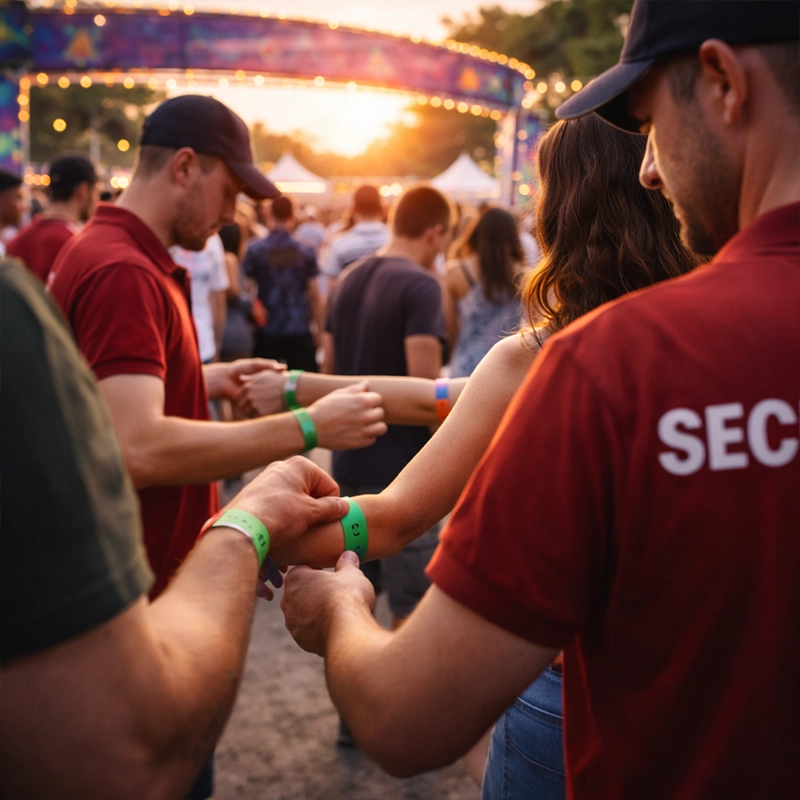
Material and construction: what are you buying?
Tyvek wristbands are made from a spun-bonded high-density polyethylene fabric. They feel like paper but are actually a synthetic fibre structure. Tyvek is lightweight and thin yet surprisingly tough for one-time use. Most Tyvek wristbands use a pressure-sensitive adhesive closure that shows obvious damage when removed, which helps deter transfer between people.
Vinyl wristbands are formed from flexible plastic. They are thicker and feel more substantial on the wrist. Vinyl is inherently water-resistant and less affected by repeated friction, perspiration or damp conditions. Vinyl bands often feature stronger snap or buckle closures, or secure metal eyelets, which make unauthorised removal and reapplication more difficult.
The choice between Tyvek and vinyl is not simply aesthetic. It affects how quickly you can process arrivals, how long wristbands last on attendees, and what level of anti-fraud protection you can reasonably expect.
Application speed and throughput impact
When planning entry operations, small differences in fitment time multiply across hundreds or thousands of guests. For example, imagine an event with 1 000 attendees where 60 percent arrive during the first hour. That means 600 arrivals in 60 minutes, or an average of 10 new wristbands to fit every minute. If a Tyvek band takes around 3 to 4 seconds to apply under skilled hands, a single gate operator can handle roughly 15 to 20 people per minute. By contrast, a vinyl wristband that requires a buckle or snap may take 5 to 7 seconds to apply, reducing the throughput of that same operator to roughly 8 to 12 people per minute.
With high arrival surges, the quicker application of Tyvek can reduce queueing and the need to deploy more staff at entrances. However, if your site design allows multiple simultaneous points of entry or you budget for more staff, the slower application time of vinyl may be an acceptable trade-off for improved durability.
Durability, environmental exposure and duration of wear
Tyvek performs well for short, low-abrasion uses. For a single-day indoor conference or a short promotional event, Tyvek is typically adequate and cost effective. It will withstand normal handling for the duration of the occasion and its adhesive closure will discourage simple transfer.
If the event lasts for several days, involves water, mud, heavy physical activity or prolonged sun exposure, vinyl generally offers a more reliable solution. Vinyl tolerates moisture and perspiration better and resists tearing and abrasion during dancing, sports or camping conditions. In practice, a vinyl wristband may remain wearable and legible for two to three days of continuous use; Tyvek can survive this too in favourable conditions, but it will show wear sooner and is more likely to crease or tear at stress points.
Cost modelling with example calculations
Costs are a frequent decision driver, so it helps to model different scenarios with example unit prices. Exact supplier prices vary by print specification, order quantity, lead time and optional security features. Use the following examples as a template, and substitute your own supplier quotes.
Example scenario: 800 attendees at an outdoor concert. Order quantity includes 10 percent contingency, so 880 wristbands would be required.
If the unit cost for a plain Tyvek band is assumed to be £0.20 as a working example, then 880 pieces would cost around £176. If the unit cost for a plain vinyl band is assumed to be £0.45, the same quantity would cost about £396. In this illustrative case the difference is £220. If the event is a single day with little physical strain on wristbands, Tyvek might represent the most economical choice. If the event involves prolonged activity or exposure to weather, the extra investment in vinyl might be justified.
Again, these figures are demonstrative. The precise unit price depends on print complexity, full colour versus spot print, whether you need sequential numbering, whether you add tamper-evident closures, and the order volume. Always request a formal quote and check minimum order quantities and delivery lead times before committing.
Security level and the risk of fraudulent access
Both Tyvek and vinyl can be printed with sequential numbers, barcodes or QR codes to support access control. Additional features such as tamper-evident closures, spot varnish, foil elements or UV-reactive inks increase the difficulty of copying or counterfeit production.
Consider a simple risk calculation: if your average ticket price is £50 and you expect 800 paying attendees, a 2 percent unauthorised admission rate corresponds to 16 people and a revenue loss of £800 in this example. Upgrading wristband security to reduce unauthorised access from 2 percent to 1 percent would halve that exposure, producing a reduction in potential lost revenue of £400. Whether that saving justifies higher unit costs depends on your profit margins and operational priorities.
Case study contrast: festival versus corporate conference
Observed practice shows distinctive patterns in which material suits which event. At a 1 500-person outdoor summer festival where attendees move, dance and camp, organiser teams commonly prefer vinyl due to its resistance to sweat, rain and abrasion. The organisers reported fewer wristband failures and less customer friction at re-entry points over a multi-day weekend when vinyl was used.
Conversely, at a 600-person indoor corporate conference, Tyvek tends to win on practical grounds. It is quicker to apply for large arrival waves, inexpensive to purchase and perfectly adequate for a day of sessions where attendees are largely seated or standing in an air-conditioned venue. The lower perceived value of the wristband in that setting is offset by the operational benefit of speed.
Decision matrix for common event types
| Event type |
Recommended material |
Reason |
| Single-day indoor conference |
Tyvek |
Fast application and low cost |
| Outdoor concert or single-day festival |
Vinyl |
Higher physical stress and moisture resistance |
| Multi-day festival or camping event |
Vinyl or woven textile |
Durability and branding opportunity |
Typical organiser mistakes and how to avoid them
One frequent error is making decisions purely on the basis of unit price. Price matters, but so do throughput, durability and security. Another common oversight is underestimating environmental exposure. Rain, mud and prolonged sun can degrade inexpensive bands quickly. A third pitfall is failing to order an adequate contingency buffer. Festivals and conferences routinely require an extra 5 to 15 percent on top of expected attendance for staff, replacements and promotional distributions.
Express production, custom printing and lead time considerations
Both Tyvek and vinyl can be custom printed with logos, sponsor artwork, serial numbers, barcodes and UV inks. If you are under a tight deadline, many suppliers offer express production services, although this typically carries a premium. When timelines are short, consider simplifying the print design or ordering a smaller number of plain bands to bridge until the fully printed stock arrives.
Lead times vary by supplier and season. Peak summer festival season can extend production times, so early planning mitigates supply risk. Make sure your supplier confirms production slots and delivery dates in writing.
Throughput modelling for large volumes
For larger concerts, the expected arrival profile drives how many staff and gates you need. Consider a theoretical 1 200-person gig where 65 percent arrive within 75 minutes. That is 780 people arriving in 75 minutes. If a single operator fits a Tyvek band in 4 seconds, they can handle about 15 people per minute and 1 125 people in 75 minutes with multiple staggered gates. If fitting vinyl takes 6 seconds per person, throughput falls to about 10 people per minute per operator, and you need more operators to avoid queues.
Translating these numbers into staffing: a slower fitment increases the total person-minutes required at entry. Either accept longer queues, provide more fitters, or opt for the faster wristband style. Always ensure your site layout and staffing plan are compatible with the product you select.
Detailed example simulation for 1 000 attendees
To put financial and fraud risk together, imagine 1 000 paying guests and a hypothetical average ticket value of £50. Order 10 percent extra wristbands, so plan for 1 100 units.
Example cost assumptions for illustration only: if Tyvek were priced at £0.18 per unit, then 1 100 units cost £198. If vinyl were priced at £0.48 per unit, 1 100 units cost £528, a difference of £330. That £330 must be compared against operational benefits such as decreased failures, lower reissue rates and any reduction in unauthorised admissions.
Now factor security impact. If unauthorised access is 2 percent with Tyvek, you would have 20 people entering improperly, representing £1 000 in lost ticket revenue under the £50 ticket assumption. If upgraded wristband security reduces this to 1 percent, lost revenue falls to £500 and the benefit equals £500 in protected income. In that scenario, paying the additional £330 for vinyl could be justified by the reduced fraud exposure and the intangible benefit of fewer entry disputes and improved guest experience.
These numbers are illustrative. Adjust the formulas with your real ticket price, profit margins and supplier quotes before making a purchasing decision.
Sequential numbering, barcodes and UV inks
Sequential numbering and printed barcodes or QR codes are straightforward ways to increase control. They allow you to match wristbands to ticket records at a glance and make cloning more difficult. UV inks provide another level of covert security. Under UV light, bands printed or marked with special UV ink reveal markings invisible to the naked eye. Use covert features when you expect high demand, high ticket values or a risk of counterfeiting.
Branding and attendee experience
Tyvek is functional and cost-efficient. It is best where the wristband is a tool rather than a keepsake. Vinyl and woven textile bands feel more premium and act as an ongoing advert for your event. Many festival-goers wear vinyl or fabric bands for days and sometimes discard them only after returning home. If your event has a strong brand or sponsor strategy, investing in a more substantial wristband can yield marketing value beyond entry control.
Common decision mistakes revisited
Organisers frequently select a wristband type based on habit rather than analysis. They sometimes fail to test fitment speed during a dry run or neglect how wristbands will be used post-entry, for example at bars, backstage access or as a loyalty item. Another oversight is insufficient contingency for staff use and replacements. Plan for additional quantities and verify the operational compatibility of closures and print features with your door teams.
Final decision framework
If your event is single-day, indoors and not physically demanding, Tyvek is normally the most practical and cost-effective choice. If your event is outdoors, lasts multiple days, involves heavy activity or carries high ticket values, vinyl or woven textile bands are likely to provide a better balance of durability and perceived value.
When security is a priority, combine robust closures with sequential numbering, barcode or QR verification and consider covert UV elements. If branding and attendee retention are objectives, use higher quality materials and full-colour custom printing.
Professional summary
Tyvek excels for rapid application, low cost and single-day or low-stress events. Vinyl is stronger, more water and abrasion resistant, and better suited to multi-day events or scenarios where a wristband must last and remain legible. The optimal choice depends on arrival profiles, environmental exposure, security needs and your marketing goals.
Use the models and example calculations in this guide to run your own scenarios. Request quotes from suppliers that include production lead times, print proofs and security options before placing an order. With proper planning, a well-chosen wristband solution will save staff time, reduce gate disputes and protect ticket revenue while supporting your brand image.