Contents
This article covers what UV printing on wristbands is, the main production methods, how the process works, typical event use cases, durability and security comparisons, cost considerations and common mistakes to avoid when choosing a supplier.
What is UV printing on wristbands?
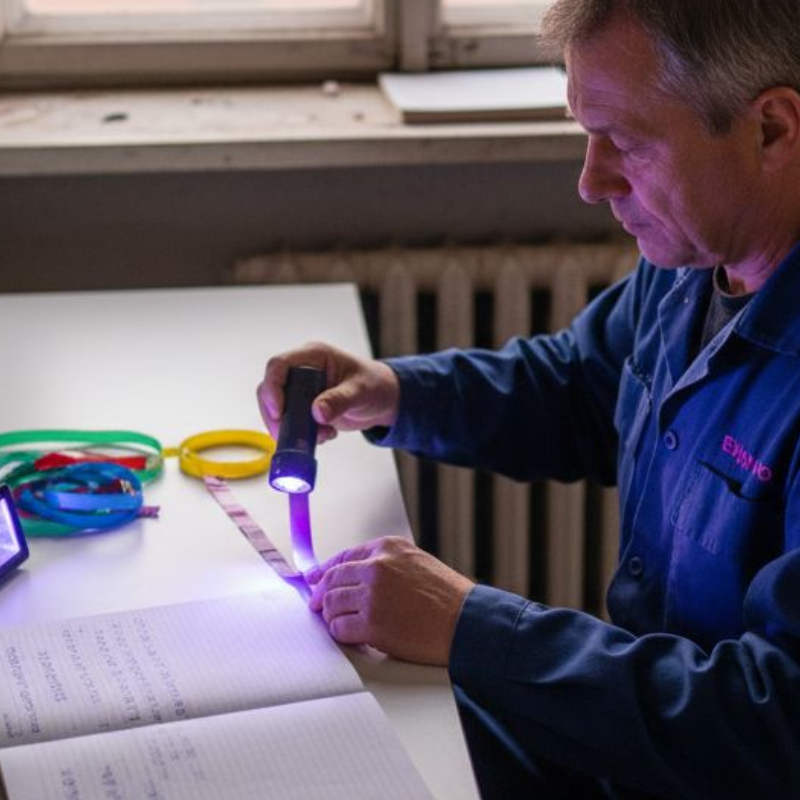
UV printing is a method of applying inks that react to ultraviolet light to create visible or invisible marks on wristbands. In a typical event-security use, UV-sensitive inks are printed onto the surface so that a pattern, logo or serial identifier becomes visible under a handheld UV torch or gate-mounted UV lamp. Because the marking is invisible or faint in normal lighting, it adds a discreet but highly effective security layer that is difficult to replicate using ordinary printers or pens.
The main benefits compared with standard visible printing are enhanced counterfeit resistance, the ability to incorporate hidden brand elements and the long-term durability of modern UV ink systems. UV inks formulated for wristbands are designed to resist water, sweat and abrasion for the duration of an event, so security features remain reliable through heavy use.
Pro tip: plan your UV security element as part of the overall access-control strategy. Match it with visible design cues, serial numbers or barcode systems to make spot checks fast and consistent.
UV printing technologies and types
There are several practical ways to apply UV inks to wristbands. The correct method depends on the material, print run size and the level of detail you need. The three most commonly used technologies are described below.
Screen printing is a traditional method that is very cost effective for medium and large runs. It delivers strong, opaque layers of ink and is excellent for simple UV security marks and logos. Once the screens are set up, the per-unit cost becomes competitive for festival and conference quantities.
Digital UV printing uses UV-curable inks and flatbed or roll-to-roll digital printers to print high-resolution artwork directly onto the wristband. It is ideal for small to medium batches and for designs that require fine detail or photographic elements. Digital UV prints are cured instantly under UV lamps which improves adhesion and reduces production time.
Pad or tampon printing is a specialist technique useful when printing onto curved or uneven surfaces. It can apply UV-sensitive inks accurately to small details, such as micro text or small icons, where other methods would struggle.
Each technology has its place: screen printing for high volumes and simple marks, digital UV for detailed bespoke runs and pad printing for awkward surfaces. The right choice balances cost, lead time and security needs.
How the UV printing process works
The process starts with artwork preparation. A UV security mark can be a logo, pattern, serial code or a combination. Artwork for invisible elements is designed in a separate layer and previewed under simulated UV conditions where possible.
Next, the chosen printing method is prepared. Screen printing uses screens and stencils, digital printers use prepared files for direct printing and pad printing uses engraved plates. UV-curable inks are applied and then exposed to UV light for instant curing. The result is a chemically hardened ink film that adheres strongly to wristband substrates such as Tyvek, plastic, vinyl or textiles.
Quality control is essential. Typical checks include verifying adhesion, confirming the UV response under the correct wavelength and intensity, and testing resistance to water and abrasion. Suppliers should perform batch tests and keep records so you have traceability for each production run.
Materials and ink considerations
Choosing the right substrate and ink chemistry is as important as the printing method. Common wristband materials include paper-based Tyvek, flexible PVC, polypropylene and woven or polyester textiles. UV inks must be formulated for the chosen material to ensure adhesion and flexibility.
There are two practical categories of UV security inks. The first category is fluorescent UV inks that glow brightly when illuminated with a UV torch. The second category is UV-reactive but visually invisible under normal light, revealing a subtle contrast only under UV. Both types can be tuned for brightness, longevity and wash resistance.
Suppliers should confirm that inks are safe for skin contact, that they comply with UK and EU chemical regulations and that any volatile components have been eliminated. If sustainability is a priority, ask about eco-friendly UV ink formulations and the recyclability of substrates.
Where UV-printed wristbands work best
UV-printed wristbands are widely used across many event types. They are especially valuable where access control must be quick and resistant to forgery. Typical applications include multi-day music festivals, stadium events, corporate hospitality, VIP areas, trade shows and private functions.
Festival organisers often deploy distinct UV patterns for different access tiers or campsite permissions. Sports events use them for personnel and team areas. Conferences and trade shows adopt UV elements to protect delegate badges from unauthorised copying. Private events benefit from discreet security for VIP and backstage access.
Combining UV marks with visible serial numbers, QR codes or RFID can create a layered security system that works well with gate scanners and manual spot checks. This hybrid approach increases deterrence and speeds up entry processes when staff know exactly what to look for.
Durability, security and cost comparison
Modern UV inks are engineered to be water resistant and abrasion resistant for the expected life of an event wristband. For a single-day event the UV mark will typically remain intact even with exposure to rain and sweat. For multi-day festivals or wristbands intended to survive several days, suppliers will select inks and lamination options that maintain visibility under UV inspection.
From a security point of view, UV printing is a cost effective layer that significantly raises the bar for counterfeiters. It is not the only defence but it is a strong deterrent when combined with other visible or machine-readable identifiers.
Cost depends on technology, volume and the complexity of artwork. Exact prices vary between suppliers and materials, so it is best to ask for quotes. As an example calculation to help planning: if the unit cost of a plain wristband is X and the additional printing overhead for a UV element is Y per band, your final unit price will be X plus Y. For illustration, if X were 25 pence and Y 10 pence then the total would be 35 pence per wristband. The precise cost will depend on your chosen material, run length and print method.
When comparing options, consider lead times, minimum order quantities and the cost of any verification tools such as handheld UV torches. Handheld torches are affordable and reusable; gate-mounted UV lamps have a higher up-front cost but speed up mass inspections at large access points.
Common mistakes when selecting UV printing for wristbands
There are several recurring pitfalls that event organisers should avoid when specifying UV-printed wristbands.
One common error is underestimating the ink-substrate compatibility. Some UV inks adhere poorly to certain soft-touch coatings or textured fabrics. Always request adhesion tests or samples on the exact substrate you plan to use.
Another mistake is insufficient verification planning. If staff are not trained to check the correct UV wavelength or pattern, the security feature loses effectiveness. Include a verification protocol and train gate staff to use the designated tools and to recognise genuine marks versus simple fluorescing materials.
Finally, some buyers focus only on price and neglect documentation. Ensure your supplier provides safety data sheets for inks, evidence of regulatory compliance and a clear quality control procedure for each batch.
Alternatives and integrations
UV printing is one tool in a wider access-security toolkit. Alternatives and complementary technologies include visible holograms, thermal printed serial numbers, barcodes and QR codes, RFID/NFC chips and tamper-evident closures. The best solution depends on your event size, site layout and budget.
For example, combining a UV mark with a short, human-readable code and a barcode provides both quick manual checks and automated scanner-based validation. If you require contactless gates or cashless payments, explore hybrid wristbands that integrate UV security with RFID tags. Those systems add hardware costs but can reduce queues and fraud in higher-budget events.
What to ask your UK supplier
When you contact a supplier, get answers to the following matters so you can compare offers confidently:
Request samples printed on the exact material you intend to use and validate them under a UV torch. Ask for details on ink certification and skin-safety data. Clarify turnaround times, minimum order quantities and whether batch traceability is recorded. Finally, check what verification equipment they can provide or recommend, and whether they supply artwork support services to prepare UV layers correctly.
Environmental and health considerations
Choose inks that are formulated without harmful volatile organic compounds and that come with safety data sheets confirming suitability for skin contact. If sustainability matters to you, ask suppliers about low-impact UV formulations and recyclable substrate options. Consider the whole life cycle of the wristband, including whether the material can be recycled locally after use.
Final thoughts
UV printing on wristbands delivers a powerful combination of durability, discreet security and creative flexibility. When deployed correctly, it strengthens your onsite verification process without compromising attendee comfort or visual branding. Select the printing method that suits the run size and complexity of your design, insist on material-ink compatibility tests and include verification tools and staff training in your event plan.
If you are organising an event in the UK, speak to a reputable local supplier and request samples and a clear specification sheet. They should be able to advise on the most suitable substrate, whether to use screen or digital UV printing and how to integrate UV marks with other security and access systems.
Ready to explore UV-printed wristbands? Ask for a sample pack and a short proof run to validate the look and performance under your venue conditions before you commit to a full production order.
Frequently asked questions
Is UV printing safe to wear? Modern UV inks intended for wristbands are formulated to be safe for skin contact. Always ask for safety data sheets and confirm compliance with UK chemical and consumer safety requirements.
Can UV marks be copied? UV marks significantly increase the difficulty of counterfeiting compared with plain visible prints. However, like any single measure they are most effective when used as part of a layered security strategy.
How long do UV marks last on wristbands? With the correct ink and substrate, UV marks will remain reliable for the intended lifespan of the band, from a few hours to multiple days. For extended multi-day use discuss ink grade and possible laminate protection with your supplier.
What tools do I need to check UV prints? Handheld UV torches are the most common tool for spot checks. For high-throughput gates, consider fixed UV lamp arrays that reveal marks as attendees pass through.