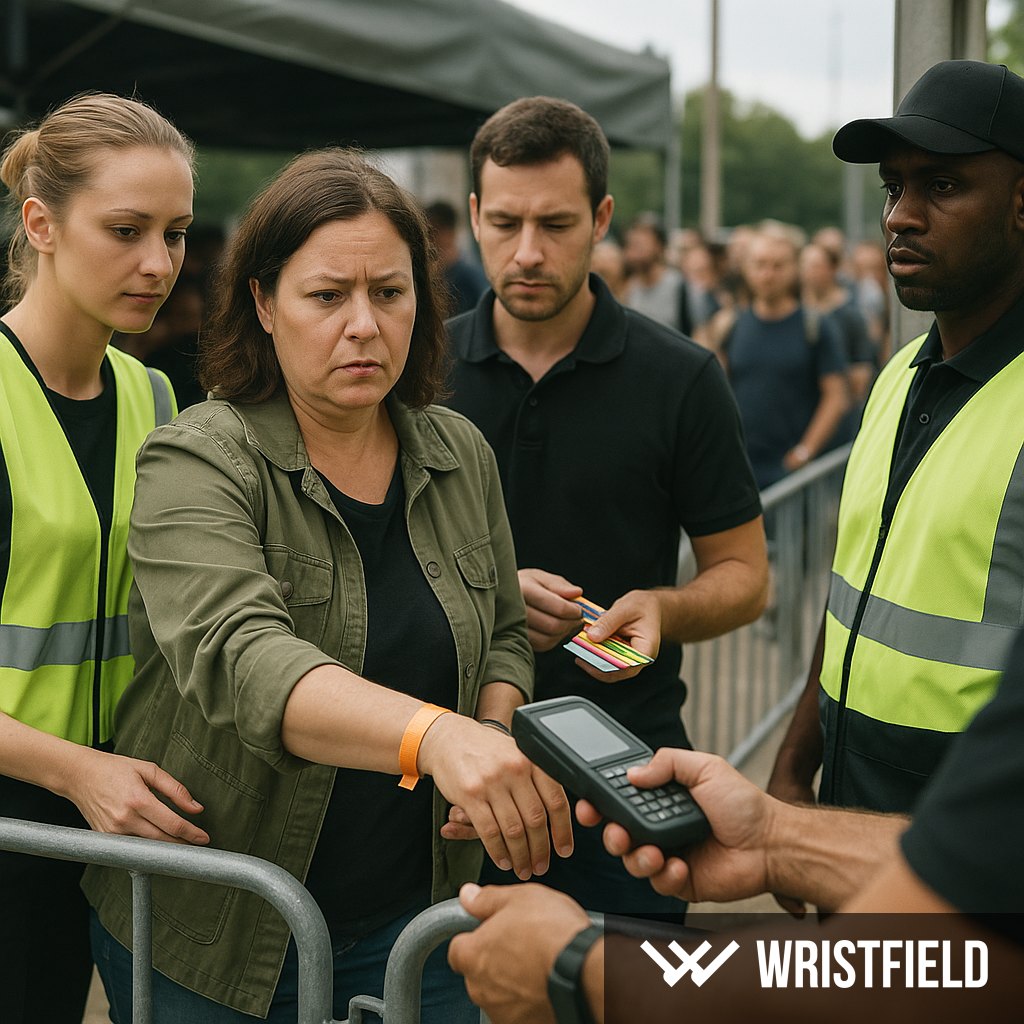
Admission is the guest's first physical experience of your event. Poorly planned entry creates long queues, security and legal risk, and unhappy attendees. This guide walks through the recurring operational mistakes organisers make at entry, why they happen, and practical fixes you can implement straight away to reduce risk and improve throughput.
Why admission matters
Entry is both an operational task and a brand moment. The same decision you make about a wristband, a gate layout or a contingency stock impacts queue times, fraud risk and guest experience. Most admission problems are predictable and repeatable: late orders, incorrect quantities, the wrong wristband type, missing spares, untested access-right structures and weak gate communication. Addressing those areas removes friction and reduces the likelihood of escalation on the day.
1. Late orders and the consequences
Ordering wristbands, locks, readers or bespoke elements too late forces expensive workarounds. Express production may be available, but it often costs more and can limit quality or security options such as UV varnish. For example, a 3,000-person concert that planned to use Tyvek wristbands with an invisible UV varnish marking may lose the UV finish if the order is rushed within two weeks of the event. That reduces anti-counterfeit defences and alters the cost-risk balance. Read a worked example in our 3,000-person concert cost model for more context: 3000-person concert cost model.
Quick fixes and policy: set hard order cut-offs by event type. Typical windows we use are 21 days for small festivals, 35 days for large festivals, and a defined express surcharge line in the budget for any late production requests. Where possible agree with suppliers a partial delivery option: plain base wristbands first, personalised or varnished elements later.
2. Ordering the wrong quantity and failing to keep spares
Under-ordering is rarely a one-off mistake. It stems from under-estimating flow, ignoring arrival patterns, or failing to account for damage and staff needs. A typical scenario: ordering exactly the ticketed numbers, then finding a percentage of wristbands are damaged on arrival and having no spares at the gate. That forces ad-hoc paper tickets or makeshift fixes that invite fraud.
Practical calculation: if you expect 1,000 attendees and know 80 percent arrive in the first two hours, build a cushion. A sensible baseline is 10 percent spare for robust materials, 15 percent for moderate supplier risk, and 25 percent if your supplier lead time is tight or shipping risk is high. Our capacity example for a 3,000-person event shows how to scale spares when lead times and supplier risk rise: 3,000-person concert cost model.
3. Choosing the wrong wristband type
Wristband material and closure type are functional choices. Tyvek suits short indoor events and mass admission where low cost and fast production matter. Vinyl is best for water-front or multi-day events requiring durability. Textile bands deliver premium feel for VIPs and pass repeated handling. Match the type to duration, environment and fraud-risk.
Security features should influence material choice. If you need higher anti-counterfeit protection, combine the base material with serialisation and an invisible UV varnish marking visible under UV light. Note: UV varnish is an invisible varnish that appears under a UV light. It is not the same as UV printing. For the operational benefits and limitations of UV varnish see our practical guide: UV varnish for wristbands.
4. Missing spare parts and essential tools
A wristband without the necessary fastener is worthless. Typical omissions include spare security locks, adhesive rollers, replacement readers and repair tape. Running out of attachment parts forces manual workarounds that slow entry and increase fraud risk.
Checklist suggestions: for a 1,000-person event hold at least 5 percent spare fasteners, 10 adhesive rollers, two spare USB readers if you use electronic checking, and a basic repair kit for torn wristbands. Tailor these values to the event style and venue. For seafront events follow the additional recommendations in our beach and waterfront entry guide: Beach and waterfront event access control.
5. Not testing access-right structures in real conditions
Permissions that exist only on paper are a hazard. If a VIP wristband is meant to restrict access but the configuration has not been proved on-site, you risk free movement into restricted zones. Test every role, every wristband type and every gate at least once under realistic lighting and crowd conditions.
Practical test: run a live dress rehearsal with the entry team performing realistic tasks. Check UV-marked wristbands under actual UV lights, and validate serial numbers where used. Numbered wristbands help accountability and post-event auditing — learn how they operate here: How numbered wristbands work.
6. Poor gate-level communication
When stewards and technicians have different instructions the result is delay and frustration. A common issue is gate staff knowing exceptions but the technical team not implementing those exceptions in the reader rules. That creates conflict at the gate and slows throughput.
Solution: produce concise gate scripts and escalation cards. Each should state the gate identifier, primary contact, quick exception rules and the emergency contact. Run a 20-minute live run-through the day before; a short rehearsal reliably surfaces ambiguous cases.
7. Miscalculating capacity and staffing
Throughput is the admission process metric that saves you money. Use a simple capacity formula: required number of gate positions = peak arrivals per minute divided by a single gate's per-minute capacity. Remember to build in redundancy.
Example: if 900 attendees arrive in an hour, that is 15 per minute peak. If a scanning gate handles 30 people per minute, one gate can meet the peak load. However never rely on a single point of failure. Aim for at least double the expected peak capacity or an agreed backup gate. If wristband application is handled manually, account for the slower rate and staff accordingly. Our guide on cutting entry times provides practical optimisation techniques: How to cut entry times by 30 percent.
8. Weak anti-counterfeit measures
Choosing a wristband solely by appearance is a risk. A layered approach is the most effective: choose the right base material, add serialisation, and where appropriate use invisible UV varnish. A visible design alone will not deter determined fraud.
Case note: a festival used visually distinctive VIP bands but no serial numbers or UV marks; the capricious result was multiple forgeries at entry. Introducing serialised bands with UV varnish on subsequent events materially reduced fraudulent entries. See our guidance on preventing wristband counterfeiting for the practical combinations of measures: Preventing wristband counterfeiting.
9. Test scenarios and a fault-resolution protocol
Good admission systems are rehearsed. Tests should be realistic: VIP access checks, 15-minute surge tests, fake damaged bands and back-office reconciliation. Record timings, error types and repair times to build a log for continuous improvement.
Set simple service-level objectives: begin technical repair within 10 minutes of reporting; resolve a gate-affecting fault within 30 minutes; if not resolved, open the contingency gate. Adjust these targets to venue size and risk profile.
10. Communication templates for gates and back office
Mismatch between verbal and written instructions causes errors. Provide standardised templates the gate team can follow: gate ID, primary steward, alternative admission method (e.g. QR scan), and escalation numbers. Print and laminate them for quick access at every gate and share them digitally in advance.
11. A pragmatic cost-decision framework
Price will vary by supplier, so avoid hard unit-costs in planning. Instead, compare options by lead time, durability and fraud-resistance. A three-option conditional approach is useful: Tyvek for short, high-volume events; vinyl for wet or multi-day events; textile for VIP and premium experiences combined with serial numbers and UV varnish where the fraud risk is material.
When production time is a constraint, explore split deliveries: core wristbands first, branded or varnished elements later. This adds logistic steps but can be cheaper than full express production.
12. Use admission as a branding opportunity — carefully
Admission is also an opportunity to strengthen your brand. Colourful textile bands or a discreet UV-branded VIP marker can improve guest perception. Always balance aesthetic decisions against operational risk: premium designs that compromise security or extend lead times may not be worth the trade-off.
13. Quick fixes for typical problems
Problem: production delayed. Fast response: activate regional backup supplier and issue temporary paper or laminated tickets for pre-registered guests until wristbands arrive.
Problem: a gate is slow. Fast response: open a spare gate, create a fast-track lane with pre-applied wristbands or redistribute staffing from lower-pressure points.
Problem: VIP wristbands not recognised. Fast response: create a single staffed VIP gate and process affected guests manually while you correct the software or reader settings.
14. Example capacity and security buffer — worked illustration
Consider a 3,000-person indoor festival where 60 percent arrive in the first two hours (1,800 arrivals). That equals 900 per hour or 15 per minute peak. If scanning gates manage 30 people per minute, one properly functioning scanning gate can meet peak demand, but redundancy is mandatory. Aim for at least two scanning gates or one scanning and two mixed gates during the peak window. For wristbands, if supplier lead time is 7 days and supplier risk is medium, a 15 percent security buffer is sensible. For a 3,000-person event that means ordering 3,450 wristbands; if risk is higher, order 3,750.
More on this example and modelling is available in the 3,000-person concert cost model: 3,000-person concert cost model.
15. Decision logic for selecting wristband type
Evaluate in this order: event duration, environmental exposure and fraud-risk. Short events: Tyvek. Multi-day or wet events: vinyl or textile. High anti-counterfeit need: serialisation plus UV varnish. If guest experience is critical, favour textile bands and offset the extra cost against increased sponsor or ticket revenue. For an extended decision tree and practical examples see our comparison materials, including Tyvek versus vinyl: Tyvek vs vinyl comparison.
16. Late order recovery — an operational playbook
If you are in a last-minute situation, follow three steps: 1) Activate the regional backup supplier for basic bands; 2) move pre-registered customers to a digital QR workflow and print temporary tickets at the gate; 3) request split delivery from the primary supplier for brand elements. Have a supplier clause in your contracts allowing emergency partial shipments.
17. A three-tier operating model for gates and escalation
Define three operational states: normal, increased load and critical failure. Normal is planned staffing and gates; increased load activates spare gates and fast-track lanes; critical failure invokes manual checks, a consolidated control gate and parallel replacement logistics. Communicate clear triggers for each state to every gate lead and the back office.
18. Closing practical recommendations
Do not rely on ad-hoc solutions. Lock in alternative regional suppliers, agree partial shipment options, and automate reminders for order cut-off dates. Plan at least a 15 percent safety stock for ordinary risk events and 25 percent where supplier or shipping risk is high. Always distinguish between UV varnish and UV printing: varnish is invisible except under UV light and requires extra production time. If you want a step-by-step template for a specific event, or to align your entry plan to a risk-tier model, see our event security risk tiers guide: Event security risk tiers.
Post-event reconciliation and forensic checks
Once the last attendee has left, the admission process is not finished. Reconciliation identifies revenue leakage, operational weaknesses and supplier shortfalls. Start by matching scanned ticket data against turnstile counts, steward logs and point-of-sale records. Focus on three key variances: total attendance versus ticket scans, number of manual admissions versus automated scans, and quantity of wristbands issued versus stock taken back. Even small mismatches can indicate systematic faults such as faulty scanners, duplicated QR codes or overstretched gates.
Forensic checks should be proportionate. Sample-check gate timestamps for irregular clusters that suggest batch-scanning failures. Compare the pattern of admissions to expected arrival curves; an unexpected flattening or spike typically signals a process issue that affected throughput or allowed unauthorised entries. Document every discrepancy and assign an owner to close the loop with suppliers or tech teams within 72 hours.
Data handling, retention and attendee privacy
Admissions increasingly rely on personal data, so compliance is not optional. Align data capture with the minimum necessary principle: collect only what you need for entry, safety and contact tracing where required. Publish a short, plain-language privacy notice at point of sale and on-site admission points. Make retention periods explicit; for example, retain gate logs for 90 days for routine audit and extend only where a security incident or legal obligation exists.
Operationally, ensure encrypted storage for scanned tickets, restrict access to named roles and log all exports. If you employ third-party scanning apps or cloud services, contractually require EU or UK data residency where possible and insist on breach notification within 24 hours. Simple measures such as anonymising logs used for performance review reduce legal risk and improve stakeholder confidence.
Steward training that sticks
Well-trained staff defuse problems before they escalate. Move beyond powerpoint briefings and use scenario-based rehearsals. Create short practical modules that cover: recognising counterfeit bands, handling upset customers, priority lane protocols and manual admission fallback. Role-play is particularly effective; simulate a busy 15-minute peak and ask stewards to rotate roles so everyone understands the gate ecosystem.
Keep guidance concise and task-focused. A single laminated aide-memoire per post that lists the three most likely faults and the immediate action for each reduces hesitation. Include a process for rapid manager escalation and ensure every steward knows the physical location of backup supplies and how to contact logistics by radio or app.
Technology testing and contingency rehearsals
Do not wait until the day to test equipment. Conduct staged dry runs in the actual venue if possible. Validate network coverage at each gate, measure scanner battery life under continuous use and verify that the CMS or access platform can handle peak concurrency. Run failover tests that simulate cloud outages, local network interruption and barcode spoofing attempts.
Maintain a simple test script and an outcomes log. For each tech component record expected versus actual results and remedial actions. A 60-minute test window is often sufficient if it follows a clear script. Where possible, shadow live sales with a controlled sample to validate end-to-end ticket-to-admission flow without compromising guests.
Accessibility and inclusivity at entry
Admissions are a first impression of your event. Ensure routes and processes are accessible to people with mobility, sensory or cognitive impairments. Provide a clearly signed accessible lane staffed by trained personnel, offer pre-arranged alternative admission methods for those with hearing or visual difficulties and make policy on assistance animals transparent.
Consider seating or a sheltered waiting area at entrance points for those who need it. Accessibility is also an operations risk mitigator: when people feel seen and assisted, gates flow more predictably and complaints drop.
Sustainability and end-of-life logistics
Wristbands and tickets generate waste. Factor disposal into procurement decisions. Choose biodegradable wristband materials where security needs allow, and avoid mixed-material items that are hard to recycle. Arrange collection points with clear signage and coordinate with venue waste management to ensure recyclable components are redirected appropriately.
Discuss return and recycling percentages with suppliers as part of the contracting conversation. A small, managed return incentive for VIP or reusable bands can materially reduce landfill and support CSR reporting.
Contract clauses and supplier accountability
Supplier agreements should be operationally specific. Include guaranteed lead times, defined partial shipment options, acceptance criteria for bands, and remedies for late or defective deliveries. Where design secrecy matters, add a limited design escrow or watermark clause that enables emergency reprints by a backup supplier while protecting intellectual property.
Payment milestones tied to delivery stages and inspection windows reduce commercial friction. For high-risk events, include an optional onsite acceptance test on delivery day with a short rectification window and a predefined credit for unresolved defects.
After-action review and continuous improvement
Close the loop within two weeks of the event. Convene gate leads, ticketing, security and suppliers for a structured debrief. Use a format that captures what worked, what did not, the root cause for each failure and a single owner with a completion date for every action. Turn repeated issues into permanent process changes rather than one-off fixes.
Maintain a short, searchable knowledge base of lessons learned that future teams can consult during planning. Over time this repository becomes one of the most cost-effective risk mitigators you have: fewer surprises, faster responses and consistently smoother admissions.