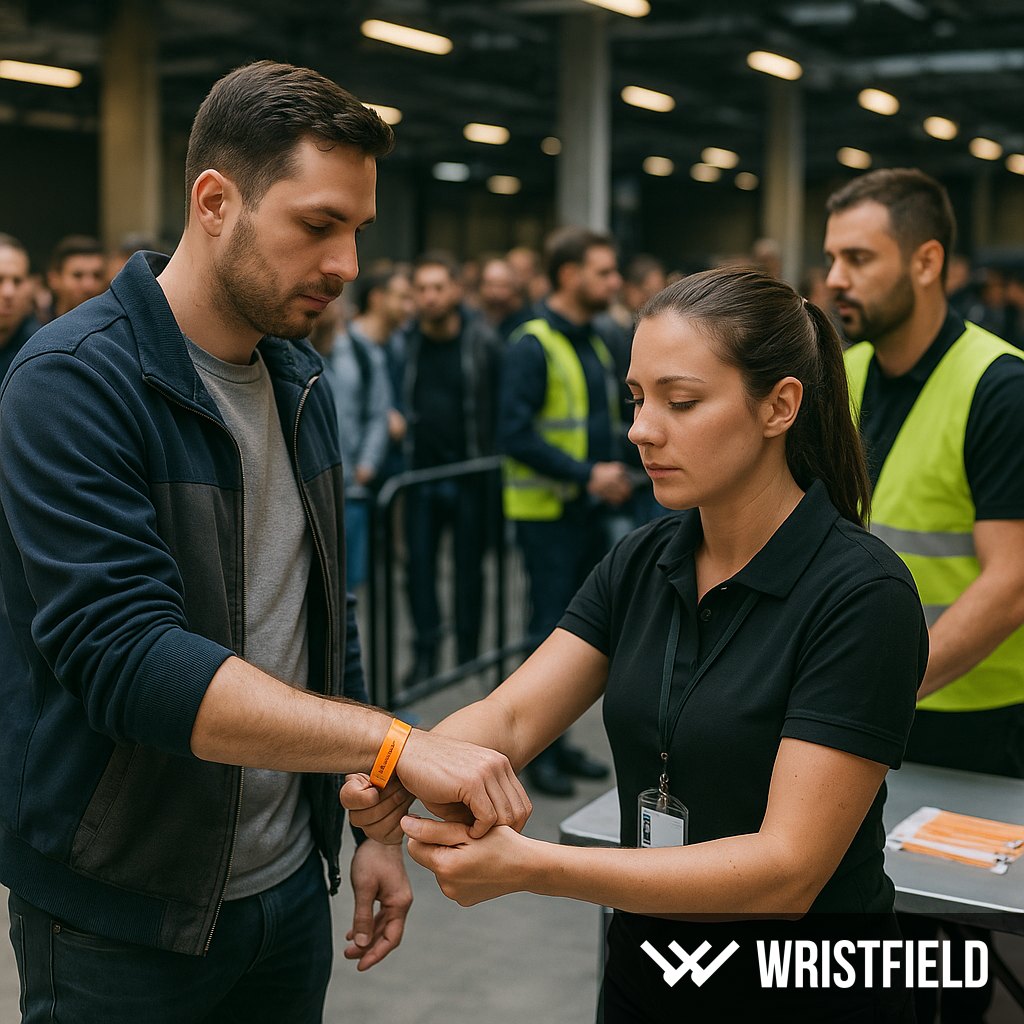
Event security risk tiers: entry control, access rights and anti-counterfeit practices
Organisers often treat wristbands as a commodity. The better approach is to place them inside a decision and risk system. The question is not simply which band costs least. It is which combination of material, marking and operational control reduces the risk of unauthorised access, fraud and reputational damage to an acceptable level given the event format, venue and services on offer.
What we mean by risk tiers
For entry and access control I use three practical tiers: low, medium and high risk. Each tier reflects the likelihood and the consequence of unauthorised entry or misuse. The tier is determined by factors such as whether admission is paid, the value of VIP or backstage access, the density and behaviour of the audience, and the venue layout. Different tiers require different wristband types, marking methods and operating protocols.
Low risk events: simple controls with clear processes
Typical examples: closed corporate gatherings, invitation-only seminars and community events where consequences of a single unauthorised entry are small. Recommended approach: a plain Tyvek wristband with sequential numbering provides traceability at minimal cost. Adding a UV varnish mark increases on-site verification speed without major expense because UV checks are quick to perform at the gate.
If your attendee list is short and arrival windows spread out, you can keep staffing lean. Still, train gate staff on how to check the band seal and the number against a registration list. Good protocols remove most low-level risk.
Medium risk events: durability and visible security
Examples: ticketed concerts of a few thousand people, paid cultural events and conferences open to the public. Motivation for abuse is larger here, so choose a more durable band such as vinyl or a medical-grade wide face vinyl. Combine unique printing and sequential numbering, and include a UV varnish mark for rapid spot checks after hours.
Operationally, adopt a two-stage entry routine. A fast visual check and band application at the outer gate, and a secondary verification inside for controlled zones. The combination of material durability and covert marking reduces both clumsy copying attempts and casual transfer of bands between people.
High risk events: layered control and hard-to-copy identifiers
High risk covers large multi-day festivals, events with valuable VIP and backstage access, and venues where service spend per head is significant. Here the operating model must be layered. Use textile bands for comfort and tamper-resistance, permanent sequential numbering and an invisible UV varnish pattern that is checked regularly in controlled zones. Restrict VIP and backstage access with dedicated checkpoints and a name or accreditation check linked to the band serial number.
Layering means the first line of entry focuses on throughput while inner lines provide stronger verification. Frequent spot audits and supervisors in zones make fraud economically unattractive.
Where abuses happen and how to disrupt them
Common abuse scenarios include: transfer of a reusable or weakly secured band, production of convincing counterfeit bands, collusion by gate staff, and multi-day re-use or swapping at festivals. The right countermeasures depend on the scenario. A one-off, low-cost Tyvek band with a secure closure defeats simple transfer attempts. A vinyl band with unique print and serial number raises the cost and skill threshold for a counterfeit. Textile bands with personalised printing and UV varnish produce the most friction for counterfeiters.
Crucially, countermeasures only work if combined with disciplined procedures. Staff must be trained to refuse reapplication of damaged seals, to check serial numbers against lists when appropriate and to escalate any suspicious behaviour to supervisors.
What UV varnish does and what it does not
In this context UV varnish refers to a discrete lacquer applied over printed artwork that fluoresces under a UV lamp. It is a covert authentication layer. It is not UV printing. UV varnish is fast to check, subtle to the audience and straightforward to add to production. We discuss practical uses and cost-risk modelling for UV varnish in detail in our specialist guide UV varnish for wristbands: a practical guide for entry control, VIP access and cost-risk modelling.
Selecting material: Tyvek, vinyl and medical bands
Tyvek is the economical baseline for single-day or low risk events. Vinyl offers better durability and weather resistance. Medical wide face vinyl is a practical vinyl example when you need a broader print area and a robust band for crowded environments. Textile bands are the premium option for multi-day festivals and VIP programmes because they remain comfortable, are hard to cut and relatively hard to counterfeit.
Where we can provide numbers from our product data, I will use them so organisers can see the trade-offs. For a medium-large one-day event of 5 000 tickets and a 5 percent production reserve you would order 5 250 bands. Using our catalogue prices in GBP for these representative SKUs the gross cost at that quantity looks like this.
| Product |
SKU |
Unit price gross (GBP) |
Total for 5 250 units (GBP) |
| Tyvek 1" plain (TOP Quality) |
T1 |
0.024 |
126.00 |
| Tyvek 1" full-colour printed |
T1FC |
0.108 |
567.00 |
| Tyvek 1" full-colour printed - EXPRESS |
T1FC-EXP |
0.132 |
693.00 |
| Medical Vinyl Wide Face wristband - Adult |
MEDVWFADULT |
0.1704 |
894.60 |
These calculations use the current product pricing in our database for the specified SKUs at the 5 250 unit quantity. They demonstrate why a plain Tyvek run is inexpensive, and why upgraded printing, vinyl or express lead times materially increase the budget. Textile bands are not priced in this table because rates depend on specifications and require a quote.
Throughput, staffing and simple capacity models
A brief arithmetic check will reduce planning errors. Suppose 3 000 attendees arrive in a two hour window. That requires an average throughput of 25 people per minute. A single gate where one person applies a band and completes a visual check typically processes 15 to 25 people per minute. For planning, assume 20 per minute capacity per staffed gate. Two simultaneous gates therefore provide 40 per minute and comfortably meet the 25 per minute need with a margin for interruptions.
We expand this analysis and cost modelling for a 3 000-person concert in our worked model. It covers gate layout, wristband choice, UV varnish sampling and staff planning. See the detailed worked example here 3000-person concert cost model: wristbands, entry design and staffing.
Sampling, audits and gate protocols
Spot checks and audits turn covert markings into operational deterrents. For example, sample 20 percent of arriving attendees for a UV check at the outer gate, and 100 percent at VIP checkpoints. A named VIP list cross-referenced with a band serial number makes illicit sharing difficult because the fraudster would require collusion and multiple tolerances to succeed.
Assign a daily audit lead for larger events to record anomalies and initiate corrective action. Simple metrics to capture include count of failed checks, count of damaged bands replaced and number of serial number mismatches. These figures tell you whether controls are working or require tightening.
Preventing counterfeits: recommended combinations
No single tactic eliminates counterfeits. The effective pattern is to combine elements that are independent and costly to replicate. A suggested mix for medium risk events: a robust material such as medical vinyl or heavy vinyl, unique printed artwork, sequential serialisation and a UV varnish covert mark. For high risk, substitute textile bands with personalisation and increase the frequency of spot checks inside restricted zones. Our practical guide on counterfeiting gives step-by-step measures and cost implications Preventing Wristband Counterfeiting: UV, Serialisation and Security Measures.
VIP and backstage: a multi-layered protocol
VIP access combines high consequence and high value. Treat it as a separate operational lane. Use personalised textile bands or numbered vinyl with a unique UV varnish and keep a live register that links name, serial number and accreditation level. Create one dedicated VIP gate with staff authorised to check both the band and a supporting ID. For more on VIP resourcing and zone management see Managing VIP Zones at Events: Access, Costs and Admission Control.
Production and lead times: express runs and risks
Special markings and full-colour prints increase setup time. Express production is available for many Tyvek options but at a premium. If your event is close to the date and you need bespoke artwork and UV varnish, validate samples early and allow the manufacturer time to test UV visibility under the lamps you will use on site. Our guide When Is Express Wristband Production Worth It? explains the trade-offs between cost, lead time and risk.
Operational mistakes to avoid
Common errors include ordering bands at the last minute without approving UV samples, under-training gate staff, and centralising all verification at a single point which creates a bottleneck. Also avoid assuming that a single visible feature deters fraud. Effective practice is to insist on good documentation, early sample approval and clear staff responsibilities for every gate and zone.
How to proceed for a quote or risk review
If you need a product-based cost model or a short operational risk review, provide the planned attendee numbers, the arrival window, the proportion of VIP or backstage passes, preferred band types and the required lead time. With those inputs we will use the product database to produce accurate unit pricing, lead times and a staffing plan. For a worked example set and a fuller cost breakdown for 1 000 and 3 000 person events see our worked models: Full Entry Cost Breakdown for a 1 000-Person Event and 3000-person concert cost model.
Summary checklist for the organiser
- Assign a risk tier for the event and align band material and marking to that tier.
- Decide on sampling rates for UV checks and serial number spot audits.
- Obtain production samples for any UV varnish and approve them under the same UV lamps you will use on site.
- Model arrival curves, set gate capacity and staff accordingly.
- Record and review daily audit data during the event.
For deeper reading and worked examples on UV varnish application and serialisation integration, consult our UV varnish guide and the numbered wristbands primer.
If you want a short risk calibration for your next event, send the expected attendee number, VIP breakdown, arrival window and preferred band type and we will respond with a product-backed recommendation and a staffing sketch.
Practical decision logic: a worked example for a 1 200-person event
Imagine a mid-size corporate conference with 1 200 attendees, 10 percent allocated as VIP or backstage access, and a 90 minute arrival window. Organisational choices here hinge on throughput, risk tolerance and lead time for production.
Start with arrival modelling. A 90 minute window for 1 200 people requires an average throughput of 13.3 people per minute. If a staffed gate where an operator applies a wristband and performs a quick visual check processes 20 people per minute under normal conditions, introducing UV spot checks changes the calculus. Use simple time accounting rather than gut-feel: assume a basic apply+visual interaction averages 3 seconds per person (20/min). A UV check adds c. 8 seconds for positioning the lamp and inspecting the mark, giving 11 seconds for that inspection (about 5.5/min for those checked).
If you plan a 20 percent UV sample rate at the outer gate, the weighted average processing time per attendee becomes 3 seconds + 0.2 * 8 seconds = 4.6 seconds. That converts to a practical throughput of 60 / 4.6 = 13.0 people per minute per staffed gate. The required arrival rate of 13.3/min therefore exceeds capacity of a single gate under the sampling regime. The operational conclusion: run two staffed gates to preserve a margin for interruptions, or keep one gate but reduce sampling to below 15 percent and accept increased residual risk.
Selecting band type by risk tier and cost impact
Apply a straightforward rule set. For low risk (less than 500 attendees, minimal valuables on site), Tyvek is the cost-effective option. For medium risk events like this conference, vinyl or heavy vinyl with sequential serialisation reduces casual fraud and supports audits. If VIP or backstage areas account for more than 10 percent of attendees, upgrade those credential bands to personalised textile or numbered vinyl and apply a covert UV varnish as the secondary control.
Crucially, when specifying UV measures, instruct suppliers and procurement teams that UV varnish is a UV-visible lacquer applied over print, not a UV printer process. Ask for production samples tested under the same UV lamp model you will use on site; differences in lamp wavelength and power materially alter visibility. For a technical primer on this distinction and practical testing steps, see our guide: UV varnish for wristbands: a practical guide for entry control, VIP access and cost-risk modelling.
Staffing and spare stock: reducing single points of failure
Operational mistakes commonly create avoidable bottlenecks. One frequent error is centralising all verification at a single checkpoint. Centralisation concentrates expertise but it also creates a single point of failure and long queues. Distribute verification: empower each gate to perform basic UV spot checks and serial number cross-references. Assign a roaming audit officer to escalate discrepancies and to perform higher-frequency checks at VIP lanes.
Plan spare stock proportional to band type and anticipated failure rate. For disposable Tyvek plan 2 percent spare. For heavier vinyl assume 3 percent. For personalised textile allow 5 percent spare to account for resizing, damage and last-minute replacements. Keep a sealed, labelled kit at each gate that includes replacements, a UV torch, a serial number log and a simple escalation form. That kit reduces downtime and keeps the audit trail intact when bands are swapped.
A simple operating model for gate teams
Define explicit roles rather than relying on assumed responsibilities. Each gate team should include:
a gate operator who applies the band and performs the visual check; a verifier who conducts random UV and serial checks at the sampled rate; and a floater who manages exceptions and liaises with the roaming audit officer. On larger events combine these roles where headcount is constrained but retain the concept of separation of duties: one person applies the band, another confirms identity or UV mark in cases of dispute. This reduces collusion risk and maintains throughput.
Decision trade-offs and a quick checklist for the budget holder
Budget decisions are trade-offs between unit cost, staff hours and residual fraud risk. A higher unit cost for personalised textile bands buys administrative clarity and easier VIP control but increases procurement lead time and unit expenditure. A modest spend on UV varnish and serialisation combined with disciplined sampling often achieves a superior risk reduction per pound spent for medium risk events. If lead time is short, consult the express production guidance before committing to bespoke artwork; express runs can remove schedule risk but at a marked price premium. For help assessing when express production is appropriate see: When Is Express Wristband Production Worth It?
As a practical test before full procurement, run a micro-pilot: produce 100 units of the chosen band type with UV varnish, test under your lamp, stage a mock gate with three staff and a 30 minute arrival curve. Capture throughput numbers and replacement events. That pilot will surface ergonomics problems, lamp visibility issues and unexpected supply constraints without exposing the full event to risk.
For worked costing templates and a larger example that walks through gate layout and staffing for a 3 000-person concert see our detailed cost model: 3000-person concert cost model: wristbands, entry design and staffing. For the audit benefits of sequential numbering at scale consult: How Numbered Wristbands Work at Events: Practical Guide for Organisers.
Operational planning that uses simple arithmetic, clear roles and early sample testing prevents most surprises. The work is predominantly about removing single points of failure and ensuring that detection measures like UV varnish are both testable and integrated into gate routines rather than treated as an afterthought.