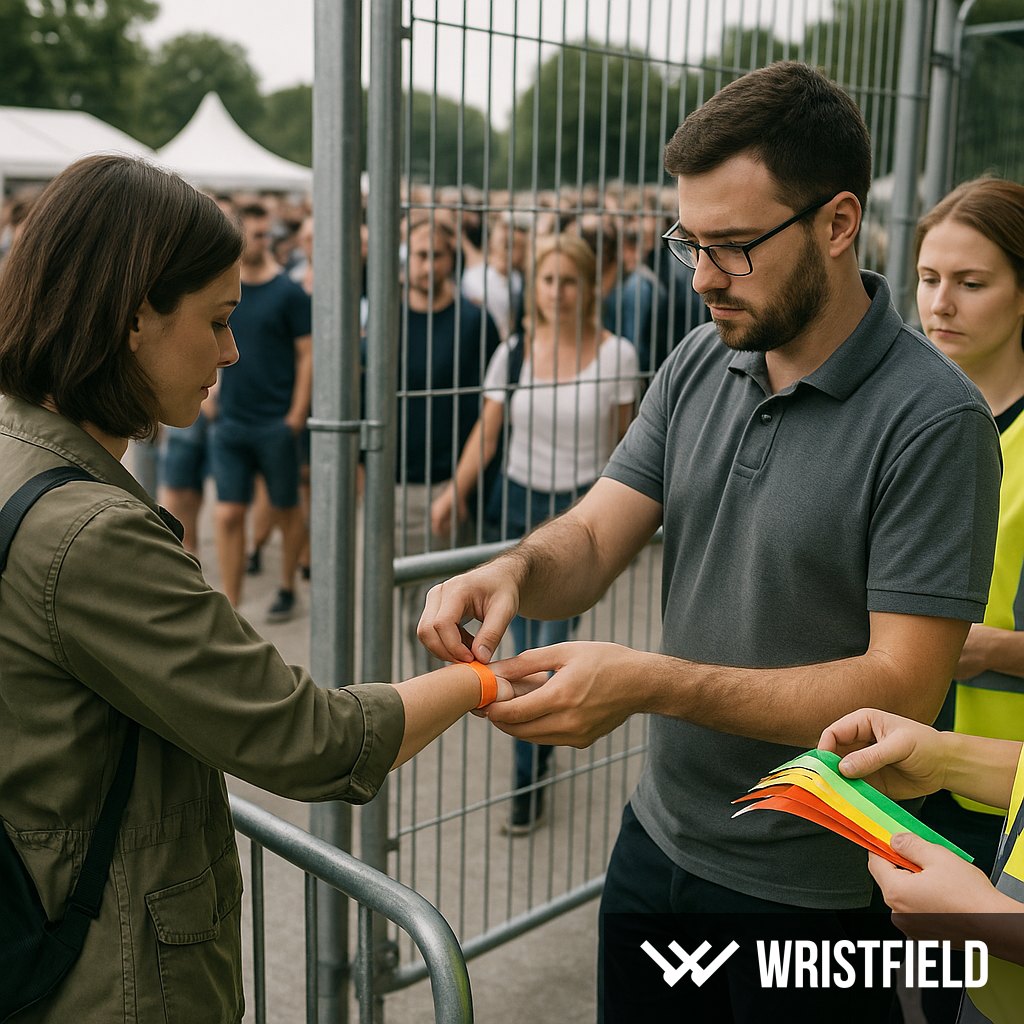
Optimising entry for one-day events
Organising entry for a single-day event means making several interdependent decisions quickly. You must set wristband quantities and types, verify manufacturing lead times, calculate gate throughput, and decide on security features such as serialisation and UV varnish. All of these choices influence queues, staffing, fraud risk and total cost. Below is a compact but comprehensive decision framework you can use in the run-up to an event.
Essential inputs: a quick decision matrix
Before you place an order, gather these core facts. They let you apply a simple decision matrix rather than guessing under pressure:
- Estimated attendees by gate at opening and total for the day, and expected no-show rate.
- Entry window length - how many hours/minutes you have to admit everyone.
- Number of gates that will be operational and available staff per gate.
- Preferred wristband material: disposable Tyvek, vinyl, or fabric bands with locks.
- Security needs: is serialisation, unique barcodes, or UV varnish required?
- Procurement lead time available and your contingency budget.
Simple rule of thumb: if the time from order to event is shorter than the supplier’s standard lead time plus your safety margin, you must seriously consider express production, even at a premium. For guidance on when express production makes sense, see our special note at When Is Express Wristband Production Worth It?
1. Quantity planning and buffer sizing
Decide quantity with two aims: handle actual footfall and mitigate operational risk. For one-day events a conservative buffer of 5-15% over your best estimate is common. Use lower buffers where admission is tightly pre-sold and higher buffers when you expect on-site sales, accreditation changes, or multiple access types (for example general, early-access and VIP).
Example approach: you expect 1,000 attendees and assume a 95% turn-up plus 5% on-site ticket sales. Order 1,050 units as a minimum and distribute buffer by access type. If you have two or three categories, pre-assign proportions of the buffer to avoid running out of one band type while overstocking another.
2. Production lead times and deciding on express
Lead time depends on material, print complexity, and security features. Tyvek bands with a single colour generally have the shortest turnaround. Adding serial numbers, barcodes, or UV varnish extends production time. If you are within your supplier’s standard lead window, normal production is usually cheaper and lower risk. If not, you must calculate whether the express surcharge is lower than the cost of entry disruption.
Decision logic: order express if the express premium is smaller than the estimated loss from delayed or congested entry. That loss includes lost sales, extra staffing, reputational damage and any refunds or compensation you may have to offer.
3. Gate throughput - how to calculate and what matters
Throughput is expressed as attendees admitted per minute per gate. It is driven by:
- Wristband application method and speed - some bands take longer to secure.
- Verification steps - ticket scanning, ID checks, or serial number matching slow processing.
- Staff training and ergonomics - a practiced operator is much faster.
- Peak arrival patterns - many guests arrive within a short period after gate opening.
| Gate type / process |
Admissions per minute |
Notes |
| Simple Tyvek band, quick apply |
15 - 25 |
Good for experienced staff |
| Serial number verification or barcode scan |
8 - 15 |
Paper/digital checks add time |
| VIP verification with additional checks |
6 - 12 |
More time per guest for validation |
When you plan gates, model the peak period. For many single-day events 40-50% of attendees arrive in the first hour. Make sure your gate capacity at peak matches the required throughput; otherwise long queues and complaints will follow.
How to size gates and staff quickly
Use this formula: Required throughput per gate per minute = Total attendees / (Entry window in minutes x Number of gates). Then compare with realistic operator throughput from the table above to estimate operators per gate.
4. Colour-coding, access levels and simplicity
Colour-coding is the fastest visual method to separate access levels. For one-day events stick to two or three colours: general admission, VIP/early access and staff/backstage. More colours add cognitive load for staff and risk of mistakes. If you need more granularity, combine a colour with a small printed icon or short text label.
Consider material when choosing colours. Tyvek prints very visibly for short use. If you need durability, vinyl or fabric bands are better, especially if you plan to add UV varnish or printed serial numbers.
5. Serial numbers as an accountability measure
Serial numbers serve two functions: they hinder casual counterfeiting and give you traceability for on-site sales and ticket reconciliation. Apply serialisation if you expect on-site transactions, high-value areas or any reason to reconcile issued bands post-event.
If you operate purely pre-sold tickets with reliable digital checks and no on-site sales, you may be able to omit serialisation to save cost. For more on this subject, read How Numbered Wristbands Work at Events.
6. UV varnish - practical role and requirements
When we say UV varnish we mean a clear varnish applied to the wristband that is invisible in normal light but visible under a UV lamp. This is not UV printing. UV varnish is a low-profile anti-counterfeit measure that is quick to check at gates with a small UV torch.
Use UV varnish when the event carries a higher risk of forgery or when access to high-value zones needs a discreet verification method. If you choose UV varnish, ensure you have at least one working UV lamp at entry and ideally mobile UV torches for roving security. For operational guidance, see UV varnish for wristbands: a practical guide.
7. Cost control - where you can realistically save
Think in systems, not unit price. A slightly more expensive wristband that halves admission time may save more in staffing and reduce lost sales than the cheaper band. Common hidden costs include express production fees, extra staff due to slow gates, and emergency purchases at the last minute.
Recommended approach: prepare two budgets. The Minimum budget covers the essential items to run the event safely. The Risk budget includes express production, UV varnish, extra buffer bands and contingency staffing. If the cost of the Risk budget is less than the expected loss from a failure of the Minimum plan, choose the Risk budget.
8. Typical organiser errors and how to avoid them
Common mistakes are underestimating gate capacity, postponing material decisions until too late, and choosing too many colour categories without staff training. The correctives are simple: set a firm decision deadline for wristband type at least 14 days before the event, confirm supplier lead times in writing, and provide short, clear gate instructions to staff with a printed cheat-sheet.
9. Worked example - conditional cost and staffing model
This is an illustrative example to demonstrate decision logic. All prices are hypothetical and used to show calculation method, not quotes.
Scenario: 2,500 attendees, entry window 120 minutes, 2 main gates. We aim to calculate staff needs, material choice and whether express production is justified.
Step 1 - throughput per gate: Required per gate per minute = 2,500 / (120 x 2) = 10.42 admissions per minute per gate.
Step 2 - staff per gate: If an operator can manage about 6 admissions per minute with simple Tyvek bands, you need 10.42 / 6 = 1.74 operators per gate. Practically, assign 2 operators per gate plus one supervisor per two gates and one roaming support. That gives a minimum of 6 gate staff plus 2 floating staff for breaks and contingencies.
Step 3 - conditional material costing (illustrative): assume Tyvek unit cost 0.12 GBP, vinyl 0.28 GBP. Serialisation +0.04 GBP per unit, UV varnish +0.07 GBP per unit. Order with 6% buffer = 2,650 bands. Cost examples:
- Tyvek plain: 2,650 x 0.12 = 318.00 GBP
- Tyvek + serialisation: 2,650 x 0.16 = 424.00 GBP
- Tyvek + serialisation + UV varnish: 2,650 x 0.23 = 609.50 GBP
- Vinyl + serialisation + UV varnish: 2,650 x 0.39 = 1,033.50 GBP
Step 4 - express premium: suppose standard lead time is 5 working days and express 48 hours with a 30% surcharge. For the Tyvek + serial + UV option, express surcharge = 609.50 x 0.30 = 182.85 GBP. If the expected loss from prolonged queues is higher than 183 GBP, express is justified.
Decision rule: order express if Express Premium < Expected Loss from throughput shortfall. Expected Loss can include lost ticket revenue, extra staffing costs and reputational impact. For example, if you estimate 50 GBP loss per minute and a likely 30 minute shortfall, the loss is 1,500 GBP, so express is clearly cost-effective.
10. Operational model suggestion - gate as a service
Treat each gate as a service unit. Assign a gate manager, define a service level (throughput per minute), fix minimum operator numbers and keep a small on-site band buffer. A gate-as-a-service contract clarifies expected performance and makes cost comparisons straightforward: for instance, an operator rate per hour multiplied by hours required versus the cost of express production.
11. Practical UV varnish checklist
- Confirm with supplier that varnish is UV-reactive and invisible in daylight.
- Plan at least one UV lamp at every entry line and a couple of mobile torches for roving checks.
- Train at least one person per gate to spot the varnish quickly and consistently.
- Record checks where necessary so you can trace issues back to production batches.
12. Final checklist and decision order
Use this sequence when time is tight:
- Confirm expected attendance and entry window.
- Decide wristband material and whether serialisation or UV varnish is required - hold this decision no later than D-14.
- Ask the supplier for standard and express lead times and costs in writing.
- Calculate required throughput and staff per gate, then translate this into an operational staffing plan.
- Compare express premium to estimated loss from throughput shortfall and make the procurement decision.
For deeper reading on the security tiering and where serialisation and UV varnish fit into your overall risk management, consult our article on Event security risk tiers, and for a worked model for a 3,000-person concert see 3000-person concert cost model. If you need a quick, event-specific calculation I can prepare a tailored quantity and capacity worksheet; send the expected attendance, entry window and number of gates and I will return a concise plan with estimated staff and material options.
If you would like a ready-to-use Excel calculator based on the formulas above, I can produce one pre-filled with your figures. Provide the target numbers and I will return the sheet with clear decision thresholds.