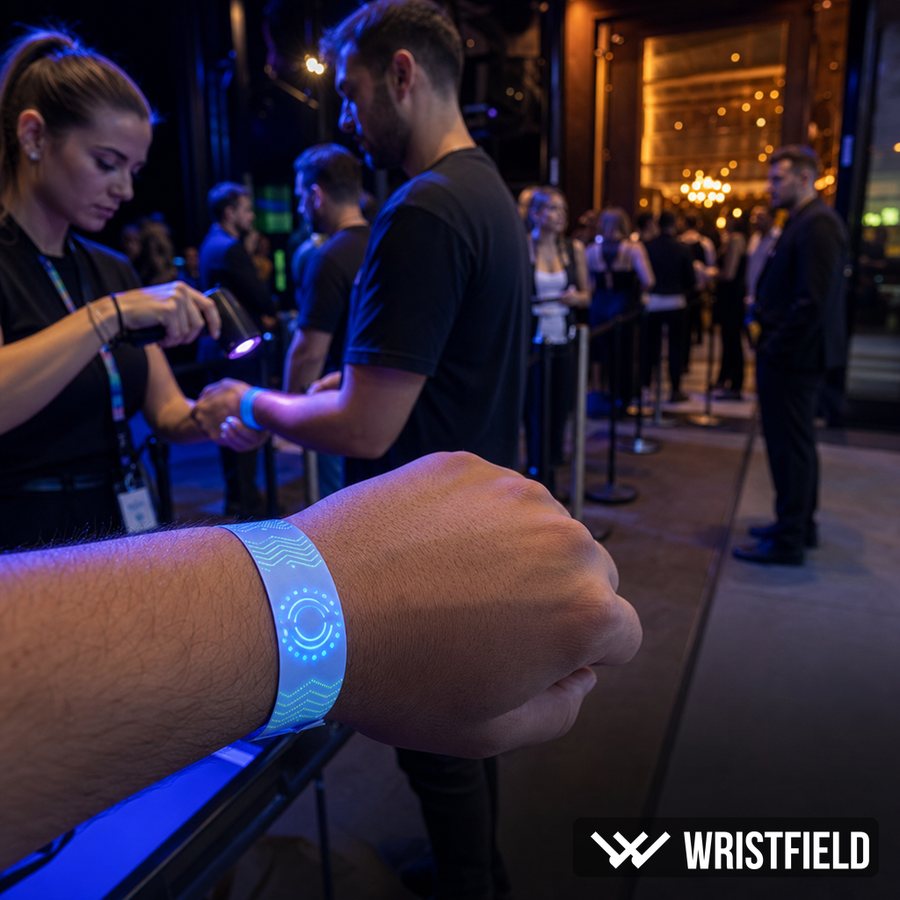
UV varnish on wristbands refers to a lacquer applied to the band that fluoresces only under ultraviolet light. That hidden layer is a fast, low-visibility security control that supports entry throughput, VIP and backstage checks, and anti-counterfeit measures. This guide explains the technique, compares it with UV printing, sets out operational requirements and shows how to model costs and risk in practical, testable terms.
UV varnish for wristbands: practical guide for organisers
When a visible wristband alone does not provide sufficient protection against fraud or unauthorised access, a covert, easily checked element adds value. UV varnish is a lacquer applied to a wristband surface that remains largely invisible in normal light and fluoresces under UV light. The control is simple to apply during production, fast to check at doors and especially useful where a second verification step is required at VIP or backstage access points. The explanation below focuses on UV varnish as a lacquer applied to wristbands, not on UV printing processes.
What UV varnish is and how it differs from UV printing
UV varnish is a liquid coating that contains a fluorescing agent. Applied selectively to a wristband, it creates marks or patterns that only appear under a UV light source. UV printing is a distinct production technique where pigments or inks are cured under UV light at the point of printing and can be visible in normal lighting conditions. The two techniques have different production workflows, costs and operational implications. Varnish produces a thin, flexible layer that preserves the feel of the band. UV printing may create visible designs and requires specialist printers. For organisers who need a covert verification layer that is quick to deploy at entry points, UV varnish is the relevant option.
When UV varnish makes sense
Consider UV varnish where any of the following apply: the wristband can be copied easily; there are high-value access zones such as VIP, hospitality or backstage areas; you need rapid secondary checks that do not require scanning equipment; there is a measurable cost from fraudulent or mistaken admissions. UV varnish is not a replacement for ticketing systems or identity checks. It is an additional physical layer that accelerates decision making at a gate and increases the cost and effort of successful counterfeiting.
How it changes entry and VIP workflows
At a standard entry gate, UV varnish can be tied to a printed cue such as a serial number or colour. Staff perform the normal visual check, and when a secondary spot check is required they illuminate the band briefly with a UV torch. At VIP and backstage doors the process is typically defined as primary visual check plus UV verification for all entries or for random spot checks. For quick checks the outcome is binary: fluoresces or does not fluoresce, enabling a rapid accept or reject decision. The time per check is short, which helps maintain throughput while adding a meaningful anti-counterfeit layer.
Technical and operational requirements
Basic equipment consists of hand-held UV torches or wand-style lamps, reliable supply of varnished wristbands and a production partner who can apply the varnish consistently. The varnish must bond to the substrate. Tyvek accepts lacquer well and is a common choice for single-use festival wristbands; vinyl and woven textile bands require validation to confirm adhesion and flexibility. Battery life and spare lamps are operational essentials. Train staff on where to place the lamp, how long to hold it, and how to log non-conformances. Define the acceptable appearance of the fluorescence and provide photographic references in the protocol.
Durability is a delivery requirement. The varnish must tolerate abrasion and perspiration for the expected wear period. Agree a testing protocol with your supplier before the event. That protocol should include rubbing tests, extended moisture exposure and UV exposure to assess fading. If the varnish creates excessive stiffness or alters comfort then compliance will drop and the control fails.
Integrating UV varnish into a multi-layer security model
UV varnish works best when combined with other controls. A wristband can carry a visible print, serial number or QR code together with an invisible UV mark. The visible elements allow normal operational flow and simple rejection of clearly invalid items. The UV layer raises the bar for someone attempting to replicate an authorised band. For guidance on serial numbering and combined controls see the practical notes on numbered wristbands and anti-counterfeiting here: How Numbered Wristbands Work at Events and Preventing Wristband Counterfeiting: UV, Serialisation and Security Measures.
Capacity planning and entry throughput
A well executed UV check adds only a few seconds to a verification if the protocol is clear. A typical UV check can take between two and four seconds. The theoretical throughput of a single lane therefore ranges widely depending on human factors. Use conservative planning assumptions and reserve capacity. For example, if an organised VIP lane requires 800 passes per day concentrated into a few peak periods, one lamp and one trained operator may be sufficient. If throughput peaks approach 1,200 or more per hour, a second lane or redundant lamp is necessary. For practical guidance on entry time improvements and lane design see How to Cut Your Event Entry Time by 30%.
A cost and risk decision framework
The decision is best framed as a cost-risk comparison. Calculate the expected loss from counterfeit or unauthorised admissions over the event, estimate how much UV varnish would reduce that loss, then compare the reduction value to the implementation cost. Implementation cost includes the additional manufacturing surcharge for varnish, lamp purchase or rental amortised over events, staff training and any incremental handling time.
Worked illustrative example using available price references
Using product data for Tyvek bands from our pricing set: Tyvek 1 inch wristbands with full colour printing have a gross unit price of approximately £0.114 at a 3,000 quantity level. That figure comes from the product price list for 3,000 units. If an organiser procures 3,000 full-colour Tyvek bands at £0.114, the base cost is £342. Add an illustrative UV varnish application surcharge. If the surcharge is £0.05 per band, the additional manufacturing cost is £150 and total wristband cost becomes £492.
Implementation additions might include two handheld UV lamps purchased or amortised at £300 in total for the event and staff training and time cost of, say, £400. Total incremental cost for the UV control is therefore £850 in this illustration. If the expected cost from fraud and incidental admission errors is estimated at £2,000 and varnish reduces that risk by 80 per cent, the risk reduction value is £1,600. Net benefit on these assumptions is £1,600 minus £850 equalling £750. These numbers are illustrative. Use your event-specific risk estimates and confirm the varnish surcharge with your supplier. For reference on how wristband choice affects total entry costs see How much does a custom wristband cost?.
Testing protocol before you commit
Run a small validation batch and perform three types of test. First, abrasion and rub resistance: simulate wrist friction by subjecting samples to repeated rubbing. Second, moisture and sweat exposure: soak samples and evaluate fluorescence after drying. Third, field simulation: distribute samples to staff and have them wear them for a typical shift. Define acceptance criteria in measurable terms. For example, require that fluorescence intensity remains above a specified reference level after 72 hours of wear and 300 rub cycles. If results are marginal, adjust varnish formulation or application thickness. Testing avoids late-stage surprises that cause operational failure at the gate.
Common implementation mistakes and how to avoid them
Organisers sometimes deploy a single lamp per gate without redundancy. A failed lamp creates a bottleneck. Always plan for spare lamps and charged batteries. Another frequent error is inadequate staff training so that checks are performed inconsistently. Provide short training sessions, visual guides and escalate rules. Finally, do not treat the varnish as a complete identity control. Use it as an added layer together with serialisation and other checks. For operational scenarios that include VIP management and access tiers, consult the practical guide on VIP zones and admission control: Managing VIP Zones at Events.
Key performance indicators to track
Monitor measurable outputs so you can evaluate benefit. Useful KPIs are average additional check time per person with UV verification; number of counterfeit detections per event; number of disputes related to incorrect admissions; and staff confidence levels in the control. Compare these before and after introduction to estimate a return on investment. For a fuller discussion on evaluating entry cost drivers, see Full Entry Cost Breakdown for a 1,000-Person Event.
When express production matters
If you need a late change or rapid delivery, confirm with your supplier whether UV varnish can be applied under express timelines. Express production typically carries a surcharge and may limit print options or testing time. If express is under consideration, consult guidance on the trade-offs: When Is Express Wristband Production Worth It?.
A brief operational scenario: a 3,000-person, multi-zone event
Imagine a festival with three access types: general admission, VIP and staff. Apply UV varnish to all VIP and staff wristbands and a sample of higher risk general admission bands. At VIP gates apply a mandatory UV check. Train a small team of supervisors to perform random audits on the general admission gates. The measured benefit can include reduced queue times at VIP gates because disputes are reduced and faster accept/reject decisions are possible. For design details that balance throughput and security, the guide on reducing entry times is relevant: How to Cut Your Event Entry Time by 30%.
Next steps for organisers
Start with a brief risk assessment. Estimate the likely financial and reputational impact of successful counterfeiting at your event. Ask your supplier for a prototype run and a clear statement of the varnish surcharge per unit at the quantities you expect. If you want help modelling the numbers, provide expected attendance, wristband substrate choice and the share of bands to be varnished. If you are already deciding between band types, the material comparison is useful: Tyvek vs Vinyl: Detailed comparison.
Note on terminology: in this context UV marking refers specifically to a varnish that fluoresces under ultraviolet light. It does not mean printing with UV-cured inks that are visible under normal lighting. The choice between varnish and printing should follow a technical and operational specification, not a marketing label.
If you would like a worked cost-risk analysis for your event please provide expected attendance, wristband material choice and the percentage of bands you would like varnished. With those inputs it is possible to produce a sensitivity table showing the break-even point under different fraud risk scenarios.
Operational decision framework: who to varnish and why
Deciding whether to apply UV varnish is fundamentally an exercise in targeted risk control. The varnish is cost-effective when used where the marginal benefit of preventing a single fraudulent or discrepant admission exceeds the marginal cost of adding varnish, lamping equipment and a small amount of staff time. That means prioritising wristbands that protect revenue, safety or reputation: staff credentials, hospitality/VIP passes, artist-facing areas and high-value ticket types. For large general admission populations a sampling strategy can deliver most of the anti-fraud benefit at lower expense and with negligible effect on throughput.
Worked example: 3,000-person festival, practical numbers
Scenario assumptions: total attendance 3,000; VIP tickets 300; staff and contractor bands 150. You plan to varnish all VIP and staff bands (450 units) plus a 5 per cent random sample of general admission (GA), which is 128 units. Total varnished units 578.
Supplier quote: varnish surcharge 0.10 per band. Equipment and training: two handheld UV lamps amortised across the event at 300, and a one-off staff training and time cost of 400. Labour rate for front‑of‑house income control staff 14 per hour.
Direct varnish cost = 578 x 0.10 = 57.80. Add lamps and training = 300 + 400 = 700. Total incremental cost = 757.80.
Operational throughput effect: a properly trained checker using a handheld lamp takes roughly 2.5 to 4 seconds extra per verification, depending on existing checks. If you apply mandatory UV checks only to VIP and staff (450 checks) the additional time is between 19 and 30 minutes of cumulative checking time across the arrival period. In staffing terms that is under one staff-hour at 14 per hour. If, alternatively, you varnish and check all 3,000 arrivals, extra cumulative time is 2.1 to 3.3 staff-hours, costing 29 to 46. All numbers are small relative to lamp and training fixed cost, which dominates for modest varnish volumes.
Fraud risk model: estimate current annualised or per-event loss from fraudulent admissions. If the event operator estimates expected loss at 2,000 without varnish and varnish reduces risk by 80 per cent where applied, the expected benefit is 1,600. Comparing benefit 1,600 with total incremental cost 758 yields a positive net contribution. Use your own inputs, but this worked example shows how modest per-band charges and single equipment purchases typically justify selective varnish use for VIP and staff bands.
Decision logic for allocation
Begin with three questions: what is the monetary or operational value per band, what is the likelihood of fraudulent misuse, and how visible are normal controls (scanning, photo ID)? If the value-per-band multiplied by the probability of fraud exceeds about twice the per-band varnish cost, mark the band for varnish. For areas where reputation or safety is impacted, lower the threshold. The factor-of-two buffer reflects the presence of fixed costs such as lamps and training; at higher volumes the buffer can be reduced because unit costs fall.
For large GA crowds where value-per-band is low, consider a sampling strategy. A 5 to 10 per cent random sample of GA achieves a high marginal detection probability of organised counterfeiting rings while keeping fixed cost per event small. Make the sampling truly random and rotate inspection points to avoid predictability.
Organisational errors that create failure modes
One recurring and avoidable failure is single‑point reliance on one lamp per gate. If a lamp fails during peak arrival, queuing doubles and the gate operator abandons UV checks, nullifying the control. Avoid this by provisioning at least one spare lamp per two active gates, carrying spare charged batteries and nominating a technical owner who can swap equipment in under five minutes. Another common mistake is insufficient escalation protocols: staff must know when a hidden mark and serial number disagree, and how to hand over to supervisors without creating a dispute that blocks the gate.
Finally, do not allow varnish to replace other identity elements. Where possible combine varnish with sequential numbering or barcode checks. The varnish is a visible deterrent and a quick verification tool, but it is not a standalone identity solution.
Operating models and contingencies
Two practical models work well. Model A is focused control: varnish all VIP and staff bands, mandatory checks at VIP entrances, and random supervisory audits at GA lanes. Model B is preventative sampling: varnish a sample of GA in addition to VIP/staff and run random gates with lamps; use a daily schedule to rotate which gates are inspected. Model A minimises hassle for the majority of arrivals and concentrates checks where cost of error is highest. Model B increases deterrence against organised copying by widening the perceived probability of detection.
Contingency planning should be explicit. Assume a lamp failure probability and calculate the impact. For instance, if a gate normally processes 900 persons per hour and one of two lamps fails, effective capacity falls to 450 per hour. During a 90-minute peak the shortfall is 675 persons; unless mitigated a queue will grow. Mitigation options include temporarily diverting arrivals to adjacent gates, deploying scanned‑only verification for a short interval while the lamp is replaced, or deploying supervisors to perform manual checks of suspicious cases. Quantify each mitigation in minutes and allocate a small budget for overtime to ensure swift response.
Integration and next steps
When you scope a supplier, request a small validation batch and a written statement of varnish durability under abrasion and moisture test conditions. Confirm the precise cost per band at planned volumes and whether express production alters varnish quality. For technical and procedural integration with broader anti-fraud measures consult guidance on complementary controls; the Preventing Wristband Counterfeiting guide provides practical measures on serialisation and covert features that work together with UV varnish. Remember that in this context UV marking means a varnish that fluoresces under ultraviolet light and not UV printing visible in normal light.