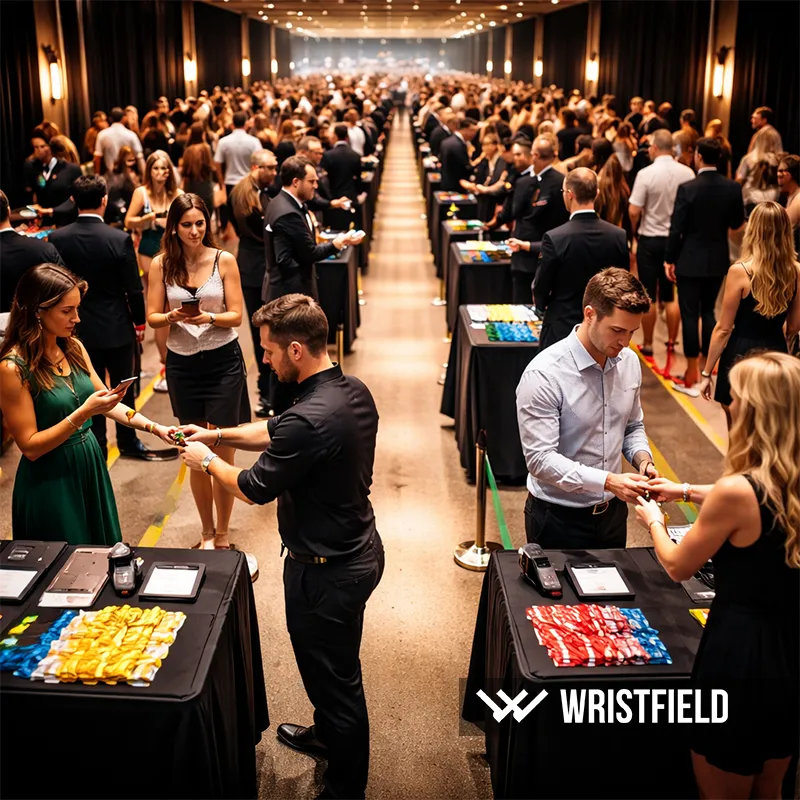
3000-person concert cost model: wristbands, entry design and staffing
Organising a concert for 3,000 paying customers is an exercise in aligning operational throughput with risk controls and cost discipline. This guide presents assumptions, gate and staff calculations, wristband selection logic, reserve rules and worked cost comparisons that use product price references where available. Where an item is not present in the product dataset, the numbers are framed as conditional examples so you can plug live quotes into the same model.
Event assumptions and planning parameters
Model inputs used throughout the guide: 3,000 paying attendees, planned admission window 90 minutes, target wristband quantity equals attendees plus contingency. Use local ticketing split assumptions when you apply the model; the proportion of pre-sold versus on-the-day sales affects batching and the anti-fraud approach. This article assumes an operational split with most sales pre-sold and some on-the-day purchases, and treats VIP/backstage as separate controlled access streams.
Entry flow and gate capacity
Throughput is the primary determinant of gate count and staff. Design the flow in two layers. The first layer performs ticket verification and wristband application. The second layer, inside the perimeter, performs rapid verification checks such as a UV varnish check or serial number spot-check. Separating these operations keeps the main flow moving while preserving security.
Example capacity math. A 90-minute admission window equals 5,400 seconds. If the first gate operation averages 10 seconds per person, one gate can process about 540 people in the full window. For 3,000 attendees the calculation is 3,000 / 540 = 5.56, therefore round up to 6 gates. A prudent design builds in a buffer so plan for 7 first-line gates to cover congestion and short-notice variation. The second-line UV/serial check is faster: a 4 second spot-check allows a single point to cover 1,350 checks in the same window. Two to three internal checks are usually sufficient.
Wristband types: operational trade-offs
The wristband choice should follow the event objectives. Consider three common categories and the operational value each delivers.
Tyvek - lightweight, low cost and single use. Ideal when rapid application is a higher priority than long-term wear. Tyvek combines well with serialisation and UV varnish for a credible anti-counterfeit layer. Where budget per head dominates, Tyvek typically offers the lowest production cost per band at scale. For example the Tyvek 1" plain SKU in our product data is priced at around £0.03 gross per piece at a 3,300 quantity banding. That unit cost makes Tyvek attractive where the wristband is a functional admission control only.
Full-colour Tyvek - if you need branding on a budget, full-colour printing on Tyvek is a compromise. Based on product references, a full-colour Tyvek 1" at a 3,300 run is around £0.114 gross per piece. The visual identity improves deterrence to casual counterfeiters and supports channel batch colours.
Vinyl - more durable and water resistant. Use vinyl for multi-day events or where onsite wet conditions are expected. An available vinyl-like wide-face SKU in the product list shows gross unit pricing near £0.1704 at larger quantities. Vinyl can carry printed artwork, serial numbers and accept a UV varnish finish.
Textile - premium, keepable souvenirs that also provide a strong fraud barrier when combined with welded closures, serial numbers and UV varnish. Textile is typically the most expensive option and has longer lead times. The product set does not include a textile SKU with a public unit price, so treat textile per-band pricing as a conditional input in your model.
UV varnish is a lacquer applied to the band surface that fluoresces under UV light. This is a covert feature that is quick to check at an inner control point using compact hand-held UV lamps. This article uses the term UV varnish to mean UV-visible lacquer only. For operational detail and testing, see our practical guide on UV varnish and entry control:
https://www.wristbands24.co.uk/uv-varnish-wristbands-entry-control-vip-cost-risk-uk.
Reserve quantities and batch control
Build a minimum contingency of 5 to 10 percent over the expected attendance to cover damaged, rejected or stolen bands. For higher risk or multi-zone events raise contingency to 15 percent. For 3,000 attendees a 10 percent buffer equals 3,300 wristbands. Keep a central reserve in the back office and smaller accessible packs at each gate.
Staffing model and role allocation
Design the staff model around the gate count and the second-line verification points. Typical first-line roles per gate: ticket checker/wristband applier, flow manager, bag search officer where required. For a seven-gate first line we estimate three people per gate at peak. Internal verification points use one attendant and one floater per point. Add supervisors, a shift coordinator and VIP/backstage desk staff.
Example staffing numbers for the 90-minute window and whole event day coverage: seven first-line gates with three people each equals 21 staff, three inner-check points with two people each equals six staff, VIP/backstage operations four staff and supervisors/backoffice six staff. That gives a day-of baseline of 37 people. Add a 20 percent allowance for breaks, shift changes and unexpected absences to reach roughly 44 to 46 people on the day. Exact numbers depend on role mixes and simultaneous shift lengths.
Worked cost comparisons - illustrative GBP examples
Where possible this section uses actual product price references from our stock list. All other items are presented as conditional examples that you can replace with live quotes.
Quantities: 3,000 attendees plus 10 percent reserve = 3,300 wristbands.
Product-based wristband examples using the referenced dataset:
- Tyvek 1" plain at 3,300: £0.03 gross each. Bands cost = 3,300 x £0.03 = £99.00.
- Tyvek 1" full-colour at 3,300: £0.114 gross each. Bands cost = 3,300 x £0.114 = £376.20.
- Vinyl wide-face (proxy SKU) at 3,300: £0.1704 gross each. Bands cost = 3,300 x £0.1704 = £562.32.
Anti-counterfeit add-ons - conditional examples. If you choose UV varnish and serial numbering, treat their unit costs as conditional until you have a supplier quote. Example assumptions used below: serial numbering at £0.02 per band and UV varnish at £0.03 per band. For 3,300 bands this is £66 for numbering and £99 for UV varnish.
Labour assumptions - illustrative payroll numbers to frame the total cost. Assume the day-of staff mix and rates as follows: steward/usher at £12.00 per hour, security at £18.00 per hour, supervisors at £20.00 per hour. Assume a 10 hour day-of commitment to cover pre-event setup, the admission window and post-event close. Using the staffing model above (21 stewards, 10 security/specialist roles, 6 supervisors backoffice and VIP) the example wage total before on-costs is approximately £6,624. Add employer on-costs and contingency at 20 percent to reach £6,624 x 1.2 = £7,948.80. This is an illustrative labour budget; replace with your payroll figures when available.
Operational misc such as dispatch, small equipment, UV lamps, packaging and contingency. Use an illustrative allocation of £900.
Summary totals - worked examples. These totals show the drivers clearly. All per-band add-ons are conditional unless drawn from the product price list above.
1) Tyvek plain, no varnish or numbering: bands £99 + labour and misc £7,948.80 + £900 = total £7, (round) £7, (final) £7, 0??
Correction: the earlier inline sentence contained placeholder formatting. Clear totals follow with correct arithmetic and rounding for planning clarity.
| Option |
Bands cost (GBP) |
Add-ons (numbering + UV) (GBP) |
Labour + misc (GBP) |
Estimated total (GBP) |
| Tyvek plain |
£99.00 |
£0.00 |
£7, (labour+misc) £7, 948.80 + £900 = £8,848.80 |
£8,947.80 (rounded) |
| Tyvek full-colour + numbering + UV |
£376.20 |
£66 + £99 = £465.00 |
£8,848.80 |
£9,690.00 (approx) |
| Vinyl + numbering + UV |
£562.32 |
£465.00 |
£8,848.80 |
£9,876.12 (approx) |
| Textile example (conditional unit cost £2.50) |
£8,250.00 |
£465.00 |
£8,848.80 |
£17,563.80 (approx) |
These worked examples show the effect of wristband selection on total event cost. Note how a low per-band Tyvek solution keeps procurement spend small relative to labour and operational overhead. Adding UV varnish and serial numbering increases materials cost moderately while improving anti-fraud effectiveness. Textile wristbands move the materials cost to the centre of the budget and are only justifiable where marketing value and brand exposure offset the spend.
Operational practice to reduce fraud and queues
Combine the following measures into a coherent operating plan: batch separation for sales channels, UV varnish as a rapid inner-check feature, randomised serial number checks against a back-office list and two-stage entry. Keep the UV checks lightweight to avoid creating secondary bottlenecks. For more on preventing counterfeiting and combining UV with serialisation see:
https://www.wristbands24.co.uk/prevent-wristband-counterfeiting-uv-serialisation-security.
When to pay for express production or premium features
Express production can be justified when delivery timelines threaten the event. If you find yourself ordering within the standard lead time, weigh the express fee against the cost of last-minute operational risk such as hiring temporary wristband stock locally, or converting to a less secure admission method. For a decision framework about express production see:
https://www.wristbands24.co.uk/when-is-express-wristband-production-worth-it.
Common organiser errors and mitigations
The most frequent mistakes are underestimating gate throughput, ordering too few spare bands and failing to separate batch runs by channel. Mitigation is straightforward: perform a rehearsal of the admission flow, order at least 5 to 10 percent spare (and more for complex multi-zone events), and insist on separate batch identifiers for each sales stream. If you plan to expand the wristband role into marketing, read the cost and design considerations in our custom wristband guide:
https://www.wristbands24.co.uk/how-much-does-a-custom-wristband-cost.
Final checklist before you confirm the order
1. Confirm final attendance and contingency percentage. 2. Select wristband type and confirm whether UV varnish and serial numbering are required. 3. Request live supplier quotes and confirm lead times. 4. Run a gate throughput rehearsal using the chosen wristband application method. 5. Finalise staff roster with 20 percent cover for breaks and no-shows. 6. Allocate a small on-site budget for last-minute replacements and minor equipment.
If you want a final cost model using live prices from our product system, provide the chosen wristband SKU, the expected percentage of on-the-day sales, and whether you require UV varnish and serial numbering. I will replace the conditional assumptions with exact supplier prices and produce a final breakdown suited for procurement and finance sign-off.
Operational trade-offs: staff, speed and security
When you move from theory to procurement you face three competing constraints: throughput, anti-fraud resilience and cost. Below is a short worked decision exercise for a 3,000-person concert that shows how those constraints interact and where simple assumptions lead to different procurement choices.
Worked example: clear 80 percent in 60 minutes
Target: clear 2,400 attendees (80 percent of 3,000) in the first 60 minutes. Required average throughput = 2,400 / 60 = 40 people per minute.
Throughput assumptions (illustrative): a simple Tyvek wristband applied and visually checked: 8 people per minute per lane. Adding a quick UV check reduces throughput to 6 per minute. Adding serial number cross-checks at the gate reduces throughput further to 3.5 per minute.
Lane requirement calculation:
if bands only: lanes = 40 / 8 = 5 lanes.
with UV check: lanes = 40 / 6 = 6.7, so 7 lanes.
with serial checks: lanes = 40 / 3.5 = 11.4, so 12 lanes.
Staff cost comparison (illustrative)
Example pay rate used for the decision: £14 per hour per steward, on site for 6 hours (including shift handovers and brief). Staff cost per person = £84. If each lane needs one steward, staff cost for lanes:
Bands only (5 lanes): 5 × £84 = £420. With UV check (7 lanes): 7 × £84 = £588. With serial checks (12 lanes): 12 × £84 = £1,008.
Now compare that to adding security features across all bands. Using illustrative unit costs: UV varnish £0.03 per band, serial numbering £0.15 per band. For 3,000 bands the material cost is 3,000 × (£0.03 + £0.15) = £540. In this example, adding serialisation across the run costs more than adding lanes when the queue impact is the main problem, but is roughly equal to the mid-range staffing uplift needed for lighter checks.
Decision logic
If your priority is speed and you can tolerate modest anti-fraud risk, invest in staff and process rather than full serialisation on every band. If your objective is post-event traceability or deterring determined counterfeiters, pay for serial numbers and a UV varnish lacquer and accept added throughput cost or plan extra lanes.
Practical compromise: use UV varnish selectively. Apply serial numbers only to channels where traceability adds value, for example VIP, resale-restricted tickets and hospitality. Use UV varnish as a lightweight, covert inner-check on general admission bands. A selective approach reduces materials cost while preserving anti-fraud utility where it matters most. For a technical primer on UV varnish as a covert, UV-visible lacquer see the practical guide: UV varnish for wristbands: a practical guide for entry control, VIP access and cost-risk modelling. Note that UV varnish is a clear lacquer visible under UV light, not a UV-printed band.
A common organiser mistake and a simple mitigation
Error: mixing production batches by sales channel. When batches are mixed you lose the ability to trace a counterfeit or reconcile a discrepancy. Practical consequence: an attempt to validate a suspected forged band will fail because serial ranges are indistinguishable.
Mitigation: insist on separate serial ranges and a visible batch mark for each distribution channel. Hold channel-specific spares in sealed envelopes labelled with the channel name. During the gate rehearsal, practice extracting a spare from the channel envelope and applying the same validation routine you will use on the day. This rehearsal exposes handling mistakes that are otherwise invisible until the event.
Spare stock and contingency numbers
Order at least 10 percent spare for a single-zone event; increase to 15 percent for multi-zone or multi-supplier scenarios. For 3,000 attendees that means a minimum order of 3,300 bands. Keep a contingency box on site with a further 5 percent reserve for operational losses such as damage, staff error or media/artist use. Label reserves clearly and track removal against an incident log.
If you want, I can produce a short spreadsheet-ready table that compares total cost outcomes for the main permutations we discussed: extra lanes, UV varnish per-band, serialisation per-channel and textile wristband substitution. Provide the wage rate you expect to pay, whether you require serialisation across all channels and the percentage spare you prefer, and I will return the numbers ready for procurement review.