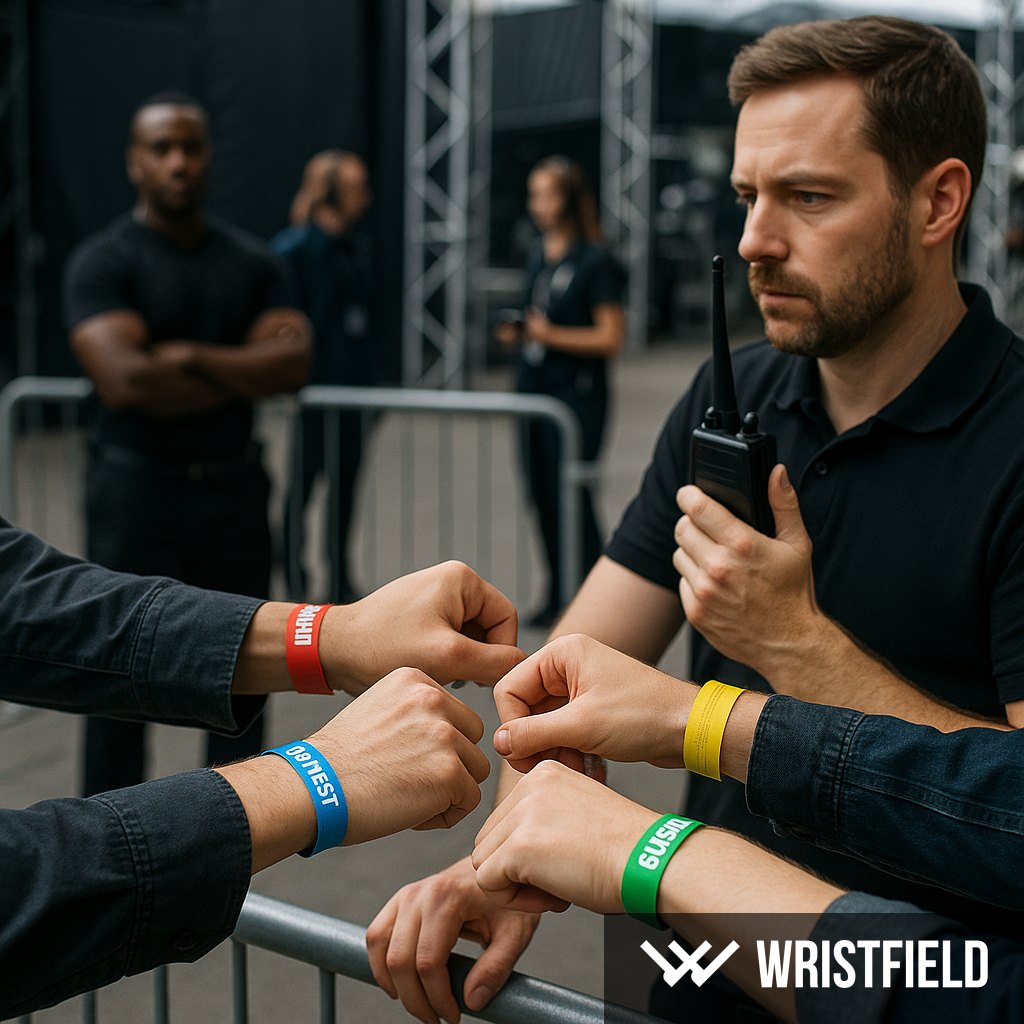
Designing VIP, Backstage and Press Access with Wristbands: a practical UK guide
Wristbands are the primary operational tool for granting and checking access at live events. They provide an immediate visual signal to stewards and security, and when combined with one or two additional layers they also offer robust protection against casual and organised misuse. This guide explains the decisions you need to make before production, the visible features that speed verification, the materials and fastening choices that reduce transfer and forgery, and the staffing required to keep lines moving while maintaining security.
Start with zones and a simple access map
Your first design task is to map the physical zones and assign the minimum access each zone requires. Typical categories are: public, VIP, backstage, crew and press. Do not assume one wristband equals one level. A single person can legitimately hold multiple roles, and some zones may need dual controls (wristband plus ID). Draw a clear plan that identifies primary gates, internal doors and any pinch points where a second check is required.
Practical example: a 3,000-person concert
For example: audience arena, VIP seating/terrace, artist backstage, production-only technical areas and a media hub. Typical tallies might be: VIP 150-300, backstage and crew 80-150, press 20-50. Those numbers inform wristband counts, spare stock and gate staffing. For deeper planning and cost modelling for an event of this scale see our related article on entry cost modelling for 3,000 attendees.
Further reading: 3000-person concert cost model: wristbands, entry design and staffing.
Make visual verification instant
At a busy gate the steward has seconds to decide whether someone may enter. A wristband must therefore convey, at a glance: the access tier, validity (day or date), and any restrictions. Use high-contrast colours and add a distinctive icon or logo for each level. Where multiple roles exist, avoid near-identical designs: VIP should not be easily confusable with press or crew.
Information to include on the wristband
Essential: role name or icon, event name, date. Highly recommended: unique serial number, and, where practical, a QR code for rapid tech-assisted checks. Add a concealed UV varnish mark on VIP and backstage items to create a quick second-layer verification. For how serialisation helps with accountability and post-event reconciliation, read our guide on numbered wristbands.
Further reading: How Numbered Wristbands Work at Events.
Choose materials and locks with the role in mind
Material choice is a trade-off between cost, durability and anti-transfer performance. Typical options:
| Material |
Best for |
Notes |
| Tyvek |
Large audience, single-day |
Very cheap and disposable, limited durability and moderate anti-transfer when used with one-time locks. |
| Vinyl |
Outdoors, wet conditions |
Waterproof and stronger; better for multi-day or more active wearers. |
| Woven fabric |
VIP, crew, long-term use |
Comfortable and premium; pairs well with tamper-evident locks and additional security features. |
One-time locking mechanisms reduce re-use and transfer. However determined fraudsters can still try to remove and reseal wristbands. Combining material choice with serialisation, concealed UV varnish and operational rules makes transfer far less likely.
UV varnish: what it is and how to use it
When we say UV varnish we mean a varnish that becomes visible under UV light. It is not UV printing. Applied as a coating or spot mark, UV varnish is invisible in normal light and only reveals a pattern, symbol or serial data when illuminated with a handheld UV lamp. That characteristic makes it an excellent verification tool at VIP and backstage gates because it is fast to check and difficult to replicate on the fly.
Operational tips:
- Make UV checks a formal part of the entry sequence for all VIP and backstage gates and issue a simple UV checklist to staff.
- Locate the varnish consistently on each wristband (for example the inner edge) to make checks predictable.
- Carry at least two handheld UV torches per entrance to avoid delays when bulbs fail or batteries run out.
For technical detail on where UV varnish fits into a layered security model see our dedicated UV guide.
Further reading: UV varnish for wristbands: a practical guide.
Anti-fraud layers: serialisation, QR/NFC and staff procedures
No single measure prevents all fraud. Use three complementary layers: a visible design that stewards can identify instantly, a concealed UV varnish or mark, and a unique identifier such as a serial number or QR code linked to your guestlist. Where budget allows, NFC or QR verification speeds internal gate checks and records entries in a staff app.
Operational measures that matter:
- Record which serial numbers go to which recipients; keep a spare pool for replacements.
- Use a two-person sign-off for distributing VIP and backstage bands to reduce mistaken or unauthorised issue.
- Train staff to check both the visible design and the UV mark, and to log any replacement or exchange with reason and serial number.
For a practical list of anti-counterfeit practices, see our article on preventing wristband counterfeiting.
Further reading: Preventing Wristband Counterfeiting: UV, Serialisation and Security Measures.
Staffing and throughput: how many gates and how many people
Plan gate staffing using realistic service times. A good rule of thumb for a general admission lane is a target processing time close to 30 seconds per person; for a VIP lane where a quicker experience is expected, target 12 to 15 seconds per person. Use arrival profile assumptions to convert those service times into staffing numbers.
Example math: if a bulk of arrivals happens in a two-hour window and you expect 3,000 attendees, that is roughly 1,500 people arriving per hour. With a 30-second processing time a single gate can manage about 120 people per hour. To handle 1,500 per hour you would therefore need approximately 13 gates. If VIP arrivals total 200 across the two hours, that is 100 per hour; one gate running at 12 seconds per person can cover that comfortably, but in practice assign two staff to make the guest experience smoother and to provide cover.
Always add staff buffer for breaks and contingencies. A 20 percent staffing reserve within rosters is prudent for busy events.
More on reducing entry time and optimising staff deployment: How to Cut Your Event Entry Time by 30%.
Typical operational mistakes and how to avoid them
Common failures include visually similar wristbands across different roles, poor coordination between ticketing and wristband distribution, and a lax handout process for production and suppliers. Fixes are straightforward: make designs distinct, enforce a clear distribution protocol and add a digital log of which serial numbers were issued to whom.
A practical corrective: use a two-step approval for backstage and VIP wristband issues. First, the person issuing the band checks the ID and guestlist; second, a manager or production lead signs off in the record. Every band issued should be traceable by serial number and by issuer.
Integrate wristbands into wider event systems
Wristband serials and scans should feed back to the ticketing and operations systems. That link helps with post-event queries, fraud investigations and reconciliations. Define clear procedures for lost or damaged wristbands: immediate invalidation of the original serial, issue of a replacement after identity verification, and logging the change.
Operational checklist before production and on the day
Before you place an order:
- Map zones and finalise the access matrix.
- Decide materials for each role and whether to use UV varnish and serialisation.
- Confirm production lead time and minimums; decide whether UV varnish will be applied during manufacture or on-site.
- Produce a distribution and replacement procedure and two-person approval for high-risk bands.
On the day:
- Run a dry gate simulation to measure actual throughput.
- Issue UV-check lists and ensure tools are at each control point.
- Keep a register of issued and spare serial numbers and log every replacement.
When to invest more: mixed models
Not every wristband needs the same level of investment. Adopt a mixed model: Tyvek for large general-admission batches, vinyl for outdoor or multi-day needs, and woven fabric for VIP and crew with UV varnish and serials. That approach concentrates protective measures where the cost of misuse is highest while keeping overall expenditure sensible. For a walk-through of cost drivers and when to choose express production see our cost guides.
Further reading: How much does a custom wristband cost? A practical UK guide.
KPIs and audit routine
Measure and report: unauthorised entry incidents, wristband replacement rate, average processing time at main gates and VIP gates, and number of serial mismatches discovered during audits. A healthy target is under 2 percent replacement rate and VIP processing under 15 seconds on average. Use brief daily reports during multi-day events and a consolidated post-event audit to feed lessons into the next iteration.
Final recommendations
Design for clarity and enforceability. Make the visible design the first line of defence, then add a concealed UV varnish and unique serials for higher-value access. Train staff to apply the same check routine consistently and keep straightforward operational records. These measures will reduce fraud, speed up entry and protect your event operations without excessive complexity.
If you want help modelling staffing, testing UV varnish on your chosen materials, or building a distribution and audit workflow for your next event, we can support the practical setup and simulation.
Staff training: simple scripts and verification routines
Consistent gate behaviour is as effective as any security feature. Train staff to use a short, polite script that enforces checks without sounding confrontational. Rehearse the flow until it becomes second nature.
Suggested gate script:
"Good morning. May I see your wristband, please? Thank you. One quick UV check and I will scan it for you. Enjoy the event." Use a two-step verification for high-risk bands: UV check, then serial scan or visual match to guestlist. Keep the exchange under 15 seconds at VIP lanes by practising the gestures and positioning yourself so the guest’s hand is presented naturally to the scanner and torch.
For replacements, staff should follow a documented escalation chain: initial identity check, brief manager approval, invalidate original serial in the system, and issue a replacement recorded against the guest. Keep notes brief but factual; date, time, issuer and reason are sufficient.
Incident response for security breaches and fraud
No system is perfect. Prepare a short, clear incident response for gate breaches, counterfeit discoveries or sudden spikes in unauthorised access. Assign roles ahead of time: who secures the gate, who communicates with operations, who liaises with venue security and police if required. Keep a simple incident log with timestamp, serial numbers involved, actions taken and outcome. That log is invaluable for resolving guest complaints and for any later investigation.
When a counterfeit or cloned serial is found, invalidate the affected serials in the ticketing system and start a triage: identify how many entries occurred under the same serial, review CCTV or manual logs, and check the chain of custody for the wristband batch. If necessary, run an emergency reissue with a different access method such as a temporary laminated pass with manager signature until replacements arrive.