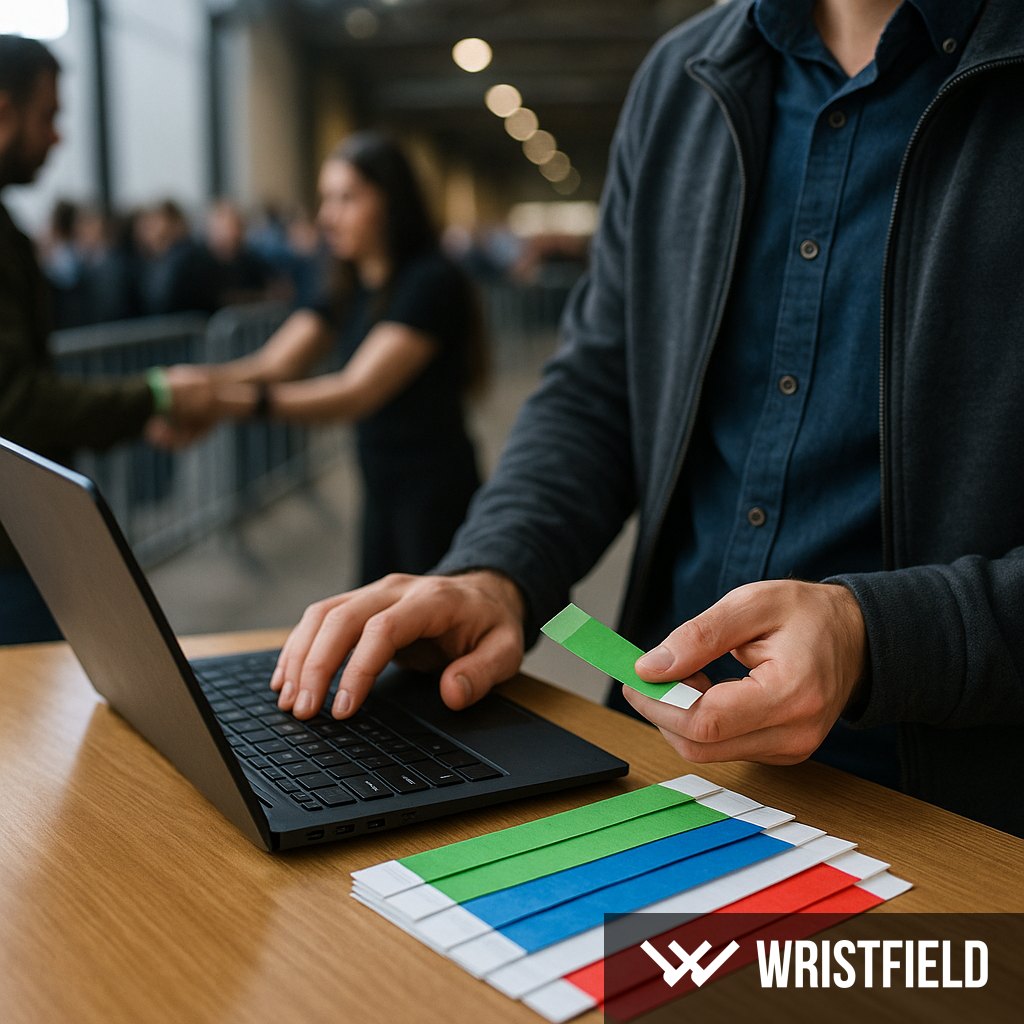
Express wristband orders: real cases, compromises and artwork preparation
When an event is days or even hours away, discovering you do not have the wristbands you need is one of those crises that forces quick decisions. Do you accept a visible compromise, try a DIY workaround at the door, or place a rush order and pay the premium? Drawing on real organiser experiences, this article walks through three common scenarios where express production saved the day, describes the trade offs involved, and gives a clear checklist for preparing artwork and making the decision under pressure.
Case 1: late shipment and an urgent top-up
At a weekend outdoor concert, the main wristband shipment was delayed and a portion of bands was damaged in storage. With the first gates due to open in less than 72 hours, organisers needed extra bands fast. The decision had immediate consequences for throughput, guest experience and security.
The decision process was straightforward and time sensitive. First, they assessed the shortfall and available stock. Second, they contacted local suppliers to check express capacity and lead times. Third, they ran a rapid cost versus risk assessment: what does a rush order cost, and what other options are viable for immediate use? Alternatives considered included temporary paper wristbands, coloured tape at the entrance, or a combination of restricted entry and printed day passes.
The organisers opted for an express top-up from a nearby supplier. To keep the production fast and reliable they accepted a few compromises: a simplified artwork, removal of some decorative layers and a focus on essential security features such as sequential numbering. They also chose a robust Tyvek option rather than textile, because it was quicker to produce and resilient for the expected conditions. The extra spend and minor aesthetic concessions were judged acceptable given the need to keep entry flowing and avoid reputational damage.
Case 2: wrong logo and a late-night fix
At a corporate product launch the wrong logo file was uploaded to the printer late in the evening. The designer only noticed the error after approving the proof, and the client faced three options: print with the incorrect logo, apply stickers later, or commission a rapid reprint. They weighed brand risk against time and cost.
The team chose express reprint. To save time and ensure security the production ran with a simplified finish. The original plan had called for multi-layer decoration including an aesthetic top coat. For the rush run they replaced the decorative coating with a single UV-visible varnish for a security feature that is visible only under UV light. This retained anti-counterfeit protection but reduced preparation and curing steps so the order could be completed within the tight window.
The key lesson is that where brand integrity is important, express reprint is often better than exposing delegates to a flawed production. The compromise is usually aesthetic complexity rather than core brand elements or security measures.
Case 3: sudden VIP security demand
On the morning of a cultural event, organisers decided to tighten access to the VIP area after ticket data showed unexpected demand from media and sponsors. They needed additional secure wristbands that are hard to counterfeit. Options included textile wristbands with specialised fastenings, or numbered Tyvek bands combined with a UV varnish mark for verification under UV light.
Textile bands would have offered a more premium appearance, but longer lead times and higher cost made them impractical. The express solution was sequentially numbered Tyvek wristbands with an applied UV varnish mark. This delivered the required control quickly and affordably. If you want a deeper primer on numbered wristbands, see our guide How Numbered Wristbands Work at Events.
When is express production worth it? Decision factors
Express production carries a premium. To decide whether it is justified, weigh these factors together rather than in isolation. First, the actual risk: does a shortage or error at the gate cause direct revenue loss, security breaches or reputational harm? Second, the volume needed: smaller batches are generally faster to handle and the setup overheads are proportionally higher on larger orders. Third, material and security requirements: features such as numbered runs, UV varnish or unique fastenings can add setup and curing time.
As a conditional illustration, if you need 500 units within 48 hours an express surcharge might be in the range of 20 to 60 percent on top of standard pricing. For 3,000 units the surcharge commonly rises because of the pressure on capacity and logistics. Adding sequential numbering is relatively quick, but layered finishes or UV varnish increase both lead time and cost because of additional processing and curing steps. If you can temporarily maintain control using short-term solutions such as printed day passes or colour-coded tape, you reduce the urgency and can avoid express premiums.
Common compromises to expect
Typical trade offs fall into three categories. First, artwork simplification: complex, multi-spot colour designs are replaced with fewer colours and minimal ornamentation to speed plate or setup changes. Second, material selection: Tyvek or vinyl options can be produced far quicker than woven textile bands and are often adopted for rush jobs. Third, security features: some elements such as bespoke holograms or complex hot foils may be excluded under time pressure. Many organisers accept a minimal viable security package for the initial run, then upgrade later when time allows.
A common real-world example: an event originally ordered premium textile bands with hologram and full-colour decoration. Under express conditions that was reduced to numbered Tyvek with a UV varnish applied later in a subsequent production batch. The result was a slightly plainer look but retained an effective fraud deterrent while meeting the immediate operational need.
Artwork preparation for express jobs: practical checklist
Fast, accurate artwork is often the difference between a successful express run and days of back-and-forth corrections. Follow these steps to reduce delays.
1. Supply vector logos where possible, in EPS or SVG format. Vectors scale without loss of quality and speed up the prepress stage. 2. Provide raster images at 300 dpi at the final print size. Low-resolution JPEGs designed for the web cause rework. 3. Include a bleed of 3 to 4 mm around edges so panels can be trimmed cleanly. 4. Specify colours clearly. If you need exact Pantone matches note them, but expect converters to CMYK on tight turnarounds and accept small colour deviations. 5. Convert fonts to outlines or provide the font files to avoid unexpected substitutions. 6. If you require a UV varnish element, supply a separate artwork layer showing what should be visible only under UV light.
Make clear in the brief the band type, desired finish and exactly which elements must be UV varnish versus standard print. Note that UV varnish here means a varnish layer that fluoresces under UV light and is not the same as UV printing. Stating this explicitly avoids confusion and prevents misapplied processes that waste time.
Frequent artwork mistakes that cause delays
Some errors are very common and easy to avoid. Wrong dimensions are high on the list. A design that looks right on-screen can be the wrong aspect ratio for a narrow wristband. Web-optimised JPGs with background artefacts are another issue; always supply print-ready files. Typos in critical labels such as VIP or date force last-minute corrections and slow production. Finally, late approvals or changing the logo after files are submitted pushes timelines into express territory.
Organisers should lock final artwork at least 72 hours before the intended production start to avoid emergency reworks. Where multiple logo versions exist, implement a clear version control and publish a single authorised file for suppliers to use.
Cost modelling for quick decisions
Precise pricing depends on supplier, material and features, but a simple conditional model helps evaluate options quickly. Assume standard production cost is X per unit with a seven working day lead time. If you need production in 48 hours expect X plus an express surcharge. A typical surcharge range for express production is 25 to 60 percent, with higher percentages for larger runs that strain capacity. Security add-ons such as numbering and UV varnish commonly add a further 10 to 30 percent, particularly where they require extra setup or curing time.
A common operational approach is a two-phase order. Place an express order for the initial, critical quantity that covers the first days or peak periods. Place the remaining quantity under standard lead time to take advantage of lower unit costs and allow full finishing, including any decorative or higher security features. For more on deciding whether express production is the right choice, see When Is Express Wristband Production Worth It?.
Typical organiser errors that lead to rush orders
The mistakes that most often lead to urgent orders are simple to identify and prevent. Poor stock records cause under-ordering. Underestimating attendee numbers or a registration system fault can increase demand unexpectedly. Weak version control for artwork is another recurring issue. And finally, poor communication with suppliers delays solutions and increases the likelihood of emergency production.
As a rule of thumb, always include a 5 to 10 percent buffer in wristband quantities, and increase to 15 percent if your audience or ticketing is unpredictable. For help sizing your order, consult guidance on entry volumes and wristband quantities in our related resources such as How Much Does a Custom Wristband Cost?.
Best practice when placing an express order
Good process and communication drastically improve the outcome of a rush order. Supply the supplier with a single, print-ready PDF, include trim marks, and highlight the UV varnish layer separately if needed. Agree the absolute latest approval time and understand that missing that deadline may void the express commitment or trigger standard pricing.
Negotiate fallbacks in advance. Many suppliers offer emergency options such as colour-limited express runs or simplified security packages that can be upgraded later. Document these in writing so there is no ambiguity under time pressure. Also ask the supplier for their demonstrated daily express capacity so you can plan partial runs across days if necessary.
If you need a primer on UV varnish benefits and how it differs from printing options, read our practical guide UV varnish for wristbands: a practical guide.
Closing thoughts and further reading
Express wristband production is a reliable contingency when a plan goes off the rails. The decision should be driven by clear risk assessment, the volume required, material and security needs, and the supplier's proven express capacity. Most compromises affect aesthetics rather than core security, enabling organisers to preserve entry control and guest experience while managing cost.
To deepen your planning and avoid future rush orders, check our linked resources on reducing entry times, numbered wristbands and cost modelling. If you manage VIP zones, our guide Managing VIP Zones at Events offers detailed planning advice that reduces the need for last-minute changes. Thoughtful processes, clear artwork versioning and sensible buffers will keep your events running smoothly and reduce the need for costly express interventions.
Practical operations model: a worked scenario
Imagine a festival expecting 4,500 guests with 72 hours to go. The organiser originally ordered 5,000 bands in standard lead time but needed to amend the logo and add sequential numbering just four days before the event. The supplier's standard lead time was seven working days; express delivery was available in 48 hours with a 40 percent capacity surcharge.
The chosen compromise was a two-stage production. An express run of 3,000 simpler bands covered day one and critical access groups such as VIP, press and crew. The remaining 2,000 were produced under standard lead time with full decoration and UV varnish. This reduced immediate spend compared with putting the full 5,000 on express, kept entry operating and delivered full security features shortly after the event opened.
Decision logic condensed
Organisers in these situations asked four core questions. 1. What is the actual operational risk if we do nothing? 2. What is the maximum extra cost the budget can bear? 3. Which security elements are essential versus desirable? 4. What is the supplier capacity for express work? If any answer points to high risk, fast supply is the right choice. If most answers point to low risk, plan for normal production and maintain a sufficient buffer stock.
On-site receipt, verification and a short acceptance protocol
When an express order arrives there is no time for guesswork. Implement a short, repeatable acceptance protocol so the first person to see the delivery can establish whether it meets the critical operational requirements. Keep this protocol to a single A4 page that your event team can follow under pressure.
Key checks to include in the protocol are easy to perform and focused on function. Confirm total quantity against the delivery note. Confirm the item type and material. Visually inspect colour and print placement against the approved proof. Check sequential numbering or barcodes for legibility across a small sample. For physical robustness, perform a simple handling test on five to ten bands: twist the band, pull gently at joins or adhesive points, and verify that closures function as intended. Record any failures immediately and segregate suspect items.
Sampling rates should be pragmatic. For runs under 1,000 bands test at least 20 items. For larger runs use 0.5 to 1 percent sampling, with a minimum of 20. If failures exceed an agreed threshold, typically 2 to 5 percent depending on expected quality, escalate to the supplier and trigger partial holdback or reprint options that were negotiated in advance.