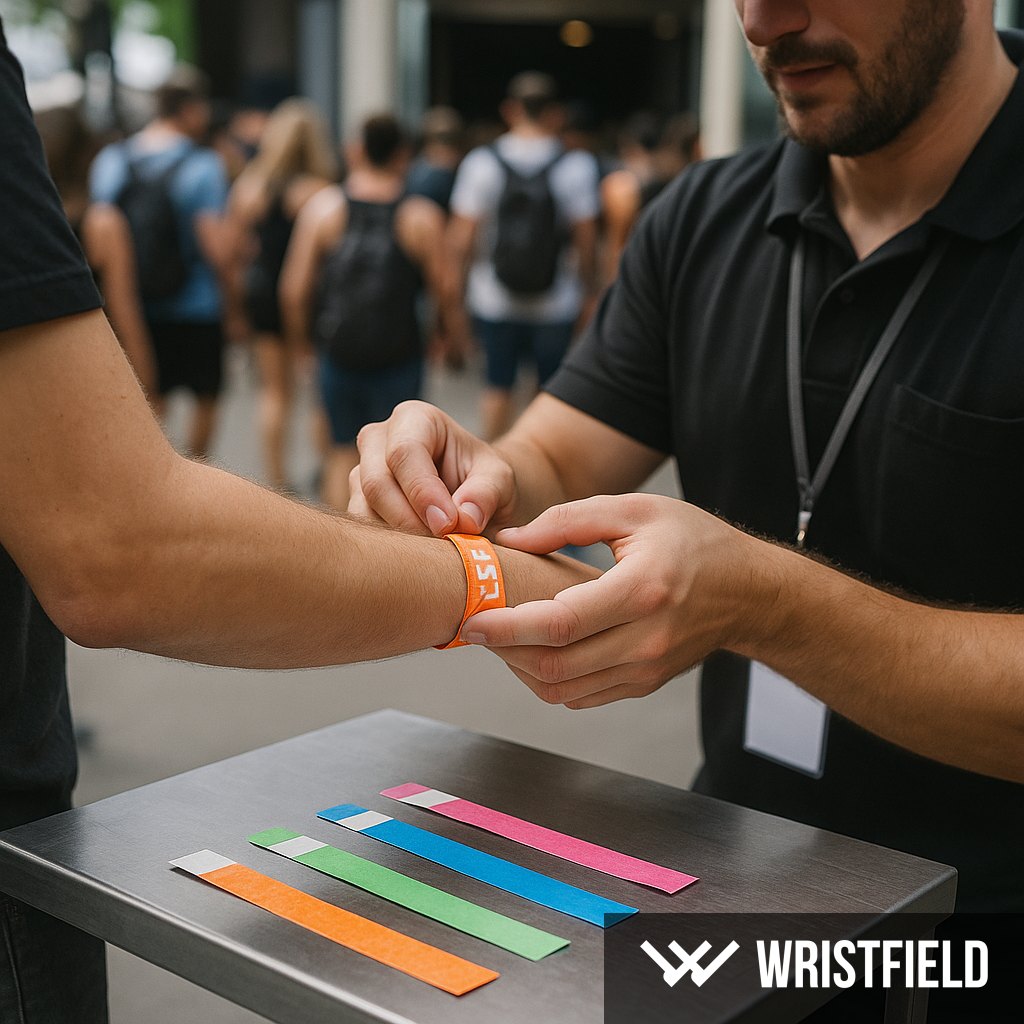
A wristband is more than a ticket. When treated as a visible, wearable communication surface it supports brand recall, sponsor exposure, photogenic content and post-event engagement. This guide explains how to select materials and printing, integrate sponsors, balance security with aesthetics, measure impact and implement wristbands as part of a coherent event marketing strategy.
Wristbands as a Marketing Asset: How to Design, Choose and Maximise Impact at Your Events
Used well, wristbands do two jobs at once: they control access and they extend your event's voice. They sit on attendees, appear in photos and videos, and often become keepsakes. The tactical choices you make about material, print and security directly shape how effectively wristbands support brand recognition, sponsor activation and social reach. Below we cover practical design rules, material trade-offs, mark-making options such as UV varnish, measurable KPIs and the operational steps to deliver a wristband strategy that pulls its weight in your marketing plan.
Why treat a wristband as a marketing surface?
Wristbands are continuously visible on an attendee and they frequently feature in user-generated content. That combination generates repeated impressions for logos, event names and creative motifs during the event and afterwards. In short, wristbands create two distinct visibility channels: the live, on-site audience and the extended, social audience. When a wristband design is clear and recognisable it multiplies the value of both channels without additional media spend.
Core design principles: readable, photogenic, fit for purpose
A successful wristband design balances three demands. First, readability: logos and the event name must remain legible in small-scale photos. Use high contrast and avoid tiny type. Second, photogenic composition: simple, bold graphics and an identifiable colour palette travel better on social feeds than dense patterns. Third, durability and comfort: choose a material that suits the event duration and expected wear. A week-long camping festival requires different durability from a single-evening club night.
Integrating sponsors without overwhelming the design
Sponsors value wristband placement because the item is both worn and photographed. But overcrowding the band with too many logos undermines the event brand and harms photo clarity. Define a clear hierarchy: the event brand should be primary, key sponsor logos secondary. Use placement and scale to create sponsor tiers: a small accent stripe for smaller partners, a larger panel or full reverse side for headline sponsors. This approach lets you create differentiated sponsor packages while keeping the visual language coherent.
Designing for social: encourage photos and shares
Treat the wristband as a 24-hour billboard inside user-generated content. Include a short, memorable hashtag and keep it legible. Consider a simple visual cue that invites interaction, for example a small icon or prompt that hints at content sharing. Where appropriate, a discreet QR code on premium bands can drive measured traffic back to a sponsor landing page or the event programme. Keep QR codes large enough to scan in real life; they rarely read from a photo, so QR codes are more about in-person interaction than social-image reach.
Keepsake value and long-term brand memory
Wristbands that look and feel like a desirable object are more likely to be kept after the event. Fabric wristbands typically perform best as keepsakes; they feel premium and are comfortable to wear post-event. Limited-edition designs or collaborations increase collectability. Decide early whether your wristbands should be disposable functional items or branded merchandise with afterlife value, as that changes material and price decisions.
Material choices and marketing impact: Tyvek, vinyl, fabric
Material selection is an expression of both budget and brand intent. Tyvek is cost-effective, water-resistant and suitable for high-volume, single-use situations. Vinyl offers a glossier finish and higher durability. Fabric provides the premium look-and-feel that increases the chance a wristband will be retained as a keepsake. If the marketing priority is mass reach at low cost, Tyvek is usually the right choice. If the priority is long-term brand visibility and merchandise potential, fabric is better despite higher unit cost. For a deeper dive on trade-offs and financial modelling, see our cost and product guides, for example the practical UK cost breakdowns at "/how-much-does-a-custom-wristband-cost" and the multi-run models for different event sizes at "/how-much-does-a-custom-wristband-cost" and "/full-entry-cost-breakdown-for-a-1-000-person-event-uk".
Printing and marking techniques that affect marketing outcomes
How you mark a wristband affects perceived value and the available creative effects. Full-wrap, multi-colour print gives the strongest visual control but costs more. Screen printing is effective for bold, minimal graphics. A technique worth noting is UV varnish. In our offering UV varnish means an applied lacquer layer that is visible under UV light rather than a UV printing process. It can be used as a discreet anti-counterfeit measure and as an experiential marketing tool: a hidden message or pattern that appears under UV creates a memorable moment at the venue. For operational and cost-risk guidance on UV varnish, see our practical guide at "/uv-varnish-wristbands-entry-control-vip-cost-risk-uk".
Security versus marketing: finding a sensible balance
Security features like tamper-evident closures, serialisation and UV varnish strengthen control but can constrain design or raise costs. Use layered measures that meet your threat profile: numbered wristbands help reconcile admissions and sales; UV varnish helps spot forgeries at entry in low-light or at checkpoints; rigid closures reduce swapping. Our practical security framework explains when to choose which controls and how they affect budgets and throughput - see "/event-security-risk-tiers-entry-access-counterfeit-uk" and "/prevent-wristband-counterfeiting-uv-serialisation-security" for specific guidance.
A simple decision matrix for material and finish
Ask three questions in sequence: duration, audience and marketing goal. If the event is single-day and the priority is cost, choose Tyvek. If multi-day and you need durability, choose vinyl or fabric. If your main objective is post-event brand recall and you expect attendees to keep the wristband, choose fabric. Add security features like serial numbers and UV varnish if fraud risk or reconciliation requirements are significant. For VIP zones and higher-control scenarios, consult our VIP guidance at "/managing-vip-zones-at-events-access-costs-and-admission-control".
Case study - 3,000-person outdoor concert
For a 3,000-person show you need speed of throughput and broad on-site visibility. A common solution is Tyvek with full-surface print and selective UV varnish for anti-counterfeit checks at entry. Reserve larger panels for your event brand and a thinner sponsor stripe for partners. If you are managing multiple sponsor tiers, place primary partner logos on the reverse or in a single stripe to avoid visual overload. For a worked cost and throughput model for this scale of event, see "/3000-person-concert-cost-model-wristbands-entry-staffing-uk".
Case study - 500-person professional conference
At a professional conference, wristbands often double as badges or networking aids. Fabric or premium vinyl increases retention and brand prestige. Consider printing the attendee name, company or a QR code to a personalised programme or sponsor content. This elevates the wristband from a pass to a networking tool and helps sponsors measure engagement. See our conference-focused recommendations and VIP handling tips at "/managing-vip-zones-at-events-access-costs-and-admission-control".
Cost modelling without fixed prices - use ratios and a simple formula
When you do not have final quotes, a conditional approach is best. Use A + (B x N) + S + T, where A is setup cost, B is unit cost, N is quantity, S is special feature cost (for example UV varnish or extra print colours) and T is freight. As a rule of thumb expect fabric unit cost to be roughly 2.5-4x a Tyvek unit cost, and UV varnish to add a single-digit to low-double-digit percent uplift on the printing cost depending on complexity. If you want to compare outcomes quickly, model per-unit cost under three scenarios - base Tyvek, Tyvek + UV varnish, fabric - and calculate cost per share or cost per engagement to present to sponsors. For calculators and worked examples for UK organisers see "/how-much-does-a-custom-wristband-cost" and our larger-event cost models at "/full-entry-cost-breakdown-for-a-1-000-person-event-uk".
Common organiser mistakes and how to avoid them
Typical errors include over-cluttering the design, underestimating durability needs, ordering a single production batch from one supplier and not planning spare stock. Mitigations: keep graphics simple, match material to duration, split production into two batches or use multiple suppliers to avoid single points of failure, and plan a 5-10 percent contingency depending on event variability. For throughput optimisation and entry planning see "/cut-entry-times-by-30-percent".
Measuring wristband marketing impact
Make impact measurable with a compact set of KPIs. Track hashtag impressions, QR code clicks, and the number of photos using the event tag. Use serialised wristbands to reconcile admissions and report sponsor reach from on-site activations. Combine these with engagement metrics and produce a cost-per-engagement or cost-per-share metric for sponsors. If you need help designing sponsor reporting, look at our guidance on combining wristband data and sponsorship ROI at "/prevent-wristband-counterfeiting-uv-serialisation-security" and related pages.
Operational checklist and implementation steps
Follow a clear sequence to make sure wristbands deliver both operational and marketing value: define objectives, choose material and security features, create a simple, high-contrast design, select supplier and production schedule, order with contingency, prepare onsite distribution and scanning or control procedures, and finalise sponsor reporting requirements. If you are managing VIP or multi-zone access, integrate wristband choices with your access control plan - see "/managing-vip-zones-at-events-access-costs-and-admission-control".
Final thoughts
Wristbands are powerful because they combine utility and visibility. The most effective designs are the result of joint decisions on material, security and creative intent. Treat wristbands as a planned marketing channel: design for photography, protect with appropriate security features, and measure the result. When executed to match the event objective, wristbands will amplify sponsorship value, boost social reach and become a memorable keepsake for your audience.
Practical design patterns you can drop into creative briefs
Below are three compact, field-tested design patterns you can paste into a supplier brief or hand to your creative team. They balance legibility, brand impact and sponsor visibility, and they work well in photos and from a distance.
1. High-throughput outdoor show (fast entry, long wear)
Material: Tyvek with full-surface 2-colour print plus selective UV varnish for anti-counterfeit checks. Layout: reserve a 30 mm wide primary panel for the event logo and headline colour field. Use a 10 mm stripe along the edge for the main sponsor. Typography: bold sans serif, minimum x-height so logo remains readable at arm's length. Avoid small text and fine lines. Colour: choose a single bright brand colour for the primary field so wristbands pop in crowd photos.
2. Conference and networking event (retention and data capture)
Material: woven fabric or heat-sealed polyester. Layout: larger surface area for name or QR code on the inner face and event brand on the outer face. Add a thin sponsor stripe on reverse. Include a unique serial or short alphanumeric code for reconciliation. Consider printing a short instruction beneath the QR code, for example Scan to view your schedule, to increase scan rates. Keep typography conservative and readable up close.
3. VIP and experiential activations (premium feel)
Material: silicone, premium woven fabric or custom-moulded PVC. Layout: central logo with debossing or spot-printed metallic finish for premium feel. Integrate security like tamper-evident closures or numbered inserts when controlling access to exclusive areas. For multi-tier VIPs, use subtly different finishes rather than loud colour changes to maintain an upscale appearance.
How to pitch wristband sponsorship - ready-to-use copy and metrics
When you approach potential sponsors, keep the offer concise and value-led. Below is a short pitch paragraph and a recommended set of metrics to include in commercial packs.
Pitch paragraph (editable)
Our event wristbands are visible across the attendee journey and in social content before, during and after the event. Each wristband acts as a mobile brand placement and a practical access control tool. We offer primary placement on the inner face for high-frequency visibility and a partner stripe for measured exposure. We will provide sponsor reporting that includes reconcilable admissions, QR code scans and social reach to quantify return on investment.
Recommended metrics to promise and deliver
- Number of wristbands issued - verified by serialised counts at entry
- Estimated impressions - composite of live photography baseline and social media mentions using the official hashtag
- QR code clicks - total and unique; provide timestamps for sponsor activations
- Cost per engagement - total sponsor cost divided by QR clicks, scans or contest entries
Include a short testimonial or image example from a past event if you have one, and clarify data refresh cadence - for example, preliminary report within 48 hours and a final report within seven working days.
Onsite distribution, staff scripts and training points
Entry and distribution are where wristband plans succeed or fail. Use a short script for consistency and train staff on a handful of behaviours.
Simple entry script
Hello, welcome. Please hold out your wrist and we will apply your band. This wristband is your access pass and we will check it as you enter each zone. If you lose it, report to the accreditation desk and we will assist you. Thank you.
Staff training essentials
- Speed and accuracy - practice a two-second application cycle for Tyvek; train for the slightly longer fabric application
- Security checks - verify serialisation and UV varnish with the appropriate light at each controlled gate
- Handling exceptions - staff should escalate lost or damaged wristbands to a named supervisor rather than improvising replacements
Run one on-site dry run before doors open and include a contingency station with spare stock, replacement closures and a small register for exception handling.
Photography and social activation - make wristbands work on camera
If you design wristbands for social amplification, think like a photographer. Simple contrasts render well: bands that use a bold, single-colour field with a white or black logo read clearly in mobile phone images. Avoid tiny repeating patterns that create moire or disappear at typical photo resolutions. For placements, position an identifiable logo panel where it will be visible when people raise their hands or hold drinks - roughly the top third of the visible wrist area.
Activation ideas that drive shares
- Photo frame station where attendees pose to highlight the wristband and tag the sponsor
- QR-enabled treasure hunt where scans on wristbands reveal time-limited coupons
- Styled wristband close-up as part of VIP package unboxing to encourage pre-event sharing
Sustainability and end-of-life options
Plan the lifecycle of your wristbands like any other piece of event collateral. If you choose single-use plastics, offset the impact with a clear recycling or takeback scheme. Fabric and woven options increase retention and reduce single-use waste, but they have a higher production footprint per item. To balance this:
Options to consider
- Compostable Tyvek alternatives where biodegradability is certified
- Reusable keep-safe bands for multi-day events that double as a merchandise item
- Post-event collection points and reward coupons for returning bands if you use recyclable materials
Include a short sustainability note in sponsor packs to align with corporate social responsibility goals. Many brands will value an explicit reduction plan or circularity statement when approving activations.
Vendor negotiation checklist and production timeline
When you are quoting suppliers, keep these points to hand:
- Ask for lead time in calendar days and confirm production start triggers
- Request print proofs and a digital mock-up showing legibility at 100 percent scale
- Negotiate split production if you need contingency stock quickly
- Confirm freight terms, customs handling and an uplift for rush jobs
- Specify quality acceptance criteria and an allowance for defect percentage
Typical production timeline for a standard order
Internal final artwork to sign-off: 2-3 days. Supplier production lead time: 7-14 days for Tyvek, 14-28 days for fabric, longer for special finishes. Freight and customs: 3-7 days domestic, 7-21 days international depending on service. Plan a minimum four-week window for international or complex finishes.
Contingency and troubleshooting quick guide
Common problems and immediate fixes
- Misprinted batch - isolate stock and use secondary supplier for a rapid top-up
- Higher than expected wristband loss - increase on-site replacements and log serial numbers for audit
- Entry bottlenecks - open a fast-track lane for pre-registered attendees wearing a clearly different band finish
- Fraud or counterfeit attempts - deploy UV verification or switch to tamper-evident closures mid-event and document changes
Keep a short decision matrix so the event manager can authorise emergency measures without delaying attendee flow. Small, documented fixes are usually preferable to wholesale on-site design changes.
Short FAQ - what organisers ask most
Q: How many wristbands should I order as contingency?
A: Order 5-10 percent over your expected attendance for predictable variance. For outdoor festivals or variable turn-up events, increase contingency to 10-15 percent.
Q: Are serialised wristbands worth the cost?
A: Yes, when you need reconciled admissions, sponsor reporting or fraud mitigation. The uplift is relatively small for printed serial numbers but provides significant operational value.
Q: Can I change wristband design on short notice?
A: Minor design changes are possible only if the supplier can reuse existing plates or print files. For fabric or special finishes, changes typically add 2-5 working days and a rework fee.
Next steps - a compact operational checklist you can copy
Use this checklist in the final two weeks before your event:
- Confirm final quantities and contingency percentage
- Approve print proofs and serialisation sequence
- Schedule proof-of-delivery and onsite inspection window
- Prepare entry staff training and scripts
- Define sponsor reporting fields and delivery dates
- Set up a sustainability statement and end-of-life plan for wristbands
Applying these recommendations will not only reduce risks but also increase the marketing yield of wristbands as a commercial asset. Treat the wristband as more than a functional item - it is a piece of mobile advertising and a touchpoint that, when executed correctly, amplifies brand presence and measurable engagement.