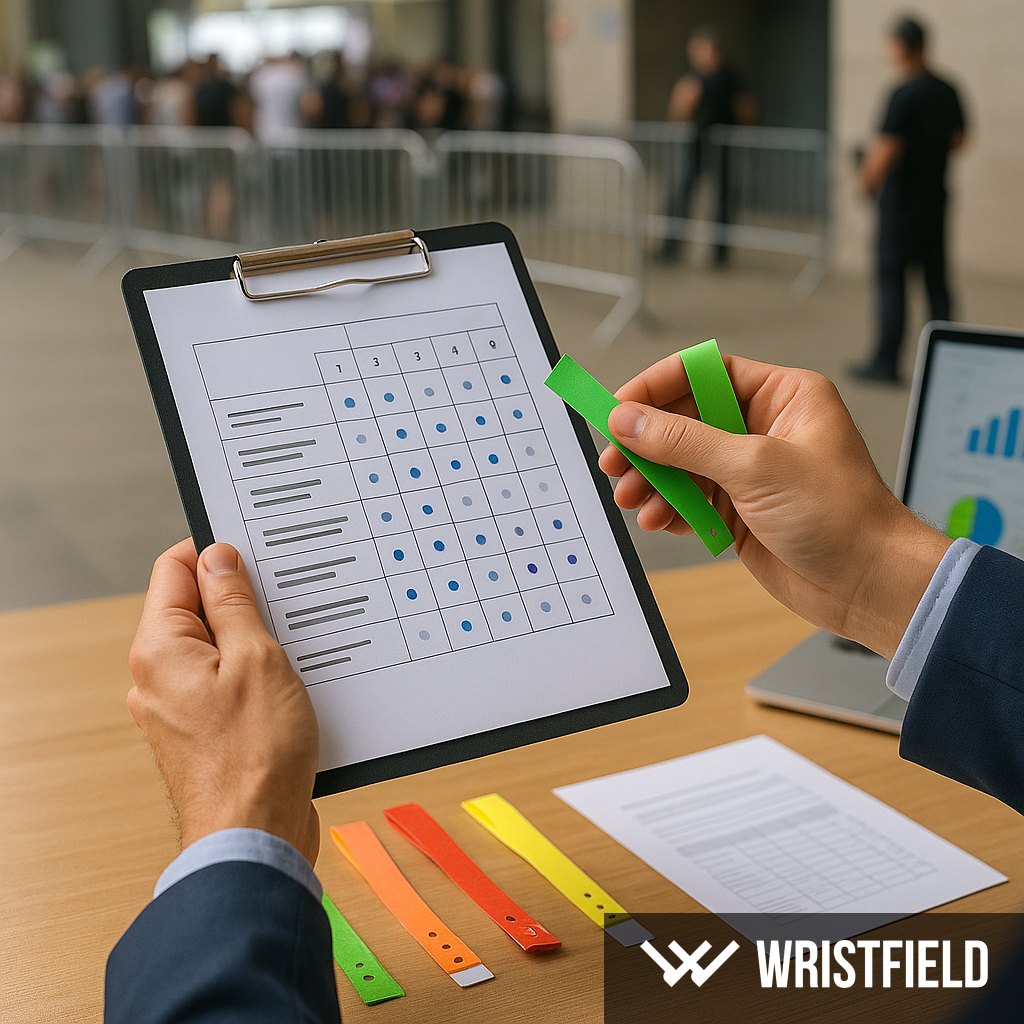
Complete wristband decision matrix for events
Every event is different. The right wristband balances physical durability, counterfeiting risk, cost, branding potential and how quickly you need the bands manufactured. The decision matrix approach reduces subjective guesswork by turning those factors into weighted scores you can test and compare. Below you will find the matrix logic, typical wristband types and their trade offs, operational considerations, a worked scoring example, and practical next steps you can apply when you place an order.
Which factors should the matrix include?
At minimum the matrix should score these dimensions, then multiply each score by a dimension weight that reflects your event priorities:
Type - material and fastening (Tyvek, vinyl, fabric, RFID/NFC).
Security level - resistance to counterfeiting and unauthorised transfer.
Event length and environment - single session, all day, multi-day camping, or beach/waterfront.
Budget - per-unit and total cost including setup fees and any system hardware.
Marketing value - visibility, sponsor space and giveaway potential.
Production lead time - in-stock options versus standard and express production.
How to build and use the matrix
Step 1: Set weights. Allocate a weight to each dimension (for example security 30, budget 30, marketing 15, event length 15, lead time 10). The weights must sum to 100. Weighting is the place to encode your event priorities.
Step 2: Score each wristband type 1 to 5 against every dimension. A higher score means better fit.
Step 3: Multiply each score by its weight, sum the weighted values for each type and compare totals. The highest total is your matrix winner for the chosen weights.
Step 4: Run sensitivity checks. Change weights to reflect alternate priorities (for example increase security weight if VIP protection is critical). If results flip significantly, document the scenarios so decision making is transparent.
Wristband types at a glance and practical trade offs
Below are the common wristband types with the practical strengths and limitations event teams encounter.
Tyvek wristbands
Pros: very low cost per unit, can be pre-printed, good for short events and high throughput entry. Cons: paper-like durability, can be removed and counterfeited more easily if used alone. Best when combined with serialisation and a discreet security marker such as UV varnish. See also: how much does a custom wristband cost? for cost structure context.
Vinyl wristbands
Pros: water resistant, more robust than Tyvek, offers a larger printable surface for branding. Cons: higher unit cost than Tyvek, medium security unless you add tamper-evident closures or security print.
Fabric (woven or printed textile) wristbands
Pros: comfortable for multi-day events, excellent branding and sponsor value, hard to remove without damaging. Cons: significantly more expensive, longer lead times. Ideal for multi-day festivals and VIP passes. For VIP management details see managing VIP zones at events.
RFID and NFC enabled wristbands
Pros: offer the highest level of access control, cashless payments and data collection. Cons: capital expenditure on readers, more complex logistics and integration, longer lead times and higher unit cost. Best for large multi-day events where the technology pays back through operations or revenue capture.
Security layering and hybrid approaches
Effective anti-counterfeit strategies use layers. A visual layer makes quick checks at entry, a covert layer stops casual copying, and a technological layer is used where practical.
Typical layered example: printed wristband (visual), serial number (traceability), UV varnish mark (covert verification), plus a tamper-evident fastening. For more on preventing counterfeiting see preventing wristband counterfeiting. Note: when this guide mentions UV varnish it means a varnish visible only under UV light, not UV printing.
UV varnish clarified and when to use it
UV varnish is a transparent coating applied during production that becomes visible under UV light. It is a low-cost covert marker used for rapid verification at controlled checkpoints such as backstage or VIP doors. It should be used as part of a layered approach rather than as a sole defence. For an operational view and cost-risk modelling refer to UV varnish for wristbands.
Production lead times and express options
Lead time is often decisive. Typical UK lead time guidance you can expect from suppliers is: in-stock Tyvek same week, standard custom Tyvek 5-10 working days, fabric 10-20 working days, RFID 3-6 weeks depending on integration. Express production is available but it increases unit cost. If you are short on time, consider an in-stock Tyvek base combined onsite with a security layer such as UV varnish or a sticker swap for evening replacements. For guidance on when express production is worth the premium see when express production is worth it.
Cost modelling approach and conditional example
When you build a cost model, separate per-unit manufacturing cost from fixed setup fees and from any operational hardware or staffing costs. Because suppliers and volumes vary, this example deliberately uses indicative ranges rather than fixed prices.
Indicative unit cost ranges (example only): Tyvek low custom run 0.05 to 0.12 GBP per unit, vinyl 0.12 to 0.50 GBP, fabric 0.90 to 6.00 GBP, RFID 1.50 to 8.00 GBP depending on chip type and integration. Setup fees might be 20 to 200 GBP for basic artwork, and substantially higher for RFID system setup. Always request full quotes that separate unit price, artwork/setup, and express surcharges.
Remember to budget for reserves. A sensible reserve is 5 to 10 percent for single day events, 10 to 15 percent for multi-day events. That reserve covers replacements for lost bands, damaged items and on-site errors.
Worked scoring example: three day outdoor music festival
Scenario: three day festival, 5 000 expected attendees, moderate budget, high brand and sponsor value, 14 day lead time. We choose weights to reflect priorities: security 30, event length 25, budget 20, marketing 15, lead time 10. Scores are 1 (poor) to 5 (excellent).
Scoring example (Tyvek, Vinyl, Fabric, RFID):
Tyvek scores: security 3, event length 2, budget 5, marketing 2, lead time 4.
Vinyl scores: security 3, event length 3, budget 4, marketing 3, lead time 3.
Fabric scores: security 4, event length 5, budget 2, marketing 5, lead time 2.
RFID scores: security 5, event length 5, budget 1, marketing 3, lead time 1.
Multiply and sum: Tyvek weighted total 0.30×3 + 0.25×2 + 0.20×5 + 0.15×2 + 0.10×4 = 3.35. Vinyl 3.10. Fabric 3.05. RFID 2.70. With these weights Tyvek wins because acceptable durability plus fastest lead time and lowest cost best meet the constraints.
If security weight rises to 40 and budget drops to 15 the RFID or fabric option becomes more likely. The point is to document the assumption set and test alternatives before contracting.
Operational model: pick and pack versus zonal distribution
Two common fulfilment models are used for wristband distribution:
1) Centralised pick and pack. Wristbands and welcome packs are prepared in a controlled environment, often pre-bundled per ticket buyer and allocated to named envelopes. This reduces queue time but increases warehousing and logistics effort.
2) Zonal distribution. Each entry gate or zone gets pre-allocated boxes with staff trained to a simple process. This reduces pre-event logistical complexity but increases the need for robust gate training.
Choose centralised pick and pack for corporate or ticketed VIP events where control and accuracy matter. For general admission gates zonal distribution with clear SOPs and simple visual checks is usually faster and cheaper.
Throughput planning and staffing
Plan gate capacity on realistic per-person servicing rates. A well-trained operator applying a wristband and doing basic checks can process around 20 to 30 people per minute at a peak gate; a conservative planning figure is 20 per minute. If your peak arrival is 2 000 people in an hour you will need multiple gates and backup staff to avoid queues. Add 20 percent contingency staffing to cover breaks and escalations.
Common mistakes and how to avoid them
Frequent errors include under-ordering reserves, underestimating production lead time, and over-relying on a single security measure. Mitigations:
Order an extra 5 to 15 percent depending on event length. Build clear approval deadlines for artwork so production slots do not slip. Combine visual and covert security layers such as serialisation and UV varnish rather than depending on one method.
On-site testing and acceptance checks
When the goods arrive perform an immediate acceptance test. Check colour consistency, serial numbers, locking mechanisms and test UV varnish marks under a portable UV torch. Run a short simulated entry exercise with staff to validate placement speed and to identify any problem with fit or comfort.
Simple operational checklist before you order
1. Confirm your event priorities and set dimension weights.
2. Get itemised quotes that separate unit cost, setup, security options and express fees.
3. Add a reserve percentage to your total quantity.
4. Plan gate staffing and run a throughput calculation for peak arrival periods.
5. Schedule a sample acceptance test and a pre-event gate rehearsal.
When to bring in technology
Only invest in RFID/NFC when you can justify the total cost of ownership. Use cases that justify the spend include cashless payments that raise net revenue, precise access control for many sensitive zones, or when you need analytics that materially affect operations and income. For a full cost and operational model for a 3 000 person concert see the 3 000 person concert cost model.
Final recommendations and next steps
Use the weighted matrix as your primary decision tool. Where possible create a short tender that requests three options from suppliers: the lowest cost practical solution, a mid-level secure solution and a premium solution with lead times and unit costs itemised. Test a small sample run if the artwork or locking mechanism is unusual.
If you would like a customised decision matrix for your event, gather participant numbers, event length, environmental factors (water, mud), a budget range and logo/artwork expectations. With those inputs you can generate a clear scoring table and a recommended purchase quantity and specification.
Further reading
Related practical guides: How numbered wristbands work at events, Preventing wristband counterfeiting and UV varnish for wristbands for a deep dive on the covert security layer.
Choosing a wristband is a multi-faceted procurement decision. Make it defensible with a transparent scorecard, test the physical sample, add reserves and combine security layers. This approach keeps queues moving, reduces fraud risk and protects both your budget and your brand.