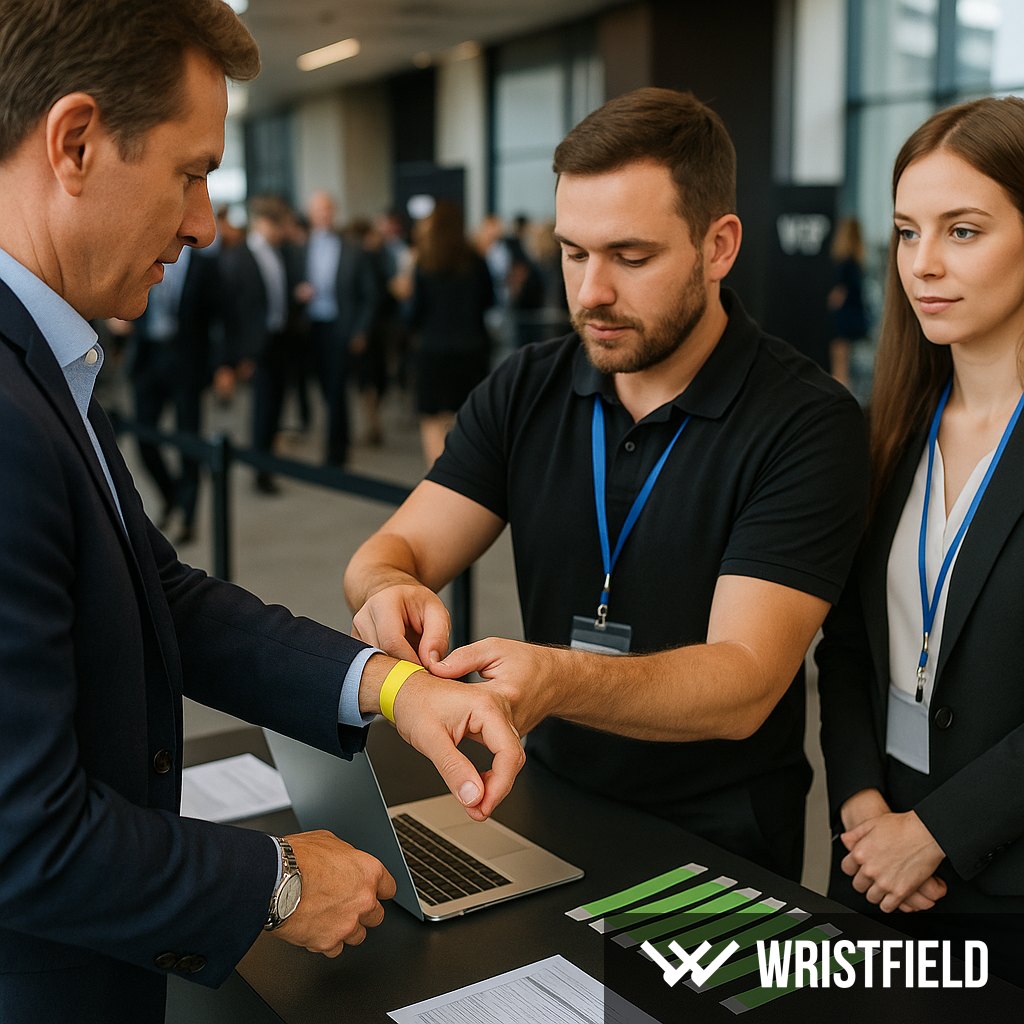
A well designed entry model keeps a corporate event secure, professional and friction free. This guide explains how to classify guests, allocate access rights, design VIP and speaker flows, and choose discreet, effective wristband solutions. It covers operational planning, anti-counterfeit measures including UV varnish, staffing maths and on-the-day protocols so organisers can make confident, practical choices.
Why you need a purpose-built entry model for corporate events
An entry model is more than headcount control. It should serve the event objectives while protecting confidentiality, guest experience and operational efficiency. A clear model establishes who can access which spaces, how those rights are verified, and what the fallbacks are if something goes wrong. Getting this right reduces bottlenecks, protects speakers and VIPs, and lowers the risk of fraud without making guests feel policed.
Guest types and access levels
Start by defining guest categories. Use a three-tier access classification: public, restricted and full. Public areas are open to registered attendees; restricted areas need visible but unobtrusive proof of entitlement; full access is reserved for staff, technical crews and certain speakers. Map each guest type to the areas they need to reach.
| Guest type |
Typical access |
Notes |
| Registered delegate |
Public sessions, networking areas |
Online pre-registration advised |
| Speaker |
Backstage, green room, stage access |
Dedicated registration point and wristband |
| Event staff & crew |
Full access for operations |
Durable wristband and internal coding |
| VIP guest |
VIP lounge, priority entry, private meetings |
Discreet handling and heightened security |
| Media |
Press areas; selective stage access with accreditation |
Accreditation checks; separate wristband colour or mark |
Designing VIP and speaker flows
VIPs and speakers require a different mix of discretion and predictability. Discreet entry means avoiding public checks in full view; predictability means they arrive on time and know where to go. Provide:
- separate arrival point or a clearly signposted quick lane,
- dedicated registration desk with sealed envelopes for VIP packs,
- a concierge or staff member assigned to escort high-profile guests when required,
- clear backstage access routing for speakers to avoid cross-traffic with delegates.
Speakers should have a single, rapid-check process. For VIPs, combine a visible token (a discrete fabric wristband or internal tag) with an invisible security feature such as UV varnish or a coded internal serial. For more on managing VIP zones see the practical guide in our resources on Managing VIP Zones at Events:
/managing-vip-zones-at-events.
Registration models and why you should mix them
Most professional events use a hybrid of three models: online pre-registration, on-site express collection and full on-site registration. Online pre-registration reduces peak-time pressure and shortens dwell times at the desks. Offer clear instructions and a reference code to speed collection. A dedicated express lane for preregistered attendees is essential.
On-site full registration needs extra capacity and signage. Plan where walk-ins queue and how they join the flow without blocking express or VIP lanes. A separate speaker desk is critical; combining speaker, VIP and walk-in issuance at a single desk increases error and slows the whole operation. For throughput optimisation techniques see our guidance on cutting entry times: /cut-entry-times-by-30-percent.
Wristband strategy: materials, invisibility and security
Choosing a wristband is a strategic decision, not merely aesthetic. Typical options are Tyvek (paper-like), vinyl (durable and waterproof) and fabric (premium). Consider durability, cost, comfort and how easily a band can be cloned or re-used. Equally important is how visible entitlement is communicated: bold visible markers can be suitable for festivals, but corporate settings often demand a discreet look.
Discreet security techniques work well in corporate events:
- internal serialisation printed inside the band for spot checks;
- UV varnish marks that are invisible in normal light and only show under a UV lamp;
- subtle fabric trims or bespoke inner labels for VIPs;
- manual signature strips for additional verification when handing over special access packs.
Important note on UV varnish: in this context UV varnish is a coating applied to the wristband that fluoresces under UV light. It is not UV printing. The mark is invisible to the naked eye and allows quick, discreet checks with a small UV torch. For technical details on UV varnish and where it helps operationally see our practical guide:
/uv-varnish-wristbands-entry-control-vip-cost-risk-uk.
Layered anti-counterfeit strategy
Preventing wristband fraud is about layers. For low-risk internal training, numbered wristbands plus ID checks may suffice. For guest-facing partner conferences or closed demos, combine several measures: a robust base material, sequential numbering, UV varnish and on-site staff trained to perform a quick, discreet check. Regular, random spot checks are far more effective than obvious public inspections. Our article on preventing wristband counterfeiting explains practical, cost-minded combinations:
/prevent-wristband-counterfeiting-uv-serialisation-security.
Staffing and throughput: a worked operational example
The planning formula is straightforward: available counters multiplied by the per-counter processing rate gives maximum throughput for the period. Below is a practical calculation for a one-day partner conference with 1,500 expected attendees. Use it as a template and adapt the processing rates to your chosen registration tasks.
Scenario assumptions: 1,500 total attendees, 70 percent preregistered (1,050), 30 percent requiring on-site registration (450). You plan to clear the morning peak within 90 minutes.
Processing rates to assume for planning: express collection 40 people per hour per counter; full registration with badge printing 15 people per hour per counter. Calculations:
Full registration counters required = 450 attendees / (15 per hour * 1.5 hours) = 20 counters.
Express collection counters required = 1,050 attendees / (40 per hour * 1.5 hours) = 17.5, round up to 18 counters.
Total counters for peak = 38; include a 10 percent contingency for staff absence and surges, bringing the recommended number to 42 counters. Allocate at least one staff member per counter, plus a small dedicated team for VIP handling, problem tickets and wristband issues. For a larger breakdown and cost modelling of a 3,000-person scenario, see our detailed case study: /3000-person-concert-cost-model-wristbands-entry-staffing-uk.
Operational errors organisers make and how to avoid them
Common failings are easy to correct:
- Mixing VIP, speaker and walk-in issuance at the same desk. Fix: separate desks and sealed VIP envelopes.
- Not allocating enough express lanes for preregistered guests. Fix: dynamic reallocation of desks during peaks.
- Poor zone signage and staff briefing. Fix: simple visual cues and a short, written zone brief for staff.
- No contingency wristband stock or replacement protocol. Fix: hold at least 5 to 10 percent extra bands and a rapid swap process for damaged bands.
On-the-day protocols: concise, actionable checklist
Create a one-page protocol for front-line staff that includes:
- arrival and brief window: counters staffed 60 minutes before doors open,
- express lane procedures and signage layout,
- VIP discrete handling: who receives sealed packs and how UV checks are performed,
- escalation path for suspected counterfeit or mismatched identity,
- protocol for wristband replacements and stock tracking.
Keep the protocol short, train staff with a 10 to 15 minute walk-through and circulate a printed copy at each desk.
Integrating entry data and post-event analysis
Link your registration platform with on-site scanners or simple collection reports. Real-time dashboards let you see queue lengths and adapt staff allocation. After the event, use the data to refine counter numbers, wristband quantities and the proportion of pre-registration promotion needed. Data-driven adjustments reduce costs and enhance guest experience for the next event.
Decision matrix and practical examples
Match event priorities to wristband and process choices:
- Brand visibility and high-end networking: fabric wristbands, UV varnish for VIPs, concierge service, dedicated VIP entrance.
- Low-cost internal workshop: Tyvek bands, strong pre-registration drive, minimal on-site staff.
- High-security partner demo: robust material, serial numbers, UV varnish and periodic spot checks by trained staff.
Example cost-thinking (conditional): if a fabric wristband costs around 40p each and Tyvek around 4p each, on a 1,500-person event the incremental spend for fabric is material but may pay back in brand perception and fewer staffing minutes if it speeds throughput. Treat price examples as conditional assumptions and substitute your supplier quotes before finalising procurement. For more on how wristband unit cost builds up see our guide:
/how-much-does-a-custom-wristband-cost.
Final checklist for organisers
Before sign-off, confirm the following:
- guest typology and zone map are final,
- wristband types and anti-counterfeit measures chosen and stock ordered with 5 to 10 percent buffer,
- separate desks for VIPs and speakers with sealed kits,
- express lanes planned and staff briefed,
- simple written on-day protocol and UV inspection routine where used,
- reporting integration for real-time flow monitoring and post-event analysis.
Closing thoughts
A corporate event entry model succeeds when it balances security, guest experience and operational simplicity. Clear guest categories, layered wristband security that favours discretion, and a staff plan based on realistic throughput figures deliver a professional result. Keep procedures simple, train the team and use data to refine future events. For tactical checklists, cost models and deeper technical details on UV varnish, serialisation and throughput modelling, consult the linked resources in this article.
Refining access levels and guest profiles for practical control
Having clearly defined access levels avoids ambiguity at the door and reduces friction for guests. Beyond the basic labels of VIP, staff and attendee, break profiles into operationally useful groups such as: core VIPs (executives, sponsors), managed VIPs (guests escorted by a host), speakers and presenters, backstage contractors, and general attendees. For each group specify three attributes: permitted zones, acceptable ID forms, and expected handling procedure at arrival.
Translate these attributes into simple entry rules. For example: core VIPs - access to VIP lounge, speaker green room and front-floor seating; presentation of government ID or company badge; collected from sealed VIP envelopes or escorted direct to concierge. Managed VIPs - access to lounge only; host presents guest at VIP desk; issued a discreet marker without public display.
Practical benefits
Designing access levels this way reduces decision-making at the gate, speeds throughput and makes it easier to train temporary staff. It also creates a traceable permission set for security checks and post-event audits.
Discrete VIP strategy: subtle signals that work
Discretion need not mean compromise on security. Use low-visibility signals that communicate privilege without singling individuals out. Options that balance elegance and practicality include:
- Sealed envelopes labelled only with a code rather than the role name, opened by concierge out of public view.
- Subtle wristband cues such as a narrow woven stripe or a matt varnish patch positioned on the inside of the band where it is visible to staff but not obvious to other guests.
- Small metal or enamel pins kept in the concierge pocket and applied under the jacket lapel on request.
These methods reduce attention on VIPs while still making rapid verification possible. Test the chosen approach during a dress rehearsal to ensure it is quick for staff to check and comfortable for wearers.
Anti-counterfeit measures and workable verification workflows
Layered anti-counterfeit controls are the most effective. Combine two or three modest measures rather than relying on a single expensive solution. Possible combinations include serialised wristbands with UV varnish, a printed short alphanumeric code linked to registration records, and random spot checks at internal chokepoints.
Verification should be a low-friction, repeatable process. A recommended sequence at entry is: scan ticket or check name on roster, visually confirm wristband or marker, perform a rapid UV check if the guest is accessing a sensitive zone. Keep UV checks targeted rather than universal. Use them primarily for VIP areas, sponsor spaces and backstage access.
Maintain a simple log for any manual verifications or reissued wristbands. A staffed table near accreditation with a tablet or paper log reduces later disputes and supports post-event analysis.
Supplier selection and procurement checklist
Choose suppliers who can deliver reliably and respond to late changes. Evaluate potential vendors on five practical criteria: lead times, minimum order quantities, sample quality, on-site support availability and clear pricing for rush orders. Ask for material samples and mock-ups before final commitment. Confirm whether serialisation or custom print runs add setup time and test whether UV varnish can be applied to the band material you prefer.
Negotiate a contingency clause. For example, include an agreement for a top-up run with agreed unit price and delivery within 48 hours if you under-order by up to 10 percent. That clause protects you against both traffic overruns and last-minute sponsor lists.
Accessibility and inclusive access management
Ensure wristband materials and attachment methods respect accessibility needs. Avoid bands that are difficult to fasten for guests with limited dexterity. Offer alternatives such as lanyards or printed guest cards with the same security features. Clearly communicate those options at registration, on the event web page and at the FAQ desk.
Train staff to recognise and support guests who need discreet assistance. Have a quiet desk area where guests can be processed away from queues and bright signage. Accessibility is not only compliance; it is an integral part of a premium guest experience.
Sustainability considerations that balance cost and quality
Event teams increasingly need to justify material choices on environmental grounds. Tyvek bands are inexpensive but single-use and plastic-based. Some fabric bands can be recycled if removed, but they often embed metallic or glued elements that complicate recycling. If sustainability is a priority, opt for bands made from recycled polyester or responsibly sourced cotton blends and confirm end-of-life instructions with the supplier.
Plan a collection and recycling point at exit. This simple gesture lowers environmental impact and can be turned into a post-event report for sponsors who care about sustainable procurement.
Staff training, rehearsals and role clarity
Spend the equivalent of one full briefing session per role. For example a two-hour briefing for desk leads and a 20-minute practical walk-through for temporary check-in staff. Focus training on the small but important details: where VIP envelopes are stored, who can authorise wristband replacement, how to record an incident, and the escalation path for suspicious documentation.
Run a short live rehearsal on site with real wristbands and timed queues. This reveals choke points and verifies your counter allocation assumptions. Use the rehearsal to test the express lane switching plan and to validate the count of spare wristbands held in reserve.
Contingency planning: four plausible scenarios and responses
Prepare for predictable issues with brief, actionable responses. Examples:
- Unexpected attendance surge. Response: open reserve counters, deploy two staff from zone management to join express lanes, and announce alternative entry points to arriving groups.
- Wristband shortage for a specific type. Response: use a temporary marker such as a branded adhesive tab plus a log entry that links the tab serial to the registrant record.
- Counterfeit band flagged. Response: remove the guest to a verification area, check ID and registration records, replace the band if authenticated and file an incident report for later review.
- VIP scheduled arrival delay. Response: hold sealed VIP envelope in secure, temperature-stable storage and send a discrete update to the host with estimated arrival time.
Document the decision triggers for each response so less experienced staff can act without waiting for approvals.
Sample single-page SOP for VIP handling
VIP HANDLING - ONE SHEET SOP

1. Preparation (60 minutes before doors)
- Sealed VIP envelopes stored in lockable concierge box.
- Concierge team leader carries key and manifest.
- Designated quiet desk set up near VIP entrance with soft lighting.

2. Arrival procedure
- Host meets guest at main arrival or they proceed to VIP entrance as requested.
- Concierge confirms guest identity against manifest (name and code).
- Envelope is opened discreetly; wristband or pin applied out of public eye.
- Guest offered immediate escort to lounge or table.

3. Verification during event
- Staff performing spot checks use the inner band marker or UV check.
- Any mismatch triggers: polite escort to verification desk, ID checked, record logged.

4. Replacement process
- Damaged or removed wristbands replaced only after checking ID and manifest.
- Replacement wristband serial logged against original serial and reason.

5. Escalation
- If counterfeit suspected: inform security lead, remove guest to private area, call the event manager.
- Do not publicly challenge guest. Use calm, professional language and maintain discretion.

6. Post-event wrap
- Return unused envelopes to secure box and file the signed manifest.
- Report any incidents to operations for follow-up with registration and legal teams.
This SOP can be printed as a pocket card for concierge staff and condensed into a laminated card at the VIP desk.
Closing practical notes
Small operational choices translate into significant differences in guest experience and security. The aim is not to make entry an obstacle but to make it reliably predictable. Test solutions at scale, define modest but enforceable rules, and use layered measures rather than a single infallible mechanism. Finally, capture the lessons from each event in a short after-action note so that your next guest typology, wristband run and desk plan are better informed and faster to deploy.