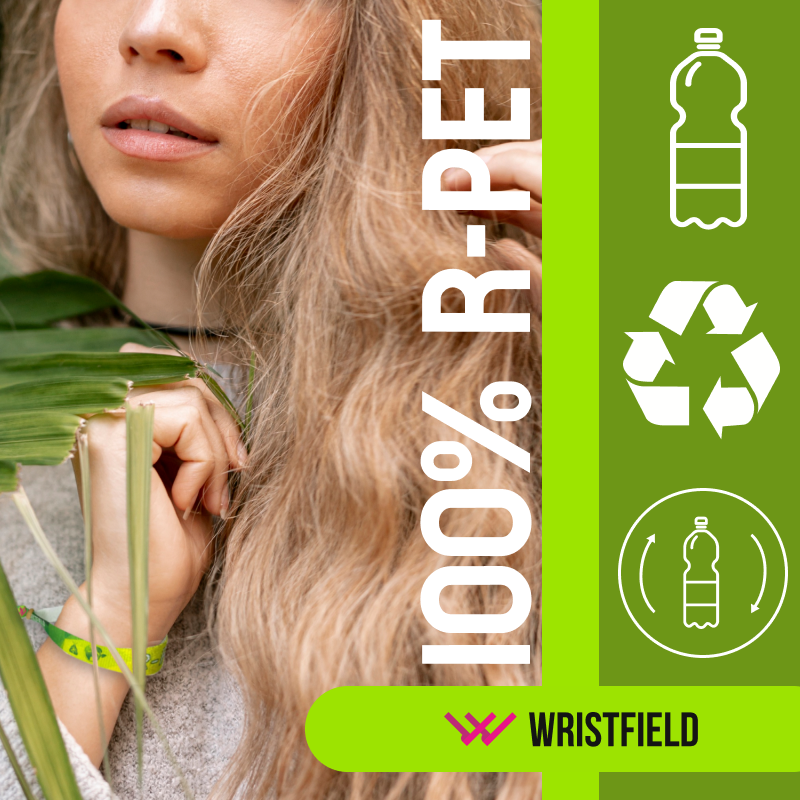
Sustainability is no longer optional for organisations that want to keep customers and partners onside. This practical guide explains how recycled polyester lanyards and wristbands made from R-PET work, what to ask suppliers, how to combine green materials with robust access control and anti-counterfeit measures, and how to present your environmental claims credibly to UK audiences.
Why choose eco-friendly lanyards and wristbands?
Clients, delegates and festivalgoers expect more from brands now: demonstrable environmental action and sensible procurement. Replacing virgin polyester or single-use plastics with recycled-polyester lanyards and R-PET wristbands reduces landfill and supports circular economy principles, while still delivering the durability and print quality organisers need.
What is R-PET?
R-PET, written as R-PET or rPET, is recycled polyethylene terephthalate derived from post-consumer plastic such as used single-use bottles. The material is processed into fibres and woven or knitted into lanyards and wristband tapes. Using R-PET reduces demand for virgin polymers, saves energy in production compared with new polyester, and diverts plastic from landfill and incineration.
Key environmental advantages and limitations
R-PET brings genuine benefits, but like all materials it has trade-offs. Below is a practical summary to help procurement decisions.
| Material |
Typical use |
Environmental credentials |
Durability |
| R-PET |
Branded lanyards, wristbands for festivals, corporate events |
Lower carbon and energy footprint than virgin polyester; uses post-consumer waste |
High - suitable for long events, reusable programmes |
| Tyvek |
Single-use wristbands, cheap events |
Mixed - light weight but often single-use and not widely recycled |
Low - designed to be tamper-evident single-use |
| Woven polyester |
Premium lanyards and wristbands |
Depends on whether the yarn is recycled; virgin has higher footprint |
Very high - designed for repeated use |
Certifications and claims to look for
Not all recycled-looking products are equal. For credible claims ask suppliers about:
- Percentage of recycled content and whether the figure is third-party certified.
- Global Recycled Standard (GRS) or similar chain-of-custody certification.
- Evidence of post-consumer feedstock (PCR) rather than pre-consumer or downcycled content.
- Oeko-Tex or REACH compliance for chemicals used in inks and finishes.
These details allow you to communicate transparently in sustainability reports and marketing copy.
Design, branding and finish options
R-PET lanyards accept the same range of customisation as conventional polyester: woven logos for a premium look, printed flat-surface graphics for full colour, and heat-seal or sublimation printing for photo-quality results. For wristbands, options include:
- Full-colour print - excellent for brand-heavy designs.
- Woven text or logos - durable and premium-feel.
- Heat-seal closures or plastic locks - options for reusability or one-time tamper-evident use.
- Attachment hardware - safety breakaway clasps for lanyards where required.
When specifying print processes, confirm that inks and varnishes meet the environmental and safety standards you require.
Security and anti-counterfeit measures that work with R-PET
Sustainable materials are compatible with the security features organisers rely on. Common options include serialisation, numbered printing, tamper-evident closures and UV markings. Important clarification: our UV marking refers to a varnish or printed element that is visible under UV light, not UV printing. If you want to learn more about how UV varnish helps at entry points, see our practical guide on UV varnish for wristbands.
For fraud prevention combine material choice with operational checks. Our related articles on preventing wristband counterfeiting and how numbered wristbands work explain practical entry procedures and ROI considerations.
Operational and lifecycle thinking
Choosing R-PET is only part of a sustainable approach. Consider the full lifecycle:
- Ordering quantities aligned to use - excess stock increases waste. See our guides on quantity modelling for events in the blog for practical examples.
- Storage and reuse - woven R-PET lanyards can be collected at the end of an event and reused at future events, lowering lifetime impact.
- End-of-life options - ask suppliers whether the product can be reprocessed and whether they run take-back schemes.
- Cleaning and longevity - R-PET is washable; provide clear washing instructions to prolong life and keep brand presentation high.
Practical procurement checklist
Use this checklist to brief suppliers and compare offers:
- Specify recycled content percentage and request certification evidence (GRS or equivalent).
- State expected lifespan and whether the item should be single-use or reusable.
- Define branding method: woven, printed, or sublimation, and request colour proofs.
- Identify security needs: serial numbers, UV varnish, tamper-evident closures, plastic locks.
- Request lead times, minimum order quantities and express production options. For time-sensitive orders, read our guide on express production.
- Ask about take-back or recycling options at the end of life.
Use cases and examples
R-PET lanyards and wristbands are suitable across a broad range of applications:
- Corporate conferences and away days where delegates keep lanyards for multiple days and beyond.
- Music festivals and outdoor events where branded wristbands can then be reused as keepsakes, encouraging reuse over single-use bands.
- Retail and hospitality for staff ID where a durable, washable strap prolongs product life and reduces replacement rates.
- Charity and fundraising events where sustainable credentials support campaign messaging.
Where security is a priority, combine R-PET wristbands with serialisation and UV varnish checks to balance sustainability with control. Our post on managing VIP zones shows how to balance access control and guest experience when using premium materials.
Cost considerations - what to expect
R-PET products are often priced similarly to virgin polyester equivalents once production volumes are considered. There can be a small premium for certified recycled feedstock and for woven finishes. When evaluating cost, consider total cost of ownership - a reusable woven R-PET lanyard that is retained after the event may be cheaper per use than a cheap disposable band. For worked examples and modelling techniques, see our guide How much does a custom wristband cost? and our event cost models for practical numbers and planning tips.
Communicating your sustainability credibly
Green claims must be specific and supported by evidence. Avoid vague phrases like green or eco-friendly without context. Better practice is to state exact recycled content percentages, name certifications and describe what you will do with used items after the event. Example wording to use in delegate emails or sponsor comms:
"These lanyards are made from 100 percent recycled polyester (R-PET) using post-consumer bottles, certified to the Global Recycled Standard. We will collect used lanyards for reuse after the event."
If you do not have full certification, be transparent: say the recycled percentage and that third-party certification is pending or not available, rather than implying a standard you do not meet.
Combining sustainability with streamlined entry
Sustainable materials should not slow entry or complicate security. Practical measures include pre-allocated numbered bands, a mix of reusable lanyards for staff and VIPs, and single-use or tamper-evident R-PET wristbands for day visitors where necessary. For tactical advice on speeding entry while maintaining control, see our post How to Cut Your Event Entry Time by 30%.
Common pitfalls and how to avoid them
- Accepting unverified recycled claims. Ask for documentation.
- Ordering large volumes without a reuse plan. Plan stocking to avoid surplus waste.
- Assuming all green-finished inks and varnishes are safe. Check Oeko-Tex and REACH compliance.
- Overlooking operational training on new security marks like UV varnish. Make sure frontline staff know how to check bands at gates; our guide on UV varnish for wristbands explains operational steps.
Ask your supplier these questions
A short questionnaire will save time and risk. Ask:
- What percentage of recycled content is in the product and can you provide certification?
- What is the recommended lifespan and wash care instructions?
- Can the product be printed with serial numbers, UV varnish or other anti-counterfeit features?
- What are lead times, minimum order quantities and express production options?
- Do you provide take-back or recycling options at end of life?
Final recommendations
If you manage events or a brand programme, R-PET lanyards and wristbands are a sensible and pragmatic way to reduce environmental impact while keeping performance and security intact. Prioritise certified recycled content, combine material choices with operational security measures such as serialisation and UV varnish, and plan a reuse or recovery route to reduce lifetime emissions further.
For detailed cost models, security deep dives and operational templates, explore our related guides on wristband costs, counterfeiting prevention and event entry planning available in the blog.
Further reading
Useful posts from our blog:
If you would like tailored recommendations for your next event or campaign, tell us about your attendee numbers, security needs and brand requirements and we can advise on materials, print methods and a cost-effective, sustainable specification.
Lifecycle thinking: measuring real environmental benefit
When making procurement decisions, the greenest option is not always the one that reads best on a spec sheet. It helps to think in terms of the whole lifecycle: raw material extraction, manufacture, transport, use and end of life. For lanyards and wristbands, the most important stages tend to be raw material production and the number of uses an item achieves.
Recycled polyester typically reduces the carbon footprint of the textile stage compared with virgin polyester. Typical reductions quoted by manufacturers sit in the 30 to 70 percent range for emissions associated with fibre production, depending on the recycling technology, the distance bottles travel to the recycling facility and whether renewable energy is used in manufacture. However, the absolute benefit on a per-item basis depends on whether the item is kept and reused. A woven R-PET lanyard worn by staff across several weeks, or a printed R-PET wristband that is retained as a keepsake, will achieve a much lower footprint per use than a low-cost disposable item.
Practical implication: ask suppliers for a product-level environmental profile or a cradle-to-gate carbon figure. If you cannot obtain a verified life cycle assessment, request at least the recycled content percentage, the origin of the feedstock (post-consumer versus pre-consumer) and an outline of the manufacturing process. These data points allow you to compare alternatives more sensibly than price alone.
Specification template you can copy
Use the following fields when requesting quotes or issuing a purchase order. They ensure suppliers compete on the right criteria and reduce the risk of greenwashing.
- Product type: woven lanyard, tubular bracelet, printed wristband, silicone wristband, etc.
- Material: recycled polyester (R-PET) with stated percentage of recycled content; or other material with specification.
- Feedstock origin: post-consumer bottles, post-industrial waste, certified recycled yarn supplier name.
- Certifications: Global Recycled Standard, OEKO-TEX, Bluesign, ISO 14001. Provide copies of certificates.
- Dimensions and construction: width, thickness, weave type, attachment hardware, closure type.
- Print and finish: print method, ink type (water-based or solvent-free where possible), varnish or UV features, serialisation options.
- Performance: expected lifespan in uses, washability instructions, tensile strength where relevant.
- Security features: tamper-evident closures, numbered sequencing, barcodes, UV varnish placement and verification method.
- End-of-life: take-back service, recyclability instructions, percentage of product that is recyclable.
- Logistics: production lead time, minimum order quantity, express manufacturing options, packaging specification (recycled or reusable packaging).
Include these fields in your request for quotation to make apples-to-apples comparisons straightforward.
Operational plan: from brief to reuse
Successful implementation needs a short, practical plan integrated with event operations. Below is a tested sequence that works on both conference and festival scales.
-
Procurement window: finalise design and security features at least six weeks ahead for standard runs; allow two to three weeks for express production if needed.
-
Pre-event distribution: where possible, mail lanyards to delegates or pre-issue to staff. This reduces onsite handling, decreases queuing and reduces the number of one-time wristband issues.
-
Onsite controls: staff training on how to check serial numbers or UV varnish marks; place verification guidance at gates and in briefings. Use simple laminated check cards rather than long manuals to speed up adoption.
-
Encouraging retention and reuse: communicate the sustainability story to attendees and staff. Provide collection points for lanyards and bracelets you want returned and incentivise returns with a small token, discount or entry to a prize draw.
-
Post-event processing: segregate returned items by material and condition. Items suitable for reuse should be cleaned and stored; damaged items should be sent to recycling partners where available.
Operational success depends on integrating procurement decisions with how you will handle, return and store items at every stage.
Design and brand: keep it sustainable and sharp
Design choices influence both perceived quality and actual longevity. Clean, bold branding tends to survive print wear better than intricate gradients. Choose colours and print methods that tolerate rubbing and washing. If you want to feature sustainability claims on the product, keep the message factual and succinct: for example, "Made with 100 percent recycled polyester. Reusable and recyclable."
Avoid over-printing small icons that cannot be scanned or verified. Instead, put a short URL or QR code that links to a page detailing certification and end-of-life options. That gives stakeholders confidence and reduces the temptation to use ambiguous green phrasing on the product itself.
Cleaning, maintenance and health considerations
Routine care extends the useful life of lanyards and woven wristbands. For textile products made from R-PET:
- Wash on a gentle cycle using mild detergent. Fasten clips and remove hardware where possible.
- Air-dry rather than tumble-dry to reduce micro-damage to fibres.
- For items used in healthcare or high-hygiene environments, ensure the material and print are compatible with the disinfectants you will use. Ask suppliers for compatibility sheets.
Operationally, provide clear wash-care labels when releasing items to staff or volunteers. Cleanable products retain value and are more likely to be reused rather than discarded.
End-of-life: practical options beyond the bin
There are several realistic routes to reduce landfill for worn or surplus items. Your choice will depend on scale and local infrastructure.
- Take-back and reuse: run a return scheme after the event; inspect, launder and reissue items for future events.
- Material recycling: where facility networks exist, collect and send items to textile recyclers able to process blended synthetics. Ask suppliers to offer this service where possible.
- Upcycling partnerships: small quantities can be converted into new promotional items or sold to partners who upcycle textiles into accessories.
- Recovery of hardware: separate metal or plastic fastenings for recycling when feasible. This reduces mixed-material contamination.
Set an end-of-life objective before you place the order. If you aim to recycle, include collection and processing responsibilities in the supplier contract so you avoid unexpected disposal costs later.
Supplier audit: what to check when you visit or assess remotely
A short supplier audit gives you confidence in sourcing claims. This is a practical checklist you can run through by video call or on site.
- Ask to see certificates and the production batch trace for the recycled yarn used. Verify serial numbers of certificates with the issuing body if you are unsure.
- Request details of the supplier's waste and energy management policies. Do they monitor energy use and have reduction targets?
- Check sample product labels for correct material declarations and care instructions.
- Discuss contingency planning: how do they manage delays, and what is their failover for raw material shortages?
- Confirm packaging materials and whether they use compostable or recycled packaging for shipping.
Small suppliers may not have every certification; what matters is demonstrable transparency and a readiness to share verifiable information.
Case snapshot: a sustainable swap that paid off
A mid-sized conference organiser replaced cheap polypropylene wristbands with a woven R-PET wristband for staff and a tamper-evident R-PET wristband for delegates. The woven staff lanyard was retained across a six-month event season and the delegate wristband was designed as a memento. The procurement cost rose by about 8 percent, but retention rates improved, reorders dropped and the effective cost per use fell by over 60 percent. The organiser also introduced a post-event collection point and worked with a recycler who accepted the returned stock, reducing disposal costs and reinforcing the sustainability message in post-event communications.
This example shows that modest increases in unit price can be offset by durability and an explicit reuse plan.
Final practical tips
When you next specify lanyards or wristbands, prioritise a clear brief, verified recycled content and an operational plan for reuse and return. Keep branding legible and robust, train gate staff on security features, and insist on end-of-life commitments from suppliers. These steps reduce environmental impact and protect the attendee experience at the same time.
If you would like a ready-to-use specification sheet tailored to your event type and expected volumes, we can provide one based on your event size, security level and sustainability objectives.