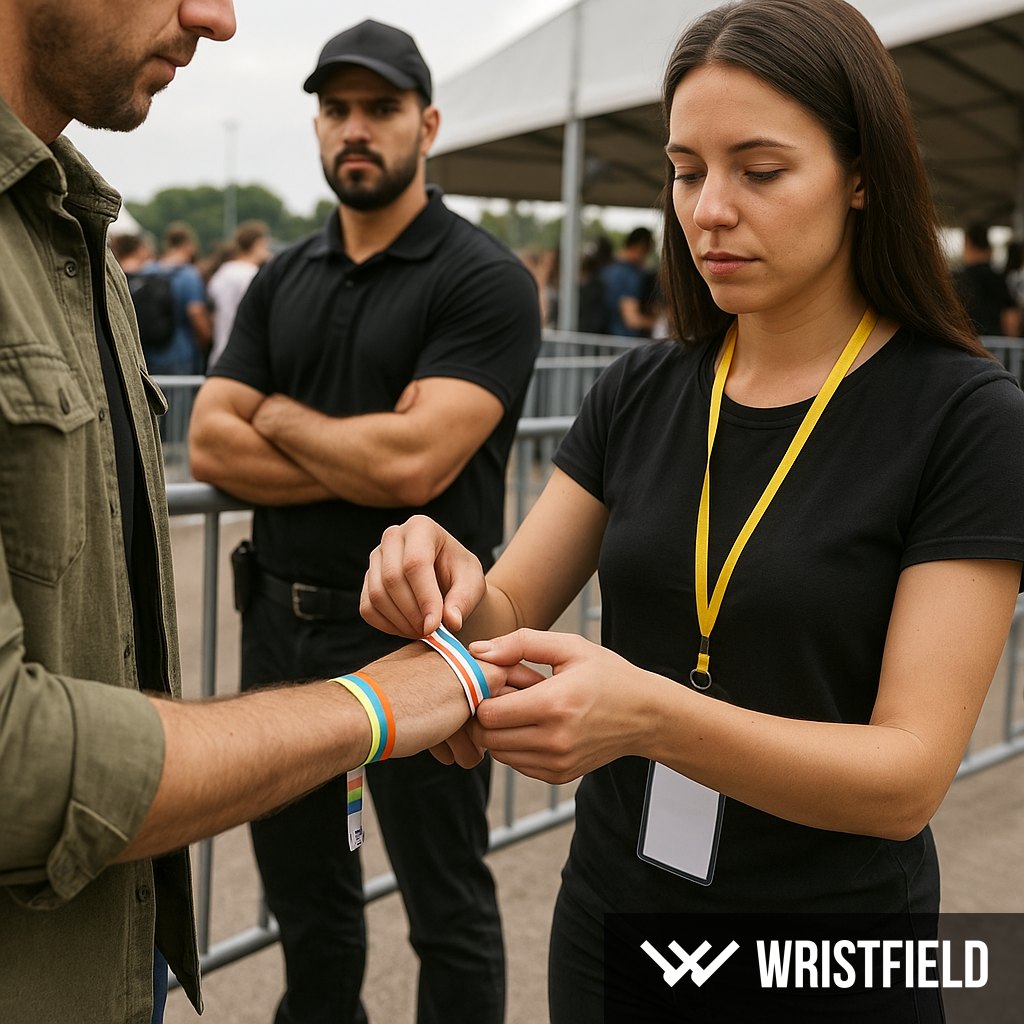
A thorough, practical manual for event organisers who need reliable, scalable entry systems. This guide explains how to choose wristband types, build layered access control, model capacity and costs, deploy UV varnish and serialisation where needed, and avoid the common operational mistakes that slow events down.
The Event Organiser's Handbook
Good entry design is more than a gate and a queue. It controls who gets where and when, reduces fraud, and shapes the guest experience. This handbook is written for busy organisers: practical, operational guidance that you can apply to one-off shows, multi-day festivals and VIP operations alike. It covers wristband selection, multi-layered access systems, capacity and staffing, how and when to use UV varnish and serialised bands, cost decision-making, and the everyday mistakes that most often cause delay.
Plan first: three questions that set the system
Before you order wristbands or confirm the number of gates, answer these three simple questions: how many people will attend, how quickly do they need to be processed, and how many distinct access levels will you operate? Throughput planning is not an academic exercise. If a gate is expected to admit 60 people a minute, that can still create long waves of arrivals, peak pressure and local bottlenecks. Account for ticket checks, security searches and the time it takes to fit a band.
If you want to dive into operational techniques for faster entry, see our practical tips on reducing entry times by 30 percent: Cut entry times by 30 percent.
Choosing wristbands: materials and when to use them
Wristbands fall into four broad categories: disposable paper/Tyvek, vinyl, woven fabric and higher-security bands such as serialised or UV-varnish-treated items. Your choice should reflect event duration, budget, the risk of fraud, and guest comfort.
Key characteristics to consider:
- Tyvek / disposable paper – lowest cost and fast to fit; ideal for short, ticketed events with low fraud risk.
- Vinyl – more robust; good for outdoor events where water resistance is useful or where a band must survive a longer day.
- Woven fabric – comfortable and perceived as a premium item; commonly used for multi-day festivals and VIP packs because attendees keep them.
- Serialised bands – add traceability and simple audit trails; especially useful where re-entry, pensions or high-value ticket types are present. See how numbered wristbands work: How numbered wristbands work at events.
Match the band to the event. For example, choose woven fabric where guest retention and comfort matter; pick Tyvek where you need the cheapest, single-use solution. If you are weighing multiple options, our pricing and decision framework can help: How much does a custom wristband cost?
Serialisation and UV varnish: what they are and what they do
Serialisation places a unique identifier on each band. It supports reconciliation at the gate, helps govern replacement bands, and provides a clear audit path after the event. Serial numbers can be printed or applied as a separate label.
UV varnish is a clear lacquer that is invisible in daylight and becomes visible only under ultraviolet light. Used correctly, it adds a low-profile, hard-to-copy layer to your wristbands. Important: in this guide UV marking always refers to varnish or printed marks that are visible only under UV light. It is not the same as UV printing. For a focused discussion of UV varnish in UK operations, see UV varnish for wristbands.
Use UV varnish where you need discreet, on-demand verification without changing the visual identity of the band. Do not rely on it as your only protection: UV checks require a protocol and handheld UV lamps at controlled checkpoints.
Designing layered access and practical examples
Access control works best when layered. A typical, pragmatic approach for a medium to large event is:
- General admission bands for standard entry.
- Distinct bands for restricted zones such as backstage, staff or VIP areas. Use a visible difference such as a special colour or fabric type.
- Serialised or UV-varnish bands for the highest risk zones where ticket types command revenue protection.
Example configuration: VIP areas use a woven fabric band with serial numbers and targeted UV checks; backstage uses serialised vinyl bands; public admission uses Tyvek. For a practical guide to VIP handling, see Managing VIP zones at events.
Throughput, gates and staffing: capacity planning
Capacity planning has two basic inputs: per-staff throughput and the acceptable average wait time. A useful operational assumption is that a well-run gate with simple checks can process 18 to 30 customers per minute per staff member, depending on whether additional checks are required. For planning, use 20 per minute as a conservative, comfortable figure.
Worked operational logic with attendee counts rather than financials:
| Input |
Assumption |
| Total attendees |
3,000 |
| Peak hour arrivals |
40% of total = 1,200 |
| Processing rate per staff |
20 people per minute |
| Staff per gate |
2 |
Calculation: 1,200 arrivals in the peak hour = 1,200 / 60 = 20 arrivals per minute on average during that hour. With 2 staff per gate at 20 per minute each, one gate is the theoretical minimum. In practice use at least three to four gates: one for VIP/fast-track, two for general entry, and one as reserve. Always plan for uneven arrival patterns and equipment failures.
Introducing manual UV checks reduces per-staff throughput. If a UV check lowers throughput from 300 per hour to 150 per hour per gate, do not run UV checks at every gate unless you accept a substantially higher gate count. A hybrid approach is usually best: full checks at high-risk gates, fast visual checks elsewhere. See a UK-specific capacity and cost model for a 3,000-person concert: 3000-person concert cost model.
Cost thinking without the guesswork
When modelling costs, separate three buckets: wristbands and related production (including serialisation and special finishes), entry staffing, and security/technology. Rather than fixating on unit price alone, calculate total cost by scenario: low-security, medium-security and high-security. Always include contingency: a stock buffer and a staffing buffer. Typical contingency planning uses 5 to 10 percent spare wristbands for single-day events and 10 to 20 percent for multi-day or unpredictable admissions.
If you need worked financial examples please consult our detailed pricing articles and ask for a tailored quote. For guidance on whether express production is worth the premium, see When is express wristband production worth it.
Security layers and anti-counterfeit measures
Counterfeiting mitigation works by combining visible and hidden measures. Consider these layers:
- Material choices that are harder to replicate (woven fabric more so than Tyvek).
- Serialisation for reconciliation and replacement control.
- UV varnish for non-public, quick checks that reveal tampering.
- Operational processes such as controlled issuance of replacement bands and mandatory ID checks for reissue.
Use a risk tier approach: low risk uses simple bands and visual checks, medium risk adds spot checks and some serialisation, high risk combines serialisation, UV checks and tighter replacement rules. For a deep dive into anti-counterfeit tactics, read Preventing wristband counterfeiting and our piece on event security tiers: Event security risk tiers.
Common mistakes that slow events down
The most frequent causes of delay are straightforward and avoidable:
- Poor quantity planning for wristbands and no accessible reserves.
- Insufficient staff at peak times and no floating capacity to redeploy.
- Poor communication between ticketing, control room and gate teams.
- No written protocol for replacements and patchy training on counterfeit detection.
One typical story: organisers chose Tyvek for a multi-day event because it was cheap. Attendees kept losing bands or wanted daily replacements. The next year organisers switched to woven fabric with serial numbers and daily UV spot-checks. Satisfaction rose and the administrative burden fell, despite a higher upfront spend.
Day-of checklist and communications
Before doors open, check these essentials:
- Gate kit: spare bands, scissors, plasters, tamper clamps (if used), printed protocols.
- Staff briefing: roles, escalation rules, how to record replacements and incidents.
- Test all devices: UV lamps, scanners and radios or chosen communications app.
- Control room watch: real-time dashboards with per-gate throughput, queue times and incidents.
Use a single communications channel for operational messages to avoid confusion. The control room should have the authority to issue overrides and order the opening of reserve gates. Train gate teams to log every replacement band with minimal friction: take a photo, record a name or contact and note the serial number of the replacement.
Replacement band protocol (do not decentralise)
Replacement bands are a frequent source of fraud if handled poorly. A tight but practical protocol looks like this:
- All replacements must be authorised by the control room. The authorisation code is recorded at the gate.
- Require minimal identification and a photograph for every replacement. Record a telephone number or name.
- Issue serialised replacement bands and record which band number was issued and why.
- Audit the replacement log at shift change and at the event close.
This protocol increases paperwork but prevents the inconsistent decisions that produce queues and complaints. If you need a template, contact our team for a replacement log format designed for fast gate use.
Post-event analysis
After the event, review key metrics: hourly admissions, average queue times, number of replacements and incidents by gate. Serialised bands make it easier to investigate anomalies. Feed these findings back into your risk and capacity model and adjust your band choice, staffing profile and replacement protocol for the next event. If you want a custom capacity and cost calculation for your event, we can produce a model that includes required gates, hourly staffing and three wristband scenarios.
Final practical suggestions
Begin by defining the event risk profile. Ask: how likely are fraudulent attempts, how important is guest comfort and what budgetary flexibility exists? Simple events often require simple bands. More complex events benefit from layering Tyvek, vinyl and fabric with serialisation and UV varnish applied only where it materially reduces risk. When in doubt, formalise your protocols and plan redundancy.
For applied, UK-focused guidance on UV varnish and where it makes sense, see our specialised guide: UV varnish for wristbands. For anti-counterfeit tactics and ROI thinking, see Preventing wristband counterfeiting.
Entry success demands more than a good idea; it needs clear protocols, training and redundancy. Build layers, plan contingencies and document what happens so every event is easier than the last.
Operational drills and rehearsal routines
Good planning only becomes effective when staff can repeat the sequence under pressure. Schedule at least one full dress rehearsal before a first-time event or when introducing a new wristband system. A rehearsal should include gate set up, issuing bands, a replacement scenario and a counterfeit detection drill. Run the rehearsal at the same tempo you expect on the busiest hour, not at a comfortable pace. That reveals bottlenecks you will not see in a slow walkthrough.
In rehearsals pay attention to small but consequential details: how long it takes to scan a barcode on a muddy wrist, whether the UV lamp reveals varnish reliably from a short distance, and whether radio messages about an authorised replacement are understood at the far gates. Log timings and repeat the scenario until the target throughput per gate is met without sacrificing accuracy.
Staff training that reduces error and fraud
Training is more than a quick briefing. Create short micro-modules: a 10 minute practical on band application and cutting, a 15 minute session on replacement protocol and data capture, and a 20 minute module on counterfeit characteristics and escalation. Keep the materials concise and hands-on. Use real examples of tampering and let staff practise recognising them. Make a laminated cheat sheet for every gate containing the replacement authorisation flow and the contact for the control room.
Staff who understand the why behind a rule enforce it more consistently. Explain the rationale for serialisation, for recording a phone or name on every replacement, and for refusing to issue a replacement without control room authorisation. Empower gate staff to call for assistance rather than improvise; give the control room authority to waive rules for a single case so that front-line teams do not bypass processes to keep queues moving.
Replacement log template
Keep a compact, searchable log. A simple column structure is adequate and can be maintained on a clipboard or an event tablet. Example fields to capture at the gate are:
| Time |
Gate |
Reason |
Original Band Serial |
Replacement Serial |
Name / Phone |
Authoriser Code |
Photo Ref |
| 09:42 |
South West |
Lost band |
N/A |
W-987654 |
J. Smith 07700 900123 |
CR-21 |
IMG_3345.jpg |
For digital capture, use ONE standard form across all gates. That makes post event reconciliation straightforward and reduces transcription errors. Remember that any personal data collected must be processed under appropriate privacy safeguards.
Privacy, records and legal compliance
Replacement logs will include names and phone numbers. Treat these as event operational data and apply the same care you would to attendee details captured at purchase. In the UK, processing of personal data must comply with the Data Protection Act 2018 and UK GDPR principles. Keep paper logs secure, limit access, retain them only as long as necessary and delete or store digital records according to your retention policy. If you rely on third party apps to capture replacement data, check their data processing agreement and server location.
Similarly check relevant safety and licensing obligations with the local authority. The Regulatory Reform Fire Safety Order 2005 sets expectations for safe egress and crowd management in England and Wales. The Health and Safety at Work Act 1974 requires you to undertake a suitable risk assessment and put proportionate measures in place. When in doubt, share your entry plan with the venue and your licencing officer before final sign off.
Accessibility and inclusivity at entry
Design your access control with inclusivity as a default. Offer a dedicated lane for guests with mobility needs and a discreet process for assisted entry. Use wristband materials that are hypoallergenic and provide non-latex options. For visually impaired guests consider a tactile or colour coded solution that is easy to check without close visual inspection. Train staff to recognise and politely assist guests who need longer time at the gate without making them queue twice. Clear signage and pre-event communications about accessible entrances reduce on-the-door confusion.
Technology integration and pragmatic choices
Technology helps but it is not a substitute for robust procedures. Barcodes and RFID speed up admission but need fallbacks. Ensure each scanner or reader has offline capability and that every gate can issue manual wristbands if tech fails. For hybrid systems that combine RFID for cashless and barcode for access control, make sure the wristband design supports both without compromising anti-counterfeit features.
When considering smart wristbands, weigh the benefits of enhanced data and contactless payments against cost, disposal and privacy complexity. Reusable RFID wristbands work well for festivals with high spend on cashless, but they require a deposit system, collection plan and cleaning protocol. If you choose disposables, favour materials that survive the expected weather and wear for the event duration.
Queue strategy and peak flow management
Map arrival curves to staffing levels. Use ticket scanning metrics from past events or industry benchmarks to predict peak hours and required lanes. A single fast lane for pre-cleared or VIP guests often reduces overall stress but should not siphon staff from general admission at critical moments. Tactical measures that work: staggered entry windows, pre-event online check-in, dedicated lanes for families and disabled guests, and a floating relief team to open a spare lane when queues exceed a threshold.
Signage and wayfinding are underrated. A clear sign telling arriving guests what they will need to show and whether bag checks are in operation keeps the queue moving. Lighting and covered queuing areas extend entry resilience when weather is poor. A simple field device that tracks queue length and feed this into your control room dashboard gives you an objective trigger to open reserve gates.
Environmental considerations and procurement timelines
Order wristbands with lead time in mind. Woven fabric with custom printing typically takes two to four weeks, while Tyvek can be produced faster. If you require serialisation, UV varnish or special inks factor in extra production time and proofs. Consider sustainability: biodegradable Tyvek variants and recyclable vinyl exist, and some suppliers offer take-back programmes. Balance environmental goals with durability and anti-counterfeit needs; green alternatives are valuable when they do not increase incident risk or replacement volume significantly.
After-action review and continuous improvement
Post-event analysis is where good systems become great. Look at admission rates, replacement percentages, counterfeit incidents and staff incident reports. Compare expected and actual arrival curves and identify where staffing profiles misaligned with demand. Interview gate staff and control room operators to capture practical suggestions you can apply immediately. Store these lessons in an access control playbook and update it after each event.
Small, documented changes compound over time. A modest initial investment in staff training and a robust replacement protocol reduces complaints, litigation risk and the number of fraudulent entries. The goal is steady improvement so each subsequent event requires less firefighting and delivers a better experience for guests and staff alike.