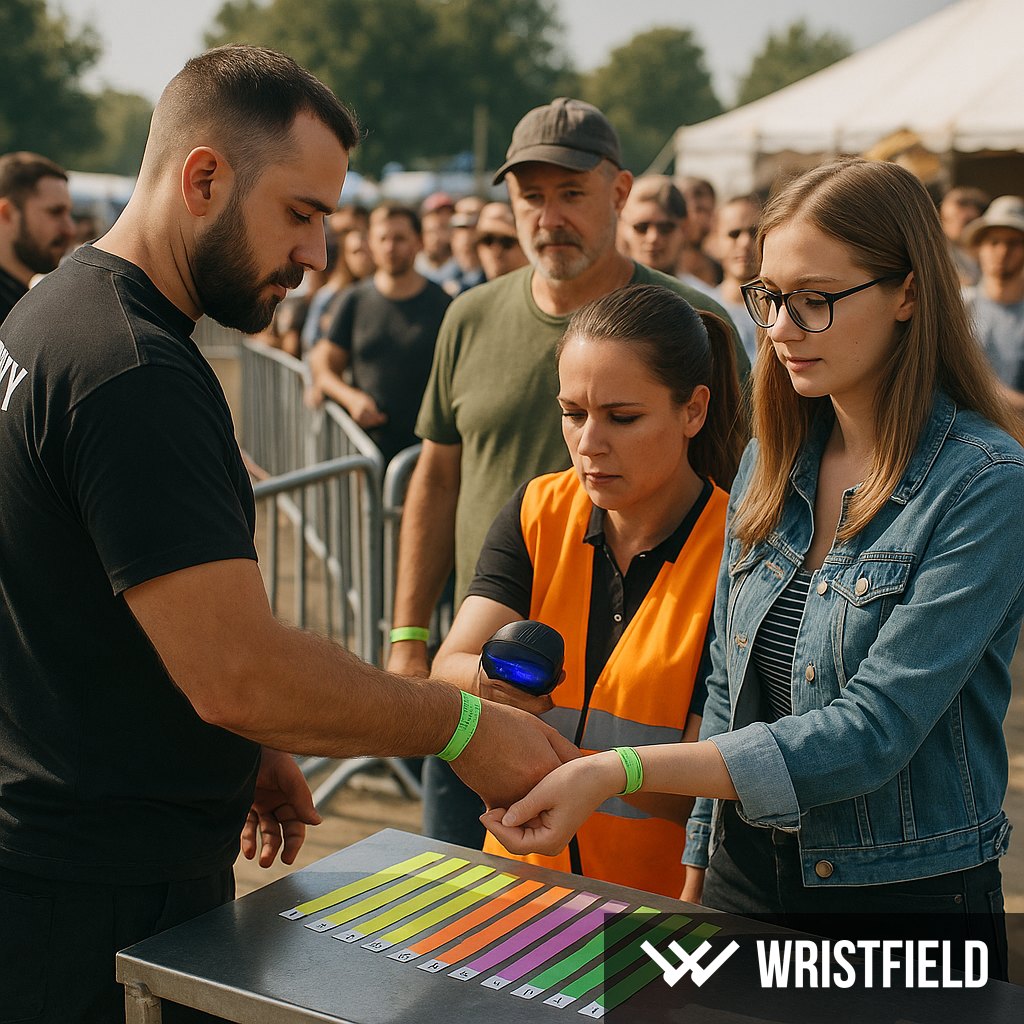
Running a successful multi-day festival depends as much on entry systems as it does on programming. A well-considered wristband and access-control strategy reduces fraud, speeds entry and makes life easier for staff and guests. This guide takes you from planning decisions through day-to-day operations to post-event audit, with practical calculations and operational rules you can apply to UK events.
Why multi-day entry is different
Multi-day festivals create specific challenges that a one-day concert does not. Attendees carry wristbands for days, they move between zones repeatedly, staff shifts must maintain continuity, and exchange or transfer requests rise. Those differences should shape your wristband materials, anti-fraud layers and the operating model for gates, exchanges and auditing.
Core functions of wristbands
A wristband performs three practical jobs: identification, proof of entitlement and anti-fraud deterrence. Choosing the right type depends on expected wear time, the number of access tiers, the need for cashless or RFID functions, and how much you want to invest in counterfeit resistance. Common materials are Tyvek, vinyl, woven textile and RFID-enabled fabric. A cost-effective additive is UV varnish - a clear marking visible only under UV light - which adds a discrete authentication layer without changing the band material. For a technical breakdown of UV varnish and how it differs from UV printing see our guide on
UV varnish for wristbands.
Plan before you order: essential decisions
Before contacting suppliers clarify: expected daily arrivals and their distribution across days, share of season-pass holders versus day ticket buyers, whether re-entry is permitted, which zones require separate credentials (VIP, backstage, staff), and how many exchanges you will allow. These choices determine materials, quantities, serialisation approach and gate layout. Failing to decide early forces last-minute compromises or expensive express production.
Wristband strategy by ticket type
A typical and effective approach is to match robustness to use: season-pass holders receive durable textile or vinyl bands with secure closures; day-ticket holders get cost-effective Tyvek bands if they will not re-enter; VIP and backstage credentials should be more tamper-resistant and comfortable for multi-day wear. Use colour-coding for quick visual recognition, then layer serial numbers and UV varnish for a higher level of security. If you need on-site transactions or visitor engagement beyond entry, choose RFID textile bands. For help weighing these options against risks and costs, see our practical risk-tier framework in
Event security risk tiers.
Serialisation: more than fraud prevention
Numbered wristbands let you audit issuance, reconcile stock and resolve disputes. If you pre-number season tickets and link numbers to sales records you gain an audit trail that helps with post-event analysis and claim handling. Serialisation is particularly useful where exchanges are permitted: you can invalidate a serial number and document the replacement. For operational guidance, see
How Numbered Wristbands Work at Events.
Colour coding and layered authorisations
Colour is your quickest tool for front-line staff. Combine it with unique serial numbers and UV varnish to raise difficulty of counterfeiting. For example: light-coloured Tyvek for day tickets, woven bands for season-pass holders, a distinct design for VIP, and a different colour for backstage. Remember that colour alone is insufficient; combine visual cues with a physical or machine-verifiable element for best protection. For VIP zone practice and typical pitfalls see
Managing VIP Zones at Events.
Exchange and transfer policy: design and controls
Decide at the time of sale whether tickets and wristbands are transferable. If transfers are allowed, enforce controls: require registration at point of collection, check ID against the purchaser where appropriate, and use serial-number validation before issuing a replacement band. Implement a documented exchange workflow at a single, staffed location. Keep an exchange log that records original serial numbers and replacement numbers and store proof of identity checks. Where you permit exchanges, plan extra staff and a reserve of 5-10 percent of bands to cover losses and fraudulent swapping.
Practical fraud-prevention layers
A multi-layered approach discourages and detects misuse: material choice, unique artwork or holograms, serial numbers, machine-readable elements (QR or RFID) and UV varnish. UV varnish is particularly useful for quick spot checks: the varnish is invisible in normal light and becomes visible under a UV lamp, so counterfeiters cannot easily replicate it. For a detailed look at anti-counterfeit techniques, consult
Preventing Wristband Counterfeiting.
Gate layout and throughput planning
Capacity planning must be based on peak arrivals, not daily averages. Use a simple formula: required gates = (peak arrivals per minute) / (gate throughput per minute), then add at least 25 percent redundancy. Example: if 2 500 people are likely to arrive in the two-hour morning peak, that is about 21 people per minute. If a QR-based gate processes 20 people per minute, the base need is 1.05 gates, so round up to 2 and then add redundancy to operate 3 gates with 1 spare. If RFID gates process 35 people per minute, one gate may theoretically suffice, but plan at least two operating gates and a spare to cover failures and staff breaks. For worked examples and staffing models see our calculation guides in
3000-person concert cost model and
How to Cut Your Event Entry Time by 30%.
Staffing, roles and training
The human element is decisive. Define roles clearly: gate operators who perform scans and issue bands, conflict handlers who deal with disputes and suspected fraud, exchange desk operators, and supervisors who monitor throughput and stock. Train staff to recognise counterfeit indicators, operate UV lamps, record serial numbers and follow the exchange protocol. For peak-time resilience, plan shift overlaps so one team hands over to the next without reducing gate numbers. Automated tools like QR scanners and pre-allocated time slots reduce staff pressure and smooth flow.
Managing the exchange desk
Make the exchange desk a controlled operation: a clear queue, documented checks and mandatory logging of every replacement. Require the claimant to provide proof linked to the original sale where possible, then void the old serial number and issue a new one. Keep printed or digital records of every swap. Limit ad-hoc front-of-house exchanges to reduce fraud; use the exchange desk for verified replacements only. Keep a contingency stock of 5-10 percent more bands for exchanges and losses, adjusted by the likelihood of on-the-day transfers.
Technology choices: QR, RFID and cashless
Choose technology to match objectives. QR is inexpensive and fast for scanned tickets but can be copied. RFID is more robust, supports re-entry and cashless payments, and speeds throughput, but increases material and hardware costs. If your primary aim is speed and simplicity, Tyvek with QR and a UV varnish layer is a practical mix. If you want long-term engagement and cashless wallets, invest in RFID-enabled textiles. For guidance on when RFID or express production pays off, see
When Is Express Wristband Production Worth It and our pricing primer in
How much does a custom wristband cost?.
A brief case study: what goes wrong and how to recover
An event that mixes ticket-issue and gate tech without synchronisation risks long queues. If front-of-house issues paper tickets while gates expect RFID or QR codes, gates will reject entries and delays will mount. Recovery requires a simple contingency plan: a manual acceptance process based on a central list, rapid issuance of compatible bands from reserve stock and prioritising affected groups (VIP, staff). Long-term fixes include ensuring ticketing and gate systems use the same database and carrying spare readers and bands at all staff locations.
Procurement and budget thinking (practical, not prescriptive)
Budget decisions should slice costs between band materials, reader rental or purchase, staff and logistics. Textile RFID bands cost more per unit but may reduce gate count and staffing. Readers can be rented or bought; buying may pay back if you run multiple events. Always include a contingency budget of 7-12 percent for express orders, extra staff, or logistic hiccups. For scenario modelling and cost balancing across equipment and labour, consult our event cost breakdowns such as
Full Entry Cost Breakdown for a 1,000-Person Event and the 3 000-person model above.
Post-event audit and continuous improvement
After the festival, reconcile issued serial numbers with remaining stock and admissions. Document exchange desk logs and any exceptions. Analysing discrepancies helps identify weak points in on-site controls and informs the next year’s ordering, staffing and exchange policies. Use serial-number data in customer-service cases and to refine marketing segmentation where appropriate. If you used serialisation and UV varnish, include lab-style checks in the audit and record findings for supplier discussions.
Common organiser mistakes and how to avoid them
Typical errors include under-ordering reserves, late wristband procurement that forces express production, staff undertraining on counterfeit signs, and mismatched ticketing-to-gate technology. Plan early, order with margin, document exchange workflows and run scenario training with UV lamps and mock disputes. For practical checklists and the most frequent pitfalls, see our system-level guide
Event security risk tiers and the full-system handbook
Full entry system guide.
Decision matrix - how to decide quickly
Ask these four questions in this order: how long will bands be worn; how many access tiers exist; how serious are fraud risks; do you need cashless or engagement features? High wear time and many tiers push towards textile or RFID with UV varnish and serialisation. Low budget and simple entry favour Tyvek plus UV varnish and QR serials. Record the chosen combination for procurement and supplier brief.
Final checklist before go-live
Make sure you have: pre-numbered and logged wristband stock; exchange desk SOP and logged staff; UV lamps at key control points; spare bands (5-10 percent depending on exchange probability); spare readers and at least one spare gate per critical entrance; staff trained on counterfeit signals and exchange rules; and a post-event audit plan.
Closing thoughts
Multi-day festivals demand a system view: wristbands are part of an operational ecosystem that includes ticketing, gates, staff, exchanges and post-event audit. Layer simple, low-cost anti-fraud measures such as UV varnish and serialisation onto the right material choice and you get a resilient, user-friendly entry process. Start planning early, test the full end-to-end flow and document the rules you will enforce on the day. If you need deeper technical or cost modelling for a specific event size, our worked examples and calculators can help: see
3000-person concert cost model and
UV varnish for wristbands.
Accessibility and inclusivity considerations
Wristband systems must work for every attendee. Plan with accessibility from the start rather than retrofitting on the day. Consider tactile markers such as raised dots or a subtle textured panel for visually impaired customers. Ensure colour choices and contrasts meet basic visual accessibility so staff and attendees with colour-vision differences can still identify tiers accurately.
Provide alternative verification methods for people who have sensory sensitivities, cognitive impairments or anxiety. A simple example is a printed admission slip that matches the wristband serial number and includes a clearly worded statement allowing a carer to escort the ticket holder. Train front-of-house staff to recognise and apply reasonable adjustments without creating friction for the guest.
Include accessibility instructions in your pre-event communications and on-site signage. Make it clear where quiet entry queues, assisted-access gates and exchange desks for substitutions are located. Record any adjustments on the exchange desk log so restoration of the correct wristband is straightforward during the event.
Environmental sustainability and end-of-life planning
An increasing number of organisers and attendees expect environmentally responsible wristband choices. Tyvek and some plastics have low recycling rates when combined with adhesives and varnishes, so treat environmental claims carefully and demand proof from suppliers. Biodegradable bands are available but vary greatly in durability and performance under sweat and rain.
Practical measures that reduce waste include offering a small deposit refund on returnable staff or vendor bands, operating a collection point at exit gates for non-textile bands, and contracting a supplier who provides take-back schemes. If you choose recyclable materials, ensure your event recycling stream is capable of processing them. Otherwise recycling claims can be misleading.
Ask suppliers for third-party environmental certifications and durability test results. Where reuse is possible, define sanitisation processes for staff bands that do not compromise RFID or printed security elements.
Data protection, serialisation and GDPR
Serial numbers themselves are not necessarily personal data. However, when linked to a ticket buyer or wallet they become identifiable information and attract GDPR obligations. Treat wristband identifiers as part of your data estate if they can be connected to a named person, ticket reference or payment record.
Practical steps to remain compliant:
- Record a lawful basis for processing, typically fulfilling a contract for ticketed entrants or legitimate interests for security, and document the assessment.
- Minimise retention: keep serial-to-ticket mappings only as long as necessary for dispute resolution, fraud investigation and financial reconciliation. Publish retention periods in your privacy notice.
- Protect the database: encrypt exports, restrict access to named staff, and keep an audit trail of who viewed or modified records.
- Include wristband handling in any DPIA where profiling, cashless payments or detailed movement data are collected.
Clearly explain to customers what data you collect, why you need it and how they can exercise rights such as access or erasure. If you intend to use movement or payment data for marketing, obtain explicit consent up front.
Supplier contracts, lead times and quality control
Negotiate contracts with explicit service level agreements. Typical clauses to include are guaranteed lead times, acceptance testing criteria for serialisation accuracy and varnish adhesion, remedies for late delivery and a warranty for material defects. Ask for production samples and retain them as the approved standard.
Chain of custody for pre-printed serial numbers is crucial when fraud risk is high. Insist suppliers log who had access to blank or numbered stock and require secure transport to site. Agree change control processes so any last-minute edits to runs - for example changing print runs when more bands are required - are documented and approved by both parties.
Testing, quality assurance and pre-event sampling
Before mass production, run a modest test batch through the full operational flow. Test items to check include scan read rates for QR and RFID under realistic queue conditions, adhesion of UV varnish after handling and sweating, tensile strength of closures and legibility of printed serial numbers exposed to rain. Document results in a short QA report and compare them with the published tolerance from the supplier.
Allocate time for an acceptance window. A two-stage acceptance allows an initial sample-approved sign off, followed by a final inspection on arrival. If you are using RFID, test interoperability between every reader model and the chosen bands. Test with staff on-site wrists, clothing and under festival wrist-clash conditions so readers are tuned to the expected real-world environment.
Practical staff training and role definitions
Training reduces adjudication time and improves detection of counterfeits. Focus on decision-making rather than rote memorisation. For example, teach exchange desk staff how to verify original sale evidence, how to log a swap and when to escalate to a supervisor. Gate staff should be trained to identify three levels of issue: quick fix, documented replacement and potential fraud requiring escalation.
Define clear role descriptions for the following positions: exchange desk operator, gate supervisor, fraud investigator, technology operator and incident log keeper. Make a short checklist for each role that fits on a laminated card for quick reference.
On-site incident response and fraud investigation
When suspected counterfeits or organised reselling are identified, follow a predictable, documented process. Keep the steps simple and focused on evidence preservation rather than confrontation.
Recommended immediate actions:
- Isolate the wristband and photograph it in controlled lighting showing serials, varnish and closure points.
- Record witness statements and the time, gate and staff involved.
- Hold the item in a secure evidence bag or envelope and log custody. If multiple counterfeit items appear, store them together with a running incident number.
- Check the ticketing database and any camera footage if available. Pause any further replacements for that serial range until you understand the scope.
- Escalate to senior security or local police when evidence suggests organised or repeated fraud beyond isolated mistakes.
Post-event, produce a short investigation report with a timeline, photographic evidence and recommended process changes. This report should feed into the next procurement and training cycle.
Cashless systems and financial reconciliation
Integration between wristbands and a cashless wallet must include clear reconciliation steps. Assign a unique identifier for each wristband that appears in both the transaction ledger and the admission log. Ensure your settlement process includes daily reconciliation during multi-day events to spot anomalies early.
Plan for chargebacks and disputed transactions. Keep a controlled archive of transaction logs for the minimum retention period required by your payment provider and regulators, and document dispute handling procedures including the evidence required from a customer to contest a charge.
Practical SOP templates to copy and adapt
Below are short, ready-to-use templates you can drop into your operations manual. Edit role names and contact numbers to match your team.
Exchange desk SOP - key steps
- Verify claimant identity against the ticketing system or proof of purchase.
- Log original serial number, buyer name (if available), reason for swap and staff initials.
- Void the original serial in the ticketing database and mark as replaced.
- Issue new band from pre-numbered reserve stock and record new serial.
- Take a brief photo of the new attachment on the wrist for audit purposes, with consent where required.
- Provide receipt to the claimant and retain a copy in the exchange log.
Incident report template - quick fields
Incident number, date/time, gate/location, staff on duty, description of issue, serial numbers involved, photographs attached, witnesses, actions taken, escalation required, closed by and closure date.