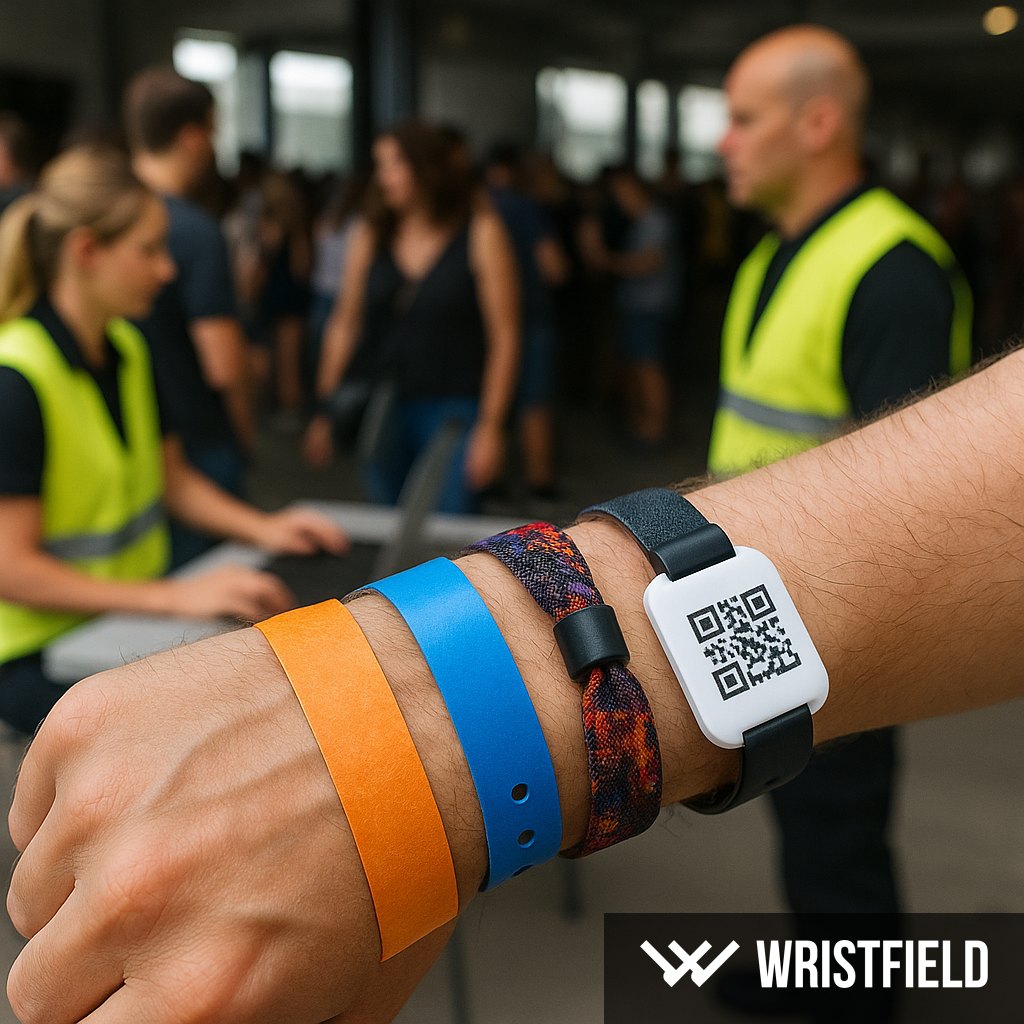
Wristband systems compared: Tyvek, vinyl, fabric and electronic options
Wristbands are more than an accessory. They affect throughput at entry, fraud risk, on-site operational workload and the impression your event makes on guests. In what follows we examine the common wristband types and systems, the security measures you can add, and practical guidance to pick the right solution for your event and budget.
What we compare and why it matters
We assess wristbands along these practical dimensions:
- Use case: single-day or multi-day, water exposure, repeat entry, VIP zones;
- Cost drivers: base material, print/setup, optional extras (serial numbers, UV varnish, RFID), production lead times;
- Durability: resistance to water, abrasion, sunlight and repeated removal/reattachment;
- Security: how easy it is to copy or transfer a band and what mitigations are effective;
- Brand and guest experience: perceived value, souvenir potential and alignment with your event positioning.
Tyvek wristbands
Tyvek bands are a paper-like, low-cost, single-use solution. They close with a tamper-evident adhesive or mechanical closure and are widely used where speed and cost-efficiency are priorities.
Best uses
One-day outdoor concerts, short events and high-throughput entry points where you need rapid distribution and low unit cost.
Limitations
Tyvek is not designed for repeated removal and reattachment. In wet or beach environments it will cope for short periods but is not as durable as vinyl or fabric over multiple days.
Security options
Alone, a simple Tyvek with adhesive closure is relatively easy to copy. Security improves when you combine mechanical tamper-evident closures with serialisation, spot UV varnish and random checks. For more on numbering, see our guide to numbered wristbands How Numbered Wristbands Work at Events. For UV varnish practicalities, see UV varnish for wristbands: a practical guide.
Vinyl wristbands
Vinyl (PVC) wristbands offer a robust middle ground. They are water resistant, flexible and typically more durable than Tyvek, making them suited to multi-day events and wet environments.
Best uses
Multi-day festivals, waterfront events and any occasion where guests may be exposed to water or abrasion for extended periods.
Durability and closures
Vinyl bands are commonly secured with plastic or metal rivets or snap closures that are harder to remove without evidence of tampering. Print durability is generally good, and you can laminate or add spot treatments for longer-lasting artwork.
Security
Vinyl is a practical substrate for anti-counterfeit features such as serial numbers, barcodes, spot UV varnish and laminated overlays. It is also a reasonable base for embedding RFID tags where required.
Fabric (textile) wristbands
Fabric wristbands are the premium option. They are made from satin, polyester or woven materials, and are often used as keepsakes. They can be finished with crimped metal or plastic closures, or engineered security clips.
Best uses
VIP areas, long-stay credentials, brand activation and festivals that want a high-end souvenir item. Fabric conveys quality and often remains with the guest after the event.
Durability and perception
Fabric is the most durable of non-electronic bands and survives repeated handling and washing. It also offers the strongest brand impact because guests keep it as a memory of the event.
Security and integrations
Fabric can combine with security measures such as custom weaves, embroidery, tamper-evident clips and embedded RFID. Where fabric is used for VIPs, communicate clearly that the band is a keepsake to reduce returns and disputes.
RFID and electronic systems
RFID wristbands incorporate a chip and antenna to enable fast scanning, cashless payments and zone control. They can be laminated into vinyl or sewn into fabric.
When to choose RFID
RFID makes sense when you need automated gates, accurate attendance analytics, cashless transactions or complex multi-zone permissions. It also provides smoother guest journeys and useful post-event data.
Infrastructure implications
RFID is a system, not just a wristband. You will need readers, backend software, integration with payment systems if used for purchases, and logistics for encoding and testing bands. This increases upfront cost and operational complexity, but the business case can be compelling when scaled correctly. For a deeper system-level approach, see our event security risk framework Event security risk tiers.
Security layers that work
Effective fraud prevention usually combines several layers rather than relying on a single measure. Typical, practical layers include:
- Robust mechanical closure or tamper-evident rivet;
- Serial numbers or unique barcodes for random verification and reconciliation;
- UV varnish (UV-visible lacquer) for covert authentication; note that UV varnish is a lacquer visible only under UV light, and is different from UV printing;
- Random spot checks at entry and inside the venue;
- RFID for high-speed gate control and transaction encryption where justified.
For a practical breakdown of anti-counterfeit techniques and ROI thinking, see our guide Preventing Wristband Counterfeiting.
Decision matrix by event type
| Event type |
Recommended wristband |
Why |
| One-day outdoor concert |
Tyvek or vinyl |
Fast distribution and cost-effective; pick vinyl if wet weather is likely. |
| Multi-day festival |
Vinyl or fabric, consider RFID |
Durability over days and zone control; RFID if you need cashless or analytics. |
| VIP event or conference |
Fabric |
Premium feel and keepsake value; easy to integrate brand elements. |
| Waterfront or beach event |
Vinyl |
Water-resistant and more robust in humid conditions. |
Cost drivers and a simple modelling approach
Rather than fixed prices, think in terms of cost components that shape your per-unit and programme cost:
- Base material and unit production;
- Artwork/setup fees and print plates or weave setup;
- Optional security add-ons: serial numbers, spot or full UV varnish, lamination, RFID chip and encoding;
- Logistics: packaging, shipping and any on-site handling or bespoke distribution;
- Contingency: reserve stock and express reprint options.
A simple calculation template you can apply internally: total programme cost equals sum of unit material and extras multiplied by quantity, plus one-off setup fees and shipping, plus a contingency buffer for replacements and express runs. If you require worked cost modelling for a mid-scale event, our 3000-person cost model explains the common trade-offs in detail 3000-person concert cost model.
Operational roles and capacity planning
A well functioning wristband strategy is also about people and process. Recommended roles:
- Procurement contact to manage supplier specification and delivery;
- Logistics coordinator to handle storage and on-site distribution;
- Entry lead to design the entry flow, kit and staffing pattern;
- Security lead to manage anti-counterfeit checks and incident response.
Capacity planning must reconcile arrival patterns, average service time per guest and acceptable queue length. As an example, consider a 3000-person event with a three hour arrival peak.
Capacity worked example
Assume 80 percent of guests arrive during the three-hour peak window: that is 2400 people. If the average time to check and fit a wristband is 12 seconds, a single entry lane can process roughly 300 people per hour (12 seconds per person equals 300 per hour). Over three hours that is 900 people per lane.
To handle 2400 arrivals you would therefore need at least three simultaneous lanes. Adding 20 percent reserve to reduce queues and cope with delays means planning for four lanes. If you use fabric bands with a more complex fit that increases average service time to 20-25 seconds, lanes will require more staff and you should scale lanes accordingly. More on entry optimisation is available in our piece How to Cut Your Event Entry Time by 30%.
Common organiser mistakes and how to avoid them
Typical errors include:
- Ordering exactly the ticketed quantity without reserve. We recommend a contingency buffer; 5 to 15 percent is common depending on event type;
- Choosing the wrong material for the environment. For example, selecting Tyvek for a beach festival risks damage and on-site replacements;
- Relying on a single security measure. Combine mechanical and covert or electronic checks for best results.
Also agree a supplier emergency plan that covers express reprints, local printing fallbacks and temporary on-site solutions like laminated paper tags in case of a failure.
UV varnish: what it is and how to use it
Important clarification: UV varnish in this context is a clear lacquer that becomes visible under UV light. It is not the same as UV printing. Applied as a spot or full surface coat, it can provide a covert authentication layer that is quick to check with a handheld UV torch.
Best practice notes:
- Use UV varnish on Tyvek and vinyl for reliable adhesion; fabric is less suitable for lacquer-based UV markings where durability is required, and stitched or woven features are preferable;
- Test bands in realistic conditions, including exposure to suncream, sweat and water, as these can affect UV contrast;
- Ensure entry staff are trained and equipped with UV torches and simple checklists to perform quick spot checks without slowing throughput. For operational detail and cost-risk modelling around UV varnish, see our practical guide to UV varnish.
Contingency and emergency on-site fixes
If there is a shortage or a material defect, pragmatic short-term fixes include laminated paper tags with serial numbers, temporary adhesive bands with security seals, or redirecting premium bands to VIPs while replacing general admission with a durable interim solution. Whatever approach you use, communicate clearly with guests and have a pre-agreed script for staff to keep frustration low.
Sustainability and waste management
Think about lifecycle and disposal. Tyvek and vinyl are not straightforward to recycle in many municipal streams, so consider collection points, recycling partners or incentives to retain fabric bands as souvenirs. If sustainability is a core part of your brand, use that as a selection criterion and communicate your approach to guests.
Final checklist before ordering
- Define the event use case and how long bands will be worn;
- Decide the security stack you need: mechanical, UV, serialisation, RFID;
- Choose a contingency percentage for replacements and order accordingly;
- Request samples including UV varnish and do a quick wear-and-water test;
- Confirm supplier lead times and emergency options for express reprints or local fallbacks;
- Plan entry lanes and staff allocation against peak arrival profiles.
Where to go next
If you want a deeper dive into any of the topics above, our related guides explore serialisation, entry cost models and operational layouts in detail: numbered wristbands How Numbered Wristbands Work, UV varnish practicalities UV varnish for wristbands and the detailed 3000-person cost and staffing model 3000-person concert cost model.
Choosing the right wristband is a balance between cost, durability, security and the experience you want to create. Match material and security choices to your event profile, plan capacity and contingencies in advance, and test samples under realistic conditions to avoid last-minute surprises.