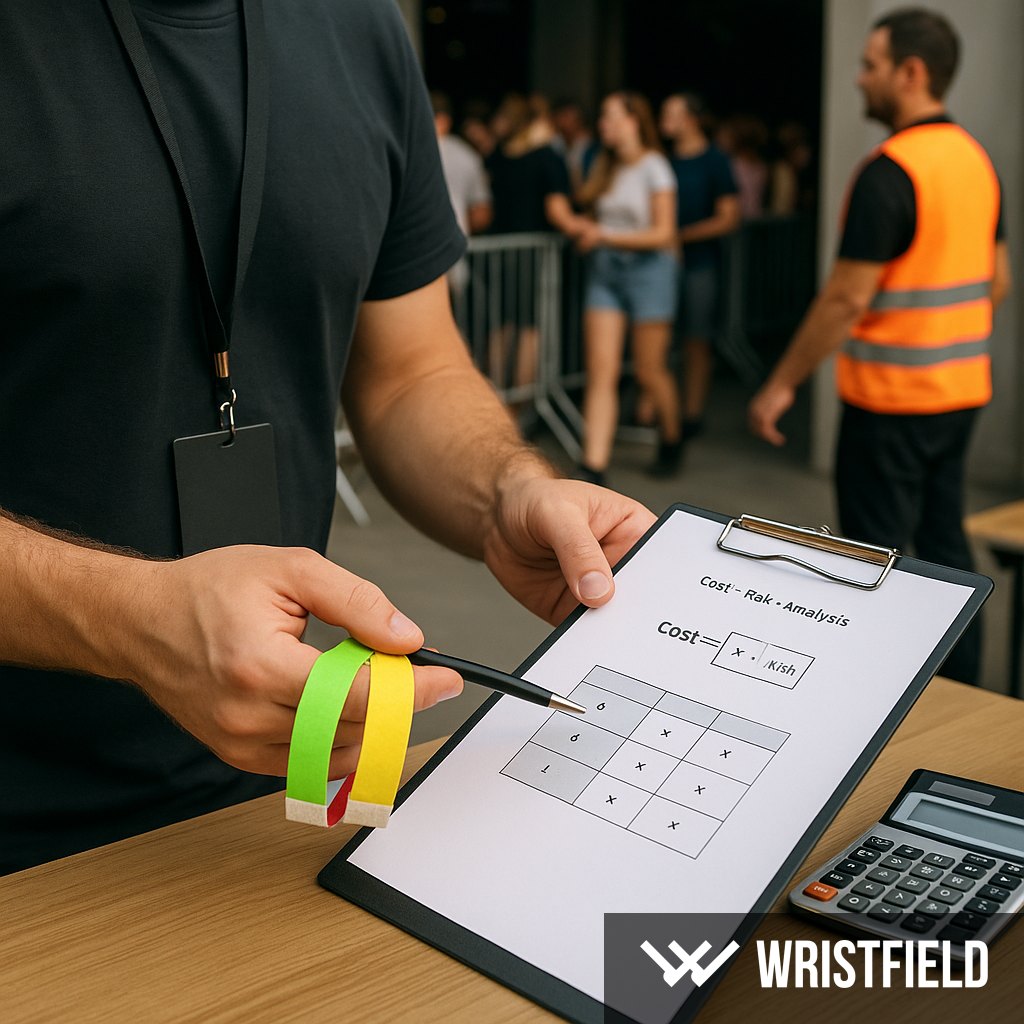
How to balance cost and risk when choosing wristbands
A wristband is more than an admission token. It can prevent lost revenue, protect VIP and backstage access, reduce disputes and limit reputational and legal exposure. But security costs money. The simple question is: when does the expected reduction in risk justify paying more for a premium wristband? This guide gives a practical decision model you can apply to UK events, including risk multipliers, formulas and three worked examples.
Core concepts: cost, risk and expected loss
We treat cost as the full operational cost related to the wristband: unit price, setup or artwork charges, any extra staffing or time at entry, and replacement costs. Risk is the chance that a security failure happens and its financial and operational impact. In decision terms we estimate expected loss and compare it to the extra cost of a safer wristband.
Expected loss is simply probability multiplied by impact. To reflect real events we multiply by risk multipliers that capture event-specific characteristics such as ticket price, VIP exposure and reputational sensitivity.
Risk multipliers to use as a starting point
The multipliers below are pragmatic starting points. They are not immutable rules; adjust them to reflect your event and available data. Use conservative values if you lack historical incident records.
Counterfeiting risk multiplier: low 0.7, medium 1.0, high 1.6. This reflects how attractive and feasible counterfeit wristbands are at your event.
Financial exposure multiplier: low 0.5, medium 1.0, high 2.0. Higher ticket prices, large VIP allocations and high per-capita spend increase the financial impact.
Reputational and legal multiplier: low 0.6, medium 1.0, high 1.8. Events with national media, sponsors or legal obligations should use higher values.
Operational impact multiplier: low 0.8, medium 1.0, high 1.3. This covers extra staffing, queuing delays and administrative effort if something goes wrong.
Combine the multipliers multiplicatively into a single S factor: S = counterfeiting × financial × reputational × operational.
Decision formula
Let L be expected loss for a wristband option. Let P be the probability of a fraud or breach with that wristband, I the estimated financial impact should the breach occur, and S the combined risk multiplier. Then
L = P × I × S
When comparing two options, cheap and premium, choose the premium option when the expected loss reduction exceeds the incremental cost C: that is
L_cheapest − L_premium > C
In practice P and I may both be reduced by the premium solution. Model that by applying an efficiency factor to P, for example P_premium = P_cheapest × efficiency_fraction. If a premium wristband reduces fraud likelihood by 70 percent, use 0.3 as the fraction.
Important note on UV varnish
In this guide UV varnish means varnish visible under UV light, not UV printing. A UV varnish mark is only visible with a UV lamp and is therefore a practical anti-counterfeit layer at entry points. If you see references to UV varnish here, assume the mark requires a UV lamp to be checked.
Worked example 1: Small indoor event, low financial exposure
Scenario: 300 attendees, average ticket price £15, mostly local community, low media interest. Options: basic Tyvek at £0.10 each versus numbered Tyvek with serialisation at £0.25 each. Assume P_basic 0.3 percent (0.003) and P_premium 0.05 percent (0.0005). Financial impact I is the average ticket price per unauthorised entry. Choose multipliers: counterfeiting low 0.7, financial low 0.5, reputational low 0.6, operational low 0.8. S = 0.7 × 0.5 × 0.6 × 0.8 = 0.168.
Calculations: expected loss with basic wristbands L_basic = 0.003 × £15 × 0.168 × expected unauthorised entries. For simplicity assume P represents proportion of attendees who gain unauthorised access, so expected unauthorised entries = 300 × P. Thus L_basic = 0.003 × (300 × £15) × 0.168 = 0.003 × £4,500 × 0.168 = £2.26 approximately.
L_premium = 0.0005 × £4,500 × 0.168 = £0.38. Risk reduction = £1.88. Incremental wristband cost C = (0.25 − 0.10) × 300 = £45. Result: risk reduction is far below C, so premium wristbands are not justified on financial grounds alone. They may still be chosen for operational convenience or for future brand reasons, but not on expected loss alone.
Worked example 2: Mid-size outdoor festival, medium exposure
Scenario: 1,000 day ticket holders, average ticket price £30, small VIP allocation. Options: numbered Tyvek at £0.20 each versus fabric wristband with UV varnish and serial numbering at £0.80 each. Assumptions: P_basic 1.5 percent (0.015) and P_premium 0.25 percent (0.0025). Estimate I as average ticket price lost per unauthorised entry and add an estimate for additional admin and refunds worth 50 percent of ticket value. So I = £30 × 1.5 = £45 per unauthorised entry. Pick multipliers: counterfeiting medium 1.0, financial medium 1.0, reputational medium 1.0, operational low 0.8. S = 1.0 × 1.0 × 1.0 × 0.8 = 0.8.
Total potential attendance value = 1,000 × £30 = £30,000. Expected loss basic L_basic = 0.015 × (1,000 × £30) × 0.8 = 0.015 × £30,000 × 0.8 = £360. L_premium = 0.0025 × £30,000 × 0.8 = £60. Risk reduction = £300. Incremental cost C = (0.80 − 0.20) × 1,000 = £600. Result: the premium wristband does not pay off purely on expected ticket-loss reduction. However if you include intangible GP and possible VIP misuse or if reputational multiplier increases, the decision can flip. See our detailed 3,000-person concert model for more sensitivity analysis at
/3000-person-concert-cost-model-wristbands-entry-staffing-uk.
Worked example 3: Large concert with VIPs, high exposure
Scenario: 3,000 attendees, average ticket price £45, significant VIP and backstage passes. Options: numbered vinyl at £0.30 versus fabric with UV varnish and custom print at £0.80. Assume P_basic 3 percent (0.03), P_premium 0.6 percent (0.006). For I take a combined figure reflecting ticket value and potential VIP losses: estimate £400 per unauthorised entry because VIP access or multiple-seat abuses inflate impact. Choose multipliers: counterfeiting high 1.6, financial high 2.0, reputational high 1.8, operational medium 1.0. Combined S = 1.6 × 2.0 × 1.8 × 1.0 = 5.76.
Total attendance value used for impact base = 3,000 × £45 = £135,000. L_basic = 0.03 × £135,000 × 5.76 = £233,280. L_premium = 0.006 × £135,000 × 5.76 = £46,656. Risk reduction = £186,624. Incremental cost C = (0.80 − 0.30) × 3,000 = £1,500. Result: the premium wristband overwhelmingly pays for itself on expected loss reduction. This is a clear case where investment in security is justified. Cross-reference the thinking in our UV varnish guide at
/uv-varnish-wristbands-entry-control-vip-cost-risk-uk.
Organiser decision matrix
The table below summarises suggested wristband choices based on event type and risk appetite. Use it as a practical checklist, not a rulebook. The table is responsive and stacks on narrow screens.
| Event characteristic |
Expected risk |
Suggested wristband |
Notes |
| Beach or waterfront event |
Medium; water damage and wear |
Waterproof vinyl or water-resistant fabric with UV varnish |
Prioritise water resistance and UV varnish for anti-counterfeit checks. See: /beach-waterfront-event-access-control |
| Large public event, low ticket price |
High counterfeiting risk |
Numbered Tyvek or basic vinyl with serialisation |
Serial numbers are a cost effective deterrent. Related: /numbered-wristbands-how-they-work-at-events |
| Concerts with VIP and backstage |
High financial and reputational risk |
Fabric wristband with UV varnish and custom printing, numbered |
Often the prevention pays. See our UV varnish and VIP guidance: /managing-vip-zones-at-events and /uv-varnish-wristbands-entry-control-vip-cost-risk-uk |
| Small private event |
Low |
Basic Tyvek or simple vinyl |
Avoid over-engineering; keep costs sensible |
Practical procurement and operational tips
If you opt for premium wristbands, consider ordering sensible reserves and testing production samples. Ask suppliers if they can combine serialisation and UV varnish on the same run. Poor execution can create a false sense of security; always test samples under the expected entry lighting conditions and train staff on recognising genuine features.
Express production is worth it only when the cost of failing to supply or replace wristbands quickly is higher than the express premium. For detailed guidance on when to choose express runs, see
/when-is-express-wristband-production-worth-it.
Common organiser mistakes and how to avoid them
A frequent error is deciding on wristbands purely by unit price. That ignores staffing time, replacement logistics and reputational risk. Another is relying on one technical solution only. The most resilient approach is layered: material choice, serialisation, UV varnish and operational process improvements combined.
How to embed the model in your planning
Steps to use this model in event planning:
- Collect event parameters: capacity, average ticket price, VIP share, weather exposure and likely media attention.
- Estimate P for the cheapest option and the premium option or estimate the premium efficiency fraction.
- Estimate I, the per-incident financial impact, including an allowance for admin and refunds.
- Choose the risk multipliers that reflect your event and multiply them into S.
- Compute L for each option and compare the reduction to the incremental cost.
Re-run the calculation with different assumptions as an easy sensitivity test. If the decision flips under small changes to P or S, document that and consider additional mitigations or conservative choices.
Final thoughts
Wristband choice is not a purely procurement decision. It interacts with operations, legal exposure and brand risk. Use the expected loss formula L = P × I × S, the decision inequality L_cheapest − L_premium > C, and the risk multipliers as practical tools. When in doubt, build two budget scenarios and run a sensitivity analysis on probability and reputation multipliers. If you would like a bespoke calculation for your event, provide your attendee numbers, ticket prices and an outline of VIP exposure and we will run the model for you.