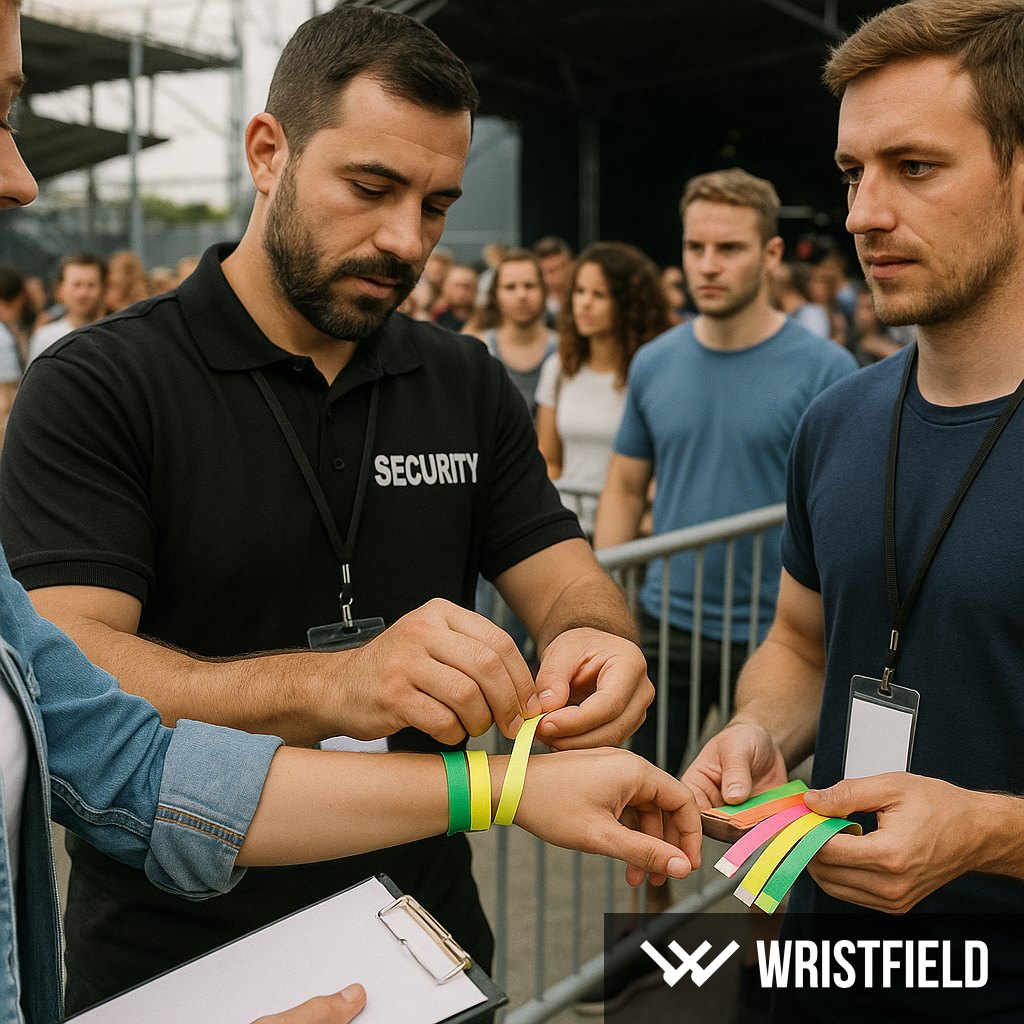
Event wristbands: everything organisers need to know
Wristbands are a simple-looking tool but they influence safety, throughput and brand perception on the day. Below you will find a structured FAQ covering the choices that matter in practice, not just theory. Each section focuses on decision points that change costs and operational behaviour at entry points.
1. Which wristband types are available and when to use them
Pick a wristband by matching its properties to your event profile: duration, environment, security needs and budget. The main categories are:
Tyvek
Paper-like, single-use, low cost and quick to apply. Good for one-day events with high volumes where low unit price and speed are priorities. Combine with serial numbers or UV varnish for basic anti-counterfeit protection.
Vinyl
Robust and water-resistant, better for outdoor and waterfront events. More durable than Tyvek but higher unit cost. Use vinyl if you expect exposure to moisture or abrasion.
Fabric
Preferred for multi-day festivals and premium access. Comfortable to wear and offers the best branding space. Choose heat-transfer or woven options depending on durability needs. Often resold as merchandise or kept as keepsakes.
RFID / NFC wristbands
Enable cashless payments, automated turnstiles and accurate attendance logging. They require back-end systems and testing but can reduce staffing needs for repeat checks and speed up transactions.
Silicone
Very durable and water resistant. Good for pool or spa access control, branded giveaways and long-term reuse. Not suitable for mass single-use entry unless you want a high-cost keepsake item.
2. Sizes, widths and fastening methods
Size and fastening affect comfort and how easy it is to transfer a band. Key factors are:
Width - Narrow bands (around 10 mm) are discreet but limit printing space. Standard festival widths are 19 mm and above. Fabric VIP bands are often 25-40 mm to support logos and security features.
Length - Disposable bands typically measure 250-300 mm so they fit most wrists. Fabric and RFID variants are available in longer lengths and can be cut or fitted to size on site.
Fastenings - Choices include adhesive seals, plastic snap locks, metal clips and tamper-evident eyelet seals. Adhesive is fastest and cheapest but easier to remove. Snap locks and eyelets are more secure for multi-day use or VIP areas.
Match the seal type to the risk of unauthorised transfer: single-day, low-risk events can often use adhesive; multi-day and controlled access areas benefit from tamper-evident fastenings.
3. Printing and customisation: what to specify
Decide on printing by balancing legibility at the gate with cost. Main printing methods are:
Screen printing - Durable and cost effective for one or a few colours on larger runs.
Digital printing - Best for full-colour, photographic designs and smaller quantities. Check colour adherence to the chosen material.
Heat transfer and woven - Standard for fabric wristbands; woven gives a premium textured look, heat transfer is durable and precise.
UV varnish - This is a varnish applied to the surface that is visible only under UV light. It is not the same as UV printing. It provides a covert, low-cost anti-counterfeit layer and is quick to verify using UV lamps at entry.
When preparing artwork, prioritise high contrast and legibility for small text like serial numbers. Request a production sample for templates with detailed artwork or small print runs.
4. Serial numbers, barcodes and QR codes
Serialisation adds a basic but effective traceability layer. Choose the level of automation you need:
Sequential numbers - Easy to add and useful for manual checks. Match printed numbers to your entry lists for quick verification.
Barcodes - Fast for ticket checks when using handheld scanners. A dedicated barcode per wristband removes much of the manual error at peak times.
QR codes - Carry more data and are readable by smartphones and scanners. Good for linking to ticket records, user profiles or dynamic permissions such as concession access.
For events that need rapid throughput, combine a simple visual inspection with barcode or QR scanning to speed up and log entry. If you need a practical primer on numbered wristbands, see our guide here: How Numbered Wristbands Work at Events.
5. UV varnish explained and how to use it
UV varnish is a surface coating that fluoresces under UV light. Two misconceptions to avoid: this is not UV printing, and the varnish is usually invisible in normal lighting. Practical benefits are:
- Covert security that is hard for casual counterfeiters to copy.
- Quick verification with handheld UV lamps.
- Integrates with serial numbers and other visible markers.
Operational points: supply UV lamps to every second gate, train staff to spot-check a proportion of entrants and combine spot checks with serial number verification. Be aware that UV varnish can degrade over time with abrasion or in wet conditions, so specify water-resistant formulations for outdoor multi-day events. For a deep-dive on the technique and operational cost-risk considerations, read: UV varnish for wristbands: a practical guide.
6. How many wristbands should you order?
Always order more than your ticketed capacity. Typical rules of thumb are:
- One-day fixed-capacity events: add 5-10 percent as reserve for damaged bands and late arrivals.
- Multi-day events: increase reserves to allow for replacements, lost bands and new on-site sales.
- Multiple gates: stock spare rolls or boxes at each gate so staff can replace units quickly without leaving the post.
Separate VIP and backstage bands into distinct batches and print them in different colours or with additional security features. If you want a worked example for your scale, see our calculators for a 1,000 or 3,000-person event: Full entry cost breakdown for a 1,000-person event and 3000-person concert cost model.
7. Typical production lead times and when to use express
Lead times vary with material and customisation level. Useful planning ranges:
- Standard Tyvek with basic printing: shortest lead times, often a few working days when stock and artwork are ready.
- Custom screen-printed or multi-colour runs: allow extra days for setup and approvals.
- Fabric or RFID bands: longest lead times owing to production and testing, sometimes several weeks.
Express production is justified when the event date is fixed and the delay would cause gate failures or major extra costs. Decide early whether you are prepared to pay express premiums, and where possible keep a small emergency stock with a local supplier to avoid last-minute rush fees. For guidance on express options, consult: When is express wristband production worth it?.
8. Practical use cases and recommended solutions
One-day outdoor concert, 3,000 people - Use robust Tyvek or basic vinyl, serial number each band and add UV varnish for occasional checks. Stock at least 10 percent extra and plan fast gate staffing to avoid queues. See our 3,000-person model for capacity and cost assumptions: 3000-person concert cost model.
Multi-day festival - Invest in fabric wristbands, preferably woven or heat-transferred, and consider RFID if you require cashless payments and turnstile automation. Durability and comfort matter more than unit cost here.
Beach or waterfront events - Choose vinyl or silicone with waterproof seals and a robust fastening. If night-time checks are likely, combine with UV varnish to deter counterfeiters. For access control on water-side sites see: Beach and waterfront event access control.
VIP and backstage areas - Use distinct colours and higher security options such as fabric with tamper-evident fastenings, UV varnish and unique serial numbers or RFID to control movement precisely. Read more on VIP zone management here: Managing VIP zones at events.
9. How to reduce counterfeiting risk in practice
Effective anti-counterfeit strategies use multiple layers. Recommended combinations include:
- Material and fastening choices that are hard to copy quickly.
- Visual markers like serial numbers, plus covert UV varnish checks.
- Operational controls: staff training, random UV checks, and logging at entry points.
- Technology where appropriate: barcodes, QR codes, or RFID for automated verification and audit trails.
For a practical risk-based approach to anti-counterfeiting, see our security tiers and recommended wristband controls: Event security risk tiers: entry control, access rights and anti-counterfeit practices.
10. Common organiser mistakes and how to avoid them
Most problems at the gate are preventable. Avoid these frequent errors:
- Under-ordering with no spare stock. Always include a contingency buffer.
- Choosing the wrong fastening for the event duration and environment.
- Not aligning security protocols with the wristband features, for example ordering UV varnish but not providing UV lamps or training.
- Late artwork approval that delays production and forces express charges.
Mitigate risk by preparing a clear brief for the supplier, ordering samples and confirming lead times early. On receipt, check a representative sample batch before the event and distribute small sample packs to gate supervisors for familiarisation.
Final checklist and next steps
Use this quick checklist to move from planning to order:
- Confirm the event profile: single or multi-day, indoor or outdoor.
- Decide the security level and any technology integration required.
- Choose material, width and fastening based on durability and comfort needs.
- Specify printing, serialisation and any UV varnish, and request a sample.
- Order reserves and confirm delivery dates including possible express options.
- Train gate staff on visual, barcode and UV checks and place spare stock at each gate.
If you would like a customised calculation for quantities and gate staffing based on your event parameters, we can create a tailored plan. We also provide worked examples for different event scales and security profiles to help you decide between Tyvek, vinyl, fabric or RFID solutions.
Artwork and print file requirements that avoid delays
Most production problems stem from incorrect artwork. Supplying files that match the printer's specifications is the single easiest way to avoid express charges or reprints. For graphic clarity provide vector files where possible, saved as PDF/X-1a or a high quality EPS. Convert fonts to outlines to prevent font substitution. Any raster images should be at least 300 dpi at final print size and supplied in CMYK colour mode. Do not use RGB files unless the supplier can convert them for you.
Always include a bleed. A 3 mm bleed is typical for wristbands because of the small format and the need to avoid white edges after trimming. Keep critical text and logos inside a safe area of 3 mm from the finished edge. If your design includes variable data such as serial numbers or QR codes, provide a sample merge file and label clearly how the sequential data should appear and where it should be placed.
Request a digital proof and, where possible, a pre-production physical sample of the exact material and printing method. A PDF proof is useful but a printed sample is worth paying for. With spot colours or metallic inks, check Pantone references and accept that colour reproduction will vary between materials such as Tyvek, vinyl and fabric.