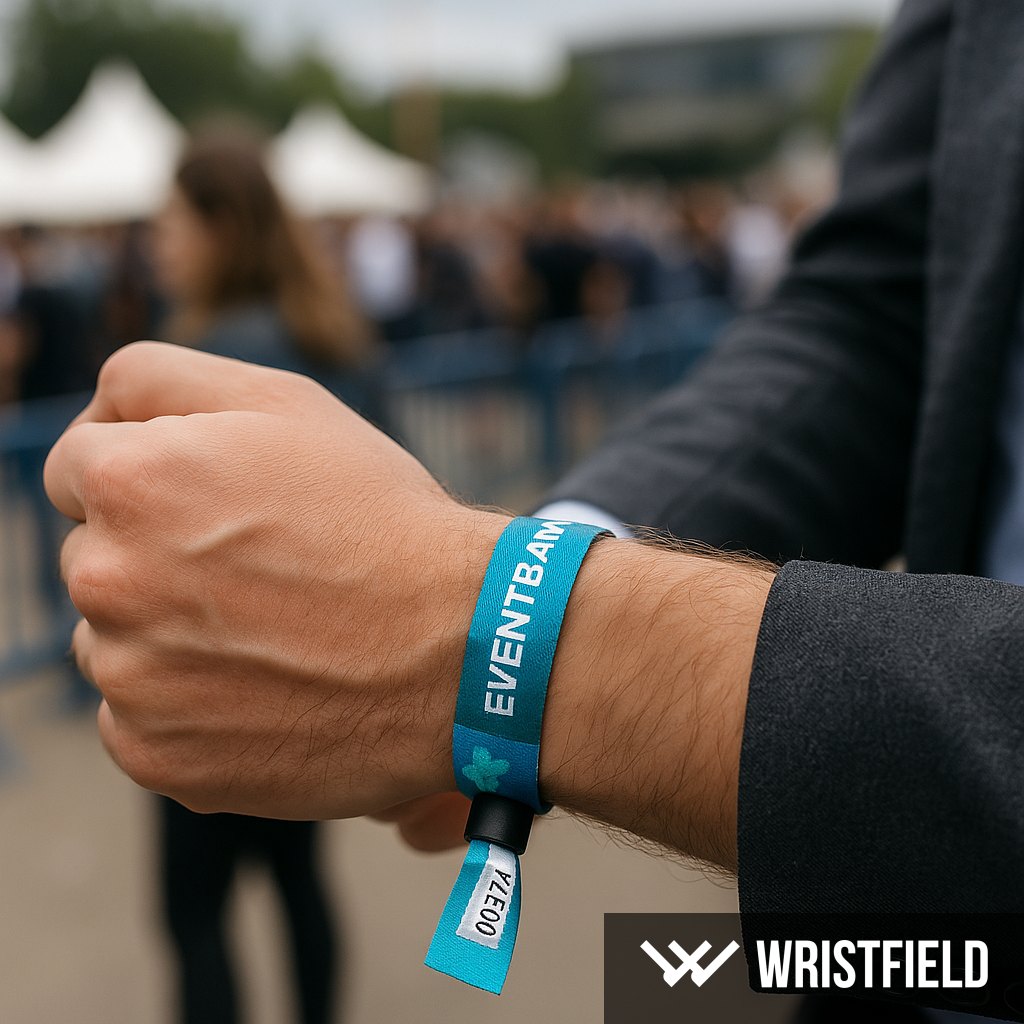
A fabric wristband is far more than an admission token. When designed and utilised with intent it can become a wearable keepsake, a measurable sponsorship asset and a practical part of your event security. This guide explains the commercial logic, operational trade-offs and practical decision steps organisers and marketers need to turn wristbands into genuine brand value.
Why fabric wristbands matter beyond entry control
Fabric wristbands are durable, comfortable and visible for longer than most paper or Tyvek options. That durability is the source of their marketing power: they stay on wrists for hours, days or even weeks, becoming a small, mobile billboard for organisers and sponsors alike. But to convert that visibility into measurable value you need deliberate choices on design, security features, measurement and commercial packaging.
What to measure: impressions, wear time and quality of contact
Start with three simple metrics: attendance, average wear time and average daily visual contacts per wristband. Multiply these together to estimate gross impressions. For example, a 2,000-person event where wristbands remain on average for two days and are seen five times per day generates 20,000 visible impressions (2,000 x 2 x 5). That calculation is intentionally straightforward because its role is to give you a consistent baseline for sponsor conversations and CPM-style pricing.
Two notes on measurement. First, impressions are not the same as engagement; a visible wristband may create mere glance impressions or strong brand associations depending on design and activation. Second, capture a sampling of post-event behaviour where possible: social media mentions, hashtag usage, landing-page visits from wristband QR codes, or redemption rate of a wristband-printed offer. These will help you translate impressions into demonstrable ROI for sponsors.
Design decisions that increase brand impact
Design choices affect both visual impact and security. Consider the following design levers:
- Colour and contrast: high-contrast printing improves readability in photos and at a glance.
- Repeat pattern vs single logo: repeat patterns create a stronger visual rhythm on the wrist and read better in social images.
- Positioning of sponsor assets: use a primary logo position for the headline sponsor and a secondary position near the fastening for secondary sponsors or utility information such as QR codes.
- Lock style and finishing: a recognisably premium lock or woven label can communicate quality and justify a higher sponsorship fee.
Remember: less is often more. Overcrowding the band with logos or dense copy reduces legibility and social shareability. Aim for one clear headline message plus a secondary piece of activation (a hashtag, QR code or promo code).
UV varnish: what it is and when to use it
When we say UV varnish we mean a clear coating that becomes visible under ultraviolet light, not UV printing. Applied selectively, UV varnish creates a covert mark that front-line staff can check quickly with a small UV torch. It is a low-cost anti-counterfeit control and also a premium visual feature when used in a branded activation.
Use UV varnish when one or more of the following are true:
- There is recorded or expected fraud risk around admission (high-value tickets, VIP areas).
- The event features low-light or night-time activity where UV checks are more practical than detailed visual inspection.
- You plan to sell a premium sponsor package that includes a verifiable exclusivity element.
If you want a deep operational view on UV varnish, including where it reduces risk and how it differs from other security options, see our specialist guide UV varnish for wristbands: a practical guide for entry control, VIP access and cost-risk modelling.
Packaging wristbands as sponsor inventory
Treat the wristband as a media asset and package it with measurable deliverables. Typical sponsor bundle elements include:
- A primary logo position and colour dominance for the headline sponsor.
- An activation code or QR that directs traffic to a sponsor landing page.
- Post-event reporting: impressions estimate, social mentions, redemption data.
- Optional security features such as serialisation and UV varnish for premium tiers.
Price packages against a CPM or against desired outcomes (leads, voucher redemptions). To keep negotiations practical, share your impressions calculation and label any pricing examples as illustrative. For example, if your estimated impressions are 35,000 for a two-day event, you can present a CPM-based offer or a fixed fee with a post-event report that demonstrates value.
Serialisation, tracking codes and authenticity checks
Serial numbers or unique alphanumeric codes printed on wristbands add auditability. They are useful for:
- Investigating suspected fraud after the event.
- Linking social competitions to verified attendees (use the serial as a contest entry ID).
- Enabling tiered access: single-use codes for backstage or VIP claims.
Combine serialisation with UV varnish for two independent verification channels: a visible serial for post-event reconciling and a covert UV element for quick on-site checks. For a practical explanation of how numbered wristbands work operationally, see How Numbered Wristbands Work at Events.
Operationally: production lead times, approvals and quality checks
Production timelines and approval processes determine cost and risk. Build a clear schedule with cut-off points for sponsor approvals and a defined express-production surcharge. Typical phases are:
- Brief and sponsor logos submitted.
- Design proof and sample wristband with any UV varnish applied and checked.
- Final approval, serialisation plan and production run.
- Quality check, packaging and delivery to site.
If time is tight, require sponsors to accept a limited number of revisions and be explicit about the express fee for shorter lead times. Express production increases the risk of design errors and typically attracts a premium. The most reliable mitigation is a physical sample approval step; never waive that for premium sponsor assets.
Entry control and staff planning where security meets marketing
Your access-control choices influence how visible and credible the sponsor asset becomes. If wristbands are being used for VIP or backstage access, make the distinguishing features obvious to gate staff and provide simple verification tools such as a UV torch and a serial list or handheld scanner.
Capacity planning for manual UV checks depends on peak flow. If a gate experiences 400 arrivals per hour and a single staff member can reliably check 60 wristbands per hour with a UV torch, you need about seven checkers per gate during peak times. Introducing barcode or RFID reading reduces staff needs significantly; a barcode reader can process several hundred scans per hour. We explore the trade-offs between staff and technology in our entry time optimisation guide: How to Cut Your Event Entry Time by 30%.
Activations and social amplification
Design activations that make the wristband part of the story rather than an afterthought. Ideas that work well:
- Photo competitions that require the sponsor hashtag and a visible wristband—use serial numbers to verify winners.
- Exclusive content unlocked by scanning a QR on the wristband at specific sponsor activations.
- Limited-edition wristband variants for VIPs that include a visible premium lock and a UV mark—good for social prestige posts.
Time your post-event engagement. Social sharing around the wristband often continues for 7 to 14 days after the event; plan remarketing or follow-up offers in that window for higher conversion.
Commercial modelling: an illustrative approach (use your own inputs)
Rather than presenting fixed prices, provide sponsors with a transparent model they can re-run. Your basic inputs should be:
- Attendee numbers
- Estimated retention/wear time (days)
- Estimated daily visual contacts per wristband
- Desired sponsor CPM or target number of impressions
- Any premium costs (UV varnish, serialisation, premium locks)
Illustrative example (for clarity only): if impressions are estimated at 35,000 and you propose a CPM of £25 for a premium sponsor package, the headline fee would be 35 x 25 = £875. Label that example as illustrative and show how adding UV varnish, serialisation or express production would change the price. Always provide a post-event report to validate the promised impressions where possible.
Common mistakes and how to avoid them
Organisers repeatedly fall into a few traps:
- Underestimating lead times and needing expensive express production.
- Overcrowding wristband artwork, reducing legibility and shareability.
- Failing to include measurement clauses in sponsor agreements.
- Skipping sample checks for UV varnish behaviour on different fabric colours.
Mitigate these by building approval windows into sponsor contracts, carrying out physical sample tests, and creating a simple measurement plan sponsors can agree to in advance.
Where to go next
If you need more operational detail, start with these focused reads from our library: practical security and risk tiers, a worked cost model for a 3,000-person event, and a specialist piece on UV varnish applications. See:
If you would like a bespoke calculation for your event (impressions, staffing plan for UV checks, sponsorship pricing template), we can produce an editable spreadsheet that accepts your attendee numbers, wear-time assumptions and desired sponsor metrics.
Practical measurement: how to demonstrate value beyond impressions
Numbers are persuasive when they can be trusted. Sponsors expect more than an assertion that wristbands delivered impressions. Provide a transparent measurement approach that mixes direct tracking with sampling and social monitoring. The best reports triangulate three sources of evidence: technology-backed data, short-form observational sampling, and social media analytics.
Technology-backed metrics
Whenever a wristband incorporates a scannable element, capture the following events and include them in the sponsor report:
- Number of unique scans or NFC reads, with timestamps and location where possible.
- Device or app identifiers where privacy allows, aggregated to avoid personal data exposure.
- Redemptions of sponsor offers triggered by the wristband QR or tag.
Present these numbers alongside conversion rates. For example: 3,450 QR scans resulting in 520 coupon redemptions = 15.1 percent conversion on scanned interactions.
Sampling and observational studies
Technology will not cover pure visual impressions. Use short observational studies at entrances, concourses and sponsor activations to estimate how many attendees see a wristband per hour. A practical approach:
- Choose representative periods, for example morning entry, peak arrivals and post-headline time.
- Have trained observers record the number of visible wrists versus total attendees in 10 minute intervals.
- Average across periods and scale to total attendance.
Document the methodology in the report so sponsors can inspect sample size and confidence intervals. A modest sample of 20 intervals usually gives directional accuracy for commercial conversations.
Social media and earned media
Provide a social listening summary focused on the sponsor hashtag, sponsor handle mentions plus image counts where wristbands are visible. Useful metrics include:
- Total posts containing the sponsor hashtag and a visible wristband.
- Estimated reach based on poster follower counts, with a conservative decay factor applied.
- Examples of high-engagement posts, saved as screenshots with timestamp and URL.
Be explicit about methodology and any assumptions. Sponsors value conservative, verifiable estimates more than optimistic projections.
Sample sponsor contract clauses for wristband campaigns
Below are short, practical clause templates you can adapt. They are written for clarity; have legal counsel review any final contract.
Scope and deliverables
"Event organiser agrees to supply Sponsor with custom-branded fabric wristbands as described in the attached specification. Deliverables include production of X wristbands, serialisation of Y units where applicable, and a post-event impressions report within 21 days of the event end date."
Approvals and timelines
"Sponsor must submit final artwork no later than [date]. Organiser will provide one physical sample proof and up to two rounds of minor artwork revisions. Any change requests after sample approval may incur additional charges and production delay charges."
Measurement and verification
"Organiser will provide a post-event report including: total wristbands distributed, technology-backed scans or reads, observational sample methodology and results, and social media summary. Organiser will allow Sponsor a 14-day window to query the report."
Liability and counterfeiting
"Organiser will use reasonable measures to prevent counterfeit wristbands. In the event of proven counterfeit circulation that materially harms Sponsor, parties agree to the following remediation steps: immediate notification, replacement wristbands where feasible, and a prorated credit to the Sponsor based on affected units."
Sustainability and disposal
"Organiser will provide Sponsor with a summary of materials used and recommended end-of-life disposal. Where compostable or recyclable materials are used, Organiser will provide certificates or supplier declarations on request."
Production specification checklist: practical items to lock down
Use this checklist as a production brief annex. It reduces ambiguity and lowers the risk of costly rework.
- Base fabric type and weight, with supplier reference or sample photo.
- Printing method: woven logo, printed dye-sublimation, or heat transfer.
- Secondary anti-counterfeit features: UV varnish, serial numbers, holographic thread.
- Attachment hardware: single-use clip, plastic lock, premium metal clasp.
- Dimensions: length, width, and tolerance (+/- mm).
- Colour references: Pantone or supplier swatch codes for both band and print.
- Text legibility: minimum font size and contrast checks against fabric colour.
- Packaging: bulk rolls, singles in envelopes, or branded bags; number per box.
- Labelling for logistics: inner count, box labels, and on-site distribution packs.
Attach a physical sample approval stage to this checklist. Do not proceed to mass production without sign-off on a physical sample unless the sponsor explicitly waives that requirement in writing.
Staff training brief for access teams: keep brand visibility and security aligned
Gate staff are custodians of both security and sponsor perception. Train them on a short script and verification routine that supports brand visibility.
Suggested verifier script:
"Good evening. Please hold out your wrist so I can check the band. Thank you. Enjoy the show." Keep the check fast and courteous. Where UV checks are required, position a small UV lamp in the palm for a 2 second quick-scan and use standard phrases that do not call attention to VIP credentials in front of other guests.
Operational points:
- Keep verification gestures consistent to avoid photo moments that obscure logos.
- Provide a simple laminated cheat-sheet with images showing genuine and counterfeit examples.
- Assign floating supervisors to peak gates to handle disputes without slowing flows.
Sustainability and end of life: choices that matter
Fabric wristbands offer a longer life than plastic, but material choice still matters. Consider these practical trade-offs when advising sponsors.
- Recycled polyester: low cost uplift, widely available, recyclable through textile recycling streams but not compostable.
- Organic cotton: higher cost, comfortable wear, biodegradable but higher production footprint unless certified.
- Compostable plant-based fibres: attractive from a marketing angle, but ensure industrial composting compatibility and label end-of-life clearly.
- Biodegradable inks and water-based dyes reduce chemical load and improve claims accuracy.
Where possible, provide suppliers certificates and a recommended disposal message printed on the ticket or event app. Sponsors prefer transparency over unverified green claims.
Pricing model: worked example and variables to discuss
Rather than a flat fee, show sponsors a transparent calculation. Below is a worked example you can adapt.
Inputs
- Attendees: 10,000
- Wristbands issued: 9,500
- Estimated daily wear time: 2 days
- Estimated visual impressions per wristband per day: 6
- Expected scanned interactions: 2,000
- Base production cost per wristband: £0.90
- Premium features (UV varnish + serialisation): £0.20 per unit
- Design and project management fee: £1,200
Calculations
Total impressions = wristbands issued x wear time x impressions per day
= 9,500 x 2 x 6 = 114,000 impressions
Headline CPM at £20 = (114,000 / 1,000) x 20 = £2,280
Production cost = 9,500 x (0.90 + 0.20) = 9,500 x 1.10 = £10,450
Gross sponsor price suggestion = CPM fee + production + PM fee
= £2,280 + £10,450 + £1,200 = £13,930
Note: This is a transparent model. You can show sponsors how removing premium features or reducing CPM affects the headline price. Always include a minimum guarantee or floor to cover production when volumes are low.
Post-event report structure: what sponsors actually read
Keep reports short, visual and evidence-based. The recommended structure:
- Executive summary: two bullet points with headline impressions and conversion metric.
- Distribution and authenticity: number of wristbands produced, numbers distributed, sample photos of wristbands in use, and any counterfeit incidents.
- Technology metrics: scans, NFC reads, coupon redemptions, location breakdown.
- Observational sampling: methodology, sample size, and impression estimate with confidence statement.
- Social lift: top posts, hashtag volume, estimated reach and engagement.
- Value add: qualitative outcomes, positive media mentions, and recommended follow-up tactics.
- Appendix: raw datasets, photo evidence, and supplier certificates.
Offer sponsors a short debrief call. The conversation is often where you turn a successful activation into a renewal.
Answers to five common sponsor questions
1. How long will people actually wear the wristbands?
Typical retention varies by event type. Festival-goers often keep wristbands for 2 to 10 days; conference attendees commonly discard them within 24 to 48 hours. Use a quick exit survey or QR follow-up to validate your assumption.
2. Can wristbands be counterfeited?
Yes, but layered security reduces risk. Combine overt features such as unique prints or holograms with covert features like UV varnish and serial numbers. Where access control matters, pair wristbands with a secondary token or scan.
3. Are wristbands good for lead generation?
Yes when they incorporate interactive elements. QR codes, short codes and NFC can capture opt-in leads if the flow is friction-free and offers immediate value, such as exclusive content or a discount.
4. What is the optimal branding area?
Keep logos simple and high contrast. A single primary logo and one supporting line of text is usually the most effective for visibility and legibility in photos.
5. How do we prove impressions to auditors?
Combine the three measurement streams outlined earlier. Where auditors require traceability, supply scan logs, timestamped photos and the observational protocol. Keep raw files for at least 90 days post-event.
Next steps and practical offers
If you would like, we can provide two low-effort next steps tailored to your event: a one-page production spec ready to send to suppliers, and a sample post-event report template populated with realistic example data. Both are editable and make sponsor conversations faster and less risky.
Tell us the event size, target sponsor category and preferred wristband features, and we will prepare the two templates within 48 hours.