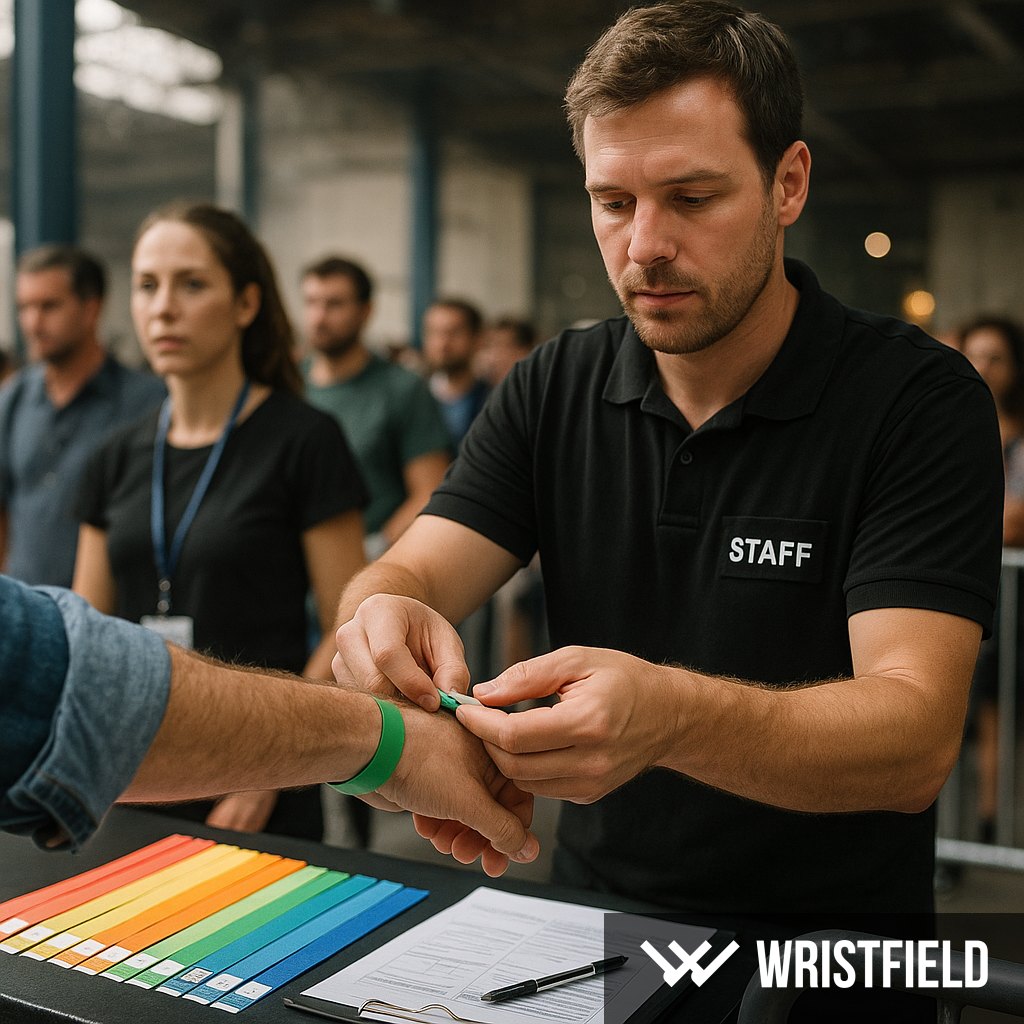
Why a clear wristband and access strategy matters for multi-day events
When your event runs over several days the wristband system becomes both a customer touchpoint and a security tool. It must deliver three things reliably: quick visual checks at entrances, a deterrent against abuse and a process for dealing with damaged or lost bands that does not grind the gates to a halt. The balance between cost, durability and security will be different for a one-day ticket, a full festival pass and backstage or VIP access. This article gives the practical rules and examples you need to design that balance.
Day-by-day colour coding and how to add layers of protection
The fastest way for stewards at turnstiles to identify entitlement is day-based colour coding. For a three-day event use three clearly different base colours so gate staff can make an instant call. Colour alone is convenient, but it is also the least secure layer. The recommended approach is to combine colour with at least one additional security layer such as UV varnish, unique numbering or a subtle printed pattern that varies by day.
If you need to distinguish multiple tiers on the same day, combine the base colour with a secondary signal. For example, make VIP bands a darker shade of the day colour, add a printed VIP motif, or conceal a VIP marker under UV varnish. For more on UV varnish and how it differs from UV printing see the practical guide to UV varnish for wristbands:
UV varnish for wristbands: a practical guide.
Managing passes and combined entitlements
Multi-day passes vary in scope. They may grant access to every public performance, to some professional or conference areas, or to restricted backstage functions. Three principles should guide your labelling and control strategy:
- Make entitlement visually immediate. Gate staff should be able to tell in one look whether a band grants entry to that area. - Add an anti-counterfeit layer. Combine visible information with numbering or a UV varnish mark. - Simplify handling at ticket desks. Replacement and upgrades must be fast and auditable.
As a practical rule, reserve your most durable materials for multi-day wristbands and use lower-cost single-day materials for day tickets. For a full overview of material choices and cost drivers, see our guide to wristband types and cost modelling:
How much does a custom wristband cost? A practical UK guide.
Replacement and exchange workflows that keep queues moving
Exchange, replacement and upgrade flows must be integrated with your ticketing system. The most common causes of request are damage, loss, and legitimate transfers. Your policy should make clear whether transfers are allowed, under what conditions, and what proof is required for replacements.
A recommended operational sequence at the point of exchange: identify the customer by name and proof of purchase, scan or record the original band number if present, invalidate the old band, issue a replacement with its new serial or identifier, and log the transaction in a central exchange register. Keep exchanges separate from the main gate to avoid backlogs. A dedicated exchange desk close to each busy entrance reduces on-gate friction and improves guest experience. For a deeper dive on reducing gate times and throughput planning see:
How to cut your event entry time by 30%.
Damage, fraud and a clear replacement policy
Every multi-day event needs a published damage and replacement policy. Explain what counts as damaged, what evidence you need for a replacement, and whether replacements carry a fee. Fees help manage demand but can lengthen queues and generate complaints if the exchange function is understaffed. Decide in advance whether to offer temporary replacements for minor damage or a full-band replacement for anything that could enable abuse.
UV varnish and serialisation as a two-factor approach
UV varnish is a covert mark that is visible only under UV light. Use it as a second layer combined with an obvious visual sign such as colour or printed text. When used with unique serial numbers you have both visual speed and forensic traceability. Keep in mind: UV varnish requires UV torches at control points and staff trained to use them. For operational details and where it helps on site see:
UV varnish for wristbands, and for numbered bands see:
How numbered wristbands work at events.
Clarify in your materials that UV varnish is not the same as UV printing. UV varnish is typically invisible in normal light and requires a UV source at checkpoints. That attribute increases security but also creates an operational dependency: list which gates will have UV lamps in your wristband spec and staff briefings.
Choosing materials: durability, cost and guest comfort
Material choice should follow the expected wear pattern. Textile or woven wristbands are the most comfortable and hard-wearing for full festival passes. Tyvek and vinyl are cost-effective for single-day tickets. If your event is outdoors or near water pick materials that withstand moisture and rubbing. For a detailed comparison of material trade-offs refer to our production and costing guide:
Wristband materials and cost modelling.
Staffing and capacity planning for exchanges and gates
Staffing determines whether your protocols succeed. The most common planning errors are underestimating replacement demand and under-resourcing exchange desks. Staff calculations must consider normal gate throughput and the expected peak of exchanges, typically the first morning of the festival. Place at least one exchange or help desk for every four to six active gates, and consider a dedicated VIP lane where entitlement is common and the cost of delay is higher. For optimisation tips see:
entry time optimisation.
Practical example: if you expect 5 000 arrivals in a single busy hour and you estimate that the combined rate for visual check and band fit is 6 seconds per person, you will need a gate layout and number of counters that sustain that throughput without queues spilling into queuing lanes. Add separate staff for exchanges so that replacements do not block the main flow.
VIP, backstage and multi-level access control
For backstage and VIP zones the visual colour method may not be sufficient. Use layered security: day colour, a VIP texture or pattern on the band, a hidden UV varnish mark and serialised IDs registered in a backstage access list. Gate staff need a clear protocol for when to request additional ID. For operational guidance on VIP zones and entry design see:
Managing VIP zones at events.
For higher-risk backstage entries, implement a two-step check: visual confirmation plus a quick database lookup for the serial number on a tablet or a printed list. Keep communications channels open between gates and stage management so suspicious cases can be escalated fast.
Quantity modelling and an illustrative cost example
Below is an operational quantity example and an illustrative cost model. Note these cost figures are examples only, included to show how to structure budgeting. Prices vary by supplier, print options and lead times so get a supplier quote before you finalise procurement.
Operational quantity example
Scenario: a three-day festival with 8 000 attendees expected per day. Assume 60 percent of attendees hold multi-day passes, and provide a 5 percent reserve for damaged bands plus a 2 percent replacement estimate across the full event.
| Item |
Calculation |
Result |
| Multi-day passes |
8 000 x 0.60 |
4 800 |
| Single-day tickets (total across three days) |
8 000 x 0.40 x 3 |
9 600 |
| Replacement and damage reserve (5%) |
(4 800 + 9 600) x 0.05 |
720 |
| Total wristbands |
|
15 120 |
When you place your order specify the split between durable textile bands for multi-day passes and cost-effective Tyvek or vinyl for single-day tickets. Also specify quantities for UV-varnish marked and serialised reserve stock so replacements are indistinguishable from originals.
Illustrative cost example - for budgeting only
To illustrate how procurement costs may be calculated, here is an example using indicative unit costs. These numbers are for demonstration only. Obtain real quotes before committing.
Example illustrative unit costs: textile wristband for multi-day pass £0.70 each, standard vinyl/Tyvek day band £0.10 each, UV-varnish marked reserve units £0.40 each. Using the quantities above you can build a simple budget and then add setup costs and freight. Remember to budget staff hours for exchanges, typically the single biggest operational cost when you need multiple exchange desks.
Common organiser mistakes and how to avoid them
Organisers commonly under-provision reserve stock, leave exchange protocols vague and choose the wrong materials for expected wear. Avoid these by: specifying a realistic replacement reserve, documenting the exchange workflow and training staff thoroughly, and combining at least two security layers such as colour plus serialisation or colour plus UV varnish. For a framework on event entry risk tiers and how that affects wristband choice see:
Event security risk tiers.
Guest experience and clear communications
The moment a wristband is applied is a small but important customer touchpoint. Train staff to perform this quickly and politely. Publish your exchange and loss policy at point of sale and on-site, and provide clear signage so customers can find the exchange desks without asking. Small investments in signage, a printed site map and a short FAQ reduce queues and complaints substantially.
Technology add-ons: when to use a database or readers
Serial numbers stored in a simple database allow fast replacement and retrospective audits. If you plan to use readers at gates for more than simple counting, test the full stack in advance and ensure trained staff are available. For larger events a system that combines visual checks with occasional serial lookups gives strong protection without adding relentless scanning at every gate. For systems thinking and worked cost models see:
3000-person concert cost model.
Decision matrix and a practical example for exchanges
A short decision tree helps staff make consistent calls at the exchange desk. Base decisions on three items: the band condition, the risk of entitlement misuse and the type of customer (e.g. VIP, artist, ticket buyer). Keep this visible at every exchange position.
| Situation | Action | Record |
|---|
| Worn, serial readable | Issue temporary replacement, log original serial | Customer name, original serial, replacement serial |
| Serial missing or mismatched | Full replacement, ID check | New serial, reason, ID details |
| Fraud suspected | Escalate to security, isolate case | Incident report, photos where appropriate |
| Water damage | Immediate replacement; if textile unavailable issue UV marked temporary band | Note circumstances and follow up for compensation if policy allows |
Final checklist before you order and operate
- Define day colour scheme and any secondary VIP/backstage markers. - Decide which ticket types get textile bands and which get Tyvek/vinyl. - Specify serialisation and UV varnish where you need forensic traceability. - Build a replacement reserve and label it in the purchase order. - Prepare exchange desks separate from gates and staff them to expected peak demand. - Train staff on the decision matrix and escalation procedures, and list which gates will have UV lamps.
If you would like a tailored quantity calculation and wristband specification for your event, including an assessment of likely replacement demand and required staffing, we can build that using your attendance profile and zone plan. For a practical procurement decision guide see:
When is express wristband production worth it?.