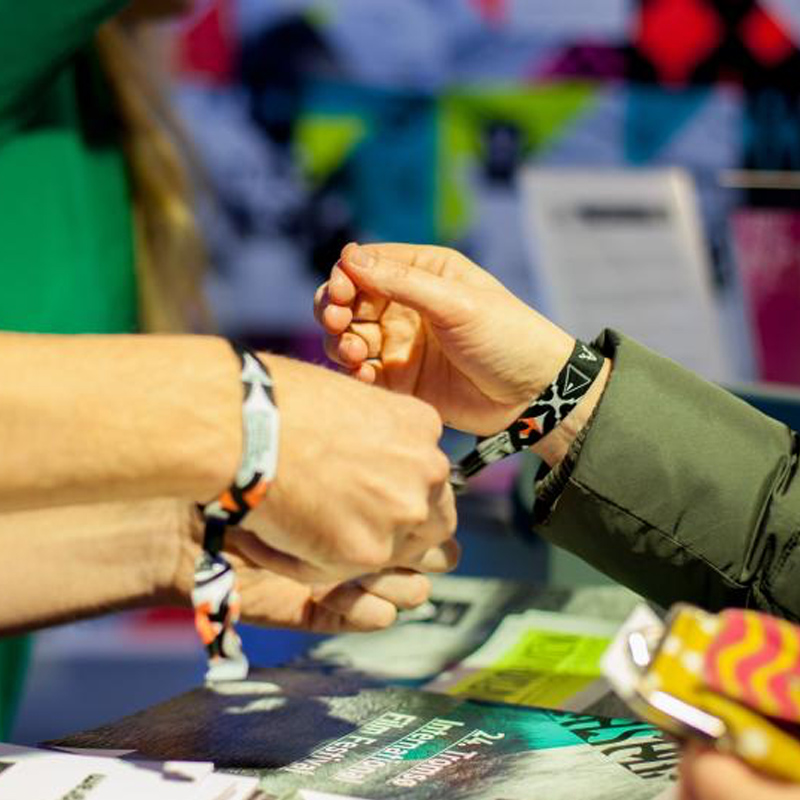
Practical functions of a wristband
At their most basic, wristbands confirm entitlement: the wearer has a right to be in a place or to access a service. But modern wristbands do several jobs at once. Use them to:
- Control entry and re-entry to the event and to sub-areas such as VIP, backstage or hospitality.
- Provide a visible, quick check for security staff so gates move faster and queues are shorter.
- Prevent counterfeiting through physical features, serialisation, or UV varnish visible under ultraviolet light.
- Enable cashless purchases and access control when combined with RFID or NFC technology.
- Act as a marketing touchpoint and a physical souvenir that extends your brand visibility after the event.
- Support operational processes such as post-event reconciliation, zone population counts and incident investigations when bands are numbered or serialized.
Access control and zone management
Wristbands are the simplest way to show who belongs where. Colour-coding alone gives immediate visual segregation across gates and zones. For events that permit re-entry, a secure wristband removes the need to exchange paper tickets or hand stamps on every return.
When you have multiple access levels within an event, combine colour coding with printed text or UV marked wording to reduce mistakes. For guidance on aligning wristband choice with event design and security layers, see our Complete Wristband Decision Matrix: Complete Wristband Decision Matrix for Events.
Security and anti-counterfeit measures
Counterfeiting is a live concern for many organisers. There are several measures you can use, layered by cost and effectiveness:
1. Material and closure design
Some wristband types are intentionally single-use and cannot be transferred without visibly damaging them. Tyvek is low-cost and tamper-evident. Vinyl with secure closures and fabric with clamp closures resist casual transfer better.
2. Serialisation and barcodes
Printing sequential numbers or barcodes lets you reconcile issued bands to sales and spot duplicates. It is especially important where ticket value or abuse risk is high. Serialisation also helps with post-event accounting and incident tracing.
3. UV varnish and UV-visible markings
UV varnish is a varnish that becomes visible under ultraviolet light. It is an inexpensive but effective invisible security layer. Under a UV torch or gate-mounted UV reader, legitimate wristbands show a characteristic mark or pattern that is hard to replicate. When discussing anti-counterfeit strategy, make sure to specify the UV varnish option in the artwork and production brief. Our Event Organiser's Handbook covers UV varnish usage and gate-level checks in detail: Event Organiser's Handbook.
When to use RFID or NFC wristbands
RFID or NFC wristbands add a digital layer. Common uses include cashless payments, granular access control and real-time crowd monitoring. Benefits include faster transactions, integration with an event app and automatic zone counting. Downsides are higher cost, potentially increased lead time and the need to integrate with payment and access control systems.
Choose RFID when the value of speed, data and convenience outweighs the additional cost and integration effort. If you want a quick comparison of wristband systems by use case, read: Wristband systems compared: Tyvek, vinyl, fabric and electronic options.
Wristbands as a marketing and brand asset
Wristbands travel. Attendees wear them after the event or post photos on social media, so they are a low-cost marketing surface. Make design choices that improve visibility and longevity if marketing is a priority. Consider:
- Full-colour printing or spot-colour logos for fabric bands.
- Durable materials that survive water and wear, increasing post-event lifespan.
- Sponsor placement and co-branding when you sell advertising space on the band.
For a practical marketing-focused approach, see our guide on maximising wristband impact: Wristbands as a Marketing Asset.
Material choices and trade-offs
Material drives most operational outcomes: cost, durability, security and brand impact. The common types are Tyvek, vinyl, fabric and hybrid RFID bands.
| Material |
Strengths |
Limitations |
| Tyvek |
Low cost, tamper-evident, quick production |
Not durable for multi-day events or water-exposed situations |
| Vinyl |
Durable, water-resistant, visible branding options |
Higher cost than Tyvek; single-use closure still needed |
| Fabric |
Premium look, durable, great for multi-day events and brand longevity |
Most expensive; needs secure clamp or tear-proof closure to prevent transfer |
| RFID / NFC |
Adds digital functionality: cashless, access logs, analytics |
Highest cost and technical complexity; requires system integration |
Design, printing and production notes
Design is operational as much as aesthetic. Clear, readable text for access levels, legible serial numbers and a simple logo are more useful than overcomplicated graphics that obscure security features. When specifying production:
- Decide which features are essential: serial numbers, barcodes, UV varnish, or RFID.
- Factor in lead time, including artwork approval and shipping. If you might need faster delivery, read our guidance on choosing production lead time: How to choose a production lead time for wristbands.
- If production is urgent, express options exist but expect compromises on print complexity or delivery cost. For tips on preparing artwork and what to expect, see: Express wristband orders.
Operational deployment and gate management
Wristbands only help if deployed with a clear gate plan. Common operational rules that speed throughput and reduce error:
1. Pre-issue where possible
Distribute wristbands at registration, accommodation or collection points before attendees reach the gate. Pre-issuing reduces on-the-day bottlenecks.
2. Simple visual checks
Train gate staff to spot correct colours and closures quickly. Reserve detailed checks using UV light or barcode scanning for random checks or secondary gates.
3. Reconciliation and reconciliation points
Use serial numbers to reconcile issued bands against sales and to investigate duplicated numbers or suspected fraud.
For a full operational template including gate staffing numbers and throughput examples, see: Building an Event Entry System from Scratch.
Data, reporting and cashless integration
When you use RFID or barcodes you gain operational data: when people entered, which zones they used and what they bought. That data helps with later planning, sponsor reporting and measuring ROI from wristband-led initiatives.
Keep privacy and payment security in mind. If you collect behavioural data or enable cashless purchases, ensure your supplier and systems are compliant with UK data protection rules and payment standards.
Cost, risk and decision rules
Costs vary by material and features. A simple decision rule to choose wristband specification is this: match the wristband security and durability to ticket value and loss risk. Low-value, single-entry events are fine with Tyvek; high-value tickets or multi-day festivals often justify fabric or RFID bands and extra security features like serialisation and UV varnish.
If you want an actionable model for balancing cost and risk, our practical decision model explains when a pricier wristband pays off and shows worked examples: How to Balance Cost and Risk When Choosing Wristbands.
Common mistakes and how to avoid them
Many organisers make simple mistakes that reduce effectiveness or increase cost:
- Ordering too few bands. Add contingency for replacements, staff bands and samples.
- Choosing a band that looks good in isolation but is impractical for gates or weather conditions.
- Not training staff on what to check. Even the best anti-counterfeit features fail if staff do not use them.
- Assuming a single solution fits all areas of the event. Consider different bands for VIP, staff, and general admission.
Measuring success and using wristbands beyond the gate
Decide what success looks like before the event. Typical KPIs include gate throughput time, incidents of ticket fraud, cashless adoption rate and post-event brand reach. Wristbands can also be part of sustainability messaging by using recycled materials or offering a re-usable premium band for VIPs.
A practical checklist for organisers
Before ordering
Decide access levels, required security features, preferred material, estimated quantities and lead time. Confirm whether you need UV varnish, serialisation or RFID.
When ordering
Provide clear artwork, specify closure type, confirm print proofs and account for express options if timelines are tight.
On the day
Train gate staff, run a few practice checks, deploy random UV or barcode checks and keep a reserve of replacement bands and tools.
Further reading
These in-depth resources are useful when planning wristbands as part of your event entry and security system:
Conclusion
Wristbands are inexpensive, flexible and, when specified thoughtfully, a powerful component of event control, security and marketing. Decide what you need them to do before you choose a material or feature set. Combine visual cues such as colour with security measures like UV varnish and serialisation where risk justifies the cost. If you are uncertain which option suits your event, start with the decision matrix to weigh security, budget and lead time: Complete Wristband Decision Matrix for Events.
If you want tailored advice for a specific event size, profile or budget, we prepare event-specific recommendations and worked examples. Contact our team with your event details and we will help match features, quantities and lead times.